Sunday, February 6, 2022

HFF 5.15: T Time

Out of order, but once again caught up on the historic cooking challenges!


The Challenge: "T" Time. Make a light dish or confection suitable for tea. Or anything with the letter "T". I decided to revisit my solo tea party menu, and noticed that I hadn't yet made rusks (and alternative to wigs on the tea table, per Mrs. Crowen's recommendations).

The Recipe: Rusks from The Economical Housekeeper by John Walsh ("assisted by a company of ladies")

The Date/Year and Region: 1860, London

How Did You Make It:  I did the full quantity this time: melted 2 oz of butter and combined with 1 cup milk; mixed 1 lb of all-purpose flour with 2 oz granulated sugar; beat 1 egg, and added it to the flour mixture along with 2.5 tsp active dry yeast (substituting for 2 Tbsp fresh), then mixed in the milk/butter, and let it all rise for an hour. At that point, I had more of a dough than a paste, but I read the instructions to 'work up into a paste' followed by cutting into strips as flattening the dough somewhat. I ended up using my hands rather rolling the dough out flat, but then proceeded to cut it into squares and let them rise another hour (plus the time required to pre-heat the oven). I baked the rusks for 10 minutes at 350F, which produced neat little square buns: cooked through and barely starting to brown. After letting them cool overnight, I again pre-heated the oven to 350F, then promptly turned it off and set the rusks back in to dry. After 40 minutes or so in the cooling oven, they had darkened substantially, so I took them out to avoid overcooking. This batch made 12 palm-sized rolls.

Total Time: About 20-30 minutes total mixing and shaping, a bit over two hours rise time, 10 minutes to bake; overnight cooling time and another 30-60 minutes to bake a second time. Make at least the day before needed; not a ton of active work, mostly lots of waiting time.

Total Cost: About $1 worth of dairy, plus pantry staples.

How Successful Was It?: Despite posible over-cooking on the 'drying' step, they're quite edible. I tried one before the second bake, and found it a rich, fairly light roll. The flavor was slightly insipid: not so much sweet as 'lacking salt'. I found some butter or preserves made up for this deficiency. All told, these remind me of sally lunn buns, but more shelf-stable. I assume the second bake is to promote this stability, so they can be baked a few days in advance rather than the exact same day. 

After the second bake, the rolls were quite dark and crispy on the outside (I think I should have let the over cool a bit more before putting them in). They were still perfectly soft on the inside, and again tasted fine with jam. Just looking at the related recipes in this book ('bread rusks', 'tops and bottoms'), the darker color may be a good sign, but I suspect that a longer bake in a cooler oven is really needed to dry out the interiors. 

I'll need to tweak the cooking time/temperature a little on the second bake, but even so I think that rusks will make a good addition to my receipt rotation. I really like that they can be made in advance, but still have the rich flavor and fine texture of other tea-time rolls and buns. And even if a longer bake changes the crumb, I think the convenience will make these more than worthwhile.

How Accurate Is It?: I used the modern oven and yeast, but my largest qualm is the shaping step. I like the size and appearance of the rusks I got, but don't know how accurate they are. Will likely need to find more sources to refine this in the future. 


Rusks


Wednesday, February 2, 2022

HFF 5.16: Soup-er Bowl

Going a little out of order in order to catch up. And because the receipt I want to try for #13 would be better over the weekend.


The Challenge: Soup-er Bowl. Make a soup or another dish served by the bowl.

The Recipe: Mulligatawny Soup No. 3 from The Lady's Own Cookery Book

The Date/Year and Region: 1844 (3rd ed.), London

How Did You Make It:  I started by preparing the broth. With no further instruction than that it be "good", I boiled some beef bones with my usual combination of vegetable peelings (carrots, parsnips, celery, onion), whatever dried herbs were on hand (savory, parsley, marjoram), a few whole peppercorns, and a little salt. I let it cool in the fridge overnight, then skimmed off as much of the fat as possible, strained out the solid bits. and decanted the clear broth (to remove the sediment).

The next day, I cut and fried two chicken breasts and 5 chopped onions in ~ 6 Tbsp butter, with ~1/2 Tbsp curry powder. Once they were cooked through, I added the chicken and onions to ~10 cups of the broth and set it to simmer for 3 hours.

Total Time: At least 5 hours on boiling/simmering things, another ~30 min chopping vegetables, ~30 minutes frying chicken, and the overnight cooling period.

Total Cost: About $6 for the beef bones and curry powder, unsure on the chicken; onions, vegetable scraps and herbs were all from my garden or else left-over from other projects.

How Successful Was It?: Tastes fine. There's a lot going on flavor-wise, but it's not overwhelming. There is an odd note to the broth, but I'm pretty sure it's just that I'm not expecting chicken and beef together. Making it again, I'd use a bit less broth for this quantity of chicken (6-8 cups instead of 10), add a pinch more salt near the end, and cut both the meat and onions finer. Also, I'm wishing for some jasmine rice and naan to go with it... This is not something I'm likely to make for myself regularly, but it's perfectly adequate to add to the soup repertoire for future events.

 How Accurate Is It?: I picked this dish because The Illustrated Queen Almanac and Lady's Calendar (1866) lists Mulligatawny as a seasonal soup for February, so the timing is accurate. 

A lot of things I feel less certain of are ones that weren't specified: the process for frying the chicken; what exactly should go into a 'good broth'; whether the curry powder I found at the store is the same spice mixture a Victorian cook in England would have used to emulate Indian cooking. I go back and forth on whether the in-specificity of the instructions makes my improvisations more accurate to the spirit of the receipt or less. After all, I'm not a trained or even an amateur 19th century cook whose skills are a product of the 19th century and whose objective is to prepare edible food: I'm a 21st century historian attempting to mimic those skills, and necessarily relying on books to do so. Book which were mostly written by people who did not learn to cook from books, for people who did not wholly learn to cook from books. End digression.

The two weak points that I'm aware of both relate to the meat. I used the only beef-related bones I could find at the grocery store (labelled 'beef stew bones') instead of the veal-knuckle that was specified. I'm not sure how far off these two things are, or if it would even make a difference to the final product, but it was a conscious 'best I can do for now' decision. I also did purchase a whole chicken carcass so that I could 'joint' it as required, but decided at the last minute to save that dish that requires cooking the chicken whole and use the pre-cuts here. I just don't need that much curry soup at this point, and it's supposed to be cut up before cooking anyway. My best guess is that neither of these things should greatly alter the taste, though the cut of the chicken will affect its texture (another reason I decided what I did).

Mulligatawny Soup #3, c. 1844.

Tuesday, February 1, 2022

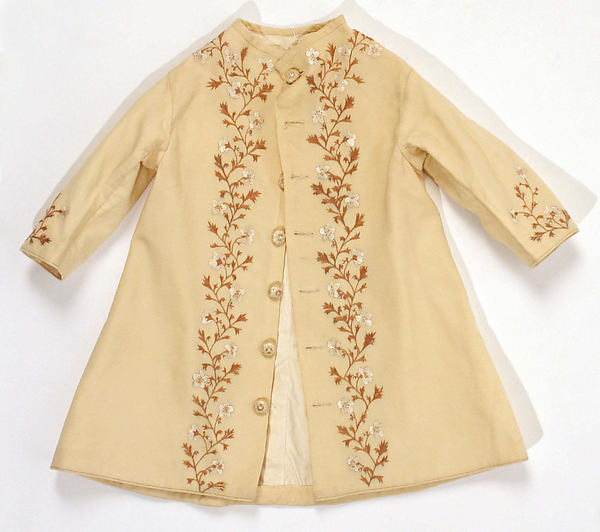
Original: Embroidered Child's Coat, c.1860

Still in a coat/outerwear mood, and February is a good time for cute things:

Child's Wool Coat with Silk Embroidery, c.1860. The Met.


Monday, January 31, 2022

January Mending

Not much to look at, but I am trying to be more timely in my mending this year and there's nothing like a scheduled blog post to hold me accountable. January flew by, so I only got a few small tasks done.

My quilted petticoat ties gave out when I last wore it, and needed to be replaced. A few stitches also secured a bit of the waistband which came loose, and an inch of the placket which worked free.


My pink half-apron has also seen some tough times. I ended up securing both pockets where the edges were coming loose, and reattaching the skirt to the waistband at two points where they detached. I also moved both buttons into better positions, so that I can actually fasten the apron with them, instead of knotting the waistband.


Sunday, January 30, 2022

HFF 5.14: Topsy-Turvy


The Challenge: Topsy-Turvy

The Recipe: "Turn-under Pie" or Apple Pie No. 4 from Mrs. Bliss's The Practical Cook Book

The Date/Year and Region: 1860, Philadelphia

How Did You Make It:  I made a half-batch of the No. 6 paste ("half-puff paste"), by cutting 4oz of butter into 2 cups flour with 1/2 tsp salt. I added one beaten egg and a little water to make a paste, then rolled it out twice, folding in another 2 oz of butter each time. The instructions said to make it like the previous puff paste after giving the starting amounts, which left me confused about whether this included layering in the extra butter--in the end, I used half as much butter as the previous recipe called to be layered in, since it otherwise would have duplicated No. 5 but with an egg.

Once the paste was rolled out, I put a crust on the pie tin, then peeled and sliced three medium-sized Granny Smith apples, which neatly filled the pan. I added a top crust, taking care to set it on top without pinching the two crusts together. I baked the pie for a bit over 45 min, though the crust was just starting to brown. I lifted off the top crust, added 1/4 cup white sugar, a small pinch of salt and a generous sprinkling of powdered nutmeg to the apple mush, removed about half of the apple, then replaced the crust upside down and spread the remaining apple over it.

Total Time: Just over an hour, including cooking time.

Total Cost: About $4 for butter and apples

How Successful Was It?: It tastes great. I'm not entirely sold on the 'flipping the crust' step actually contributing anything worthwhile, but it was something to do. I think the reduced butter amount was necessary--I've had some mixed experiences using period puff paste recipes, and this avoided the worst of those problems. The crust was rich, but it wasn't leaking butter. The sugar amount was a guess, but it suits the tartness and quantity of apples; next time I would use a hair less nutmeg. 

The half batch of pastry was a good idea for this pan, and I had sufficient leftover paste to make third crust. The apple cooked down a lot, so next time I use this pan I'll aim for 4-5 instead of three and really mound them up. I'd also be tempted to find an apple that holds up better to cooking.

Additional note: it says to serve hot. This is absolutely imperative. I couldn't eat the whole pie in one evening, but by the next morning it was distinctly un-appetizing. If I make this in the future, it'll be for an event with enough people that left-overs aren't a concern.

How Accurate Is It?: I used the modern oven and a modern apple variety, but prepared the ingredients with hand tools. I did use my new repro tin pie pan, and especially liked how easy it was to shape the paste along the scallops.


Upside-down apple pie.


The apples before cooking.


Thursday, January 6, 2022

Food Pairing Advice

Happy Twelfth Night! I didn't make a cake in this, the second year of the plague, but thought to share some culinary advice I found during a recent research project.


VEGETABLES AND SAUCES APPROPRIATE TO DIFFERENT MEATS 

Potatoes are good with all meats. With fowls, they are nicest mashed. Sweet potatoes are most appropriate with roast meat, as also are onions, winter squash, cucumbers, and asparagus.

Carrots, parsnips, turnips, greens, and cabbage are eaten with boiled meat; and corn, beets, peas, and beans are appropriate to either boiled or roasted meat. Mashed turnip is good with roasted pork, and with boiled meats 

Tomatoes are good with every kind of meat, but specially so with roasts. Apple sauce with roast pork; cranberry sauce with beef, fowls, veal, and ham. Currant jelly is most appropriate with roast mutton. Pickles are good with all roast meats, and capers or nasturtiums with boiled lamb or mutton. Horseradish and lemons are excellent with veal.

--The Young Housekeeper's Friend (1859)


Wednesday, January 5, 2022

Aunt Sophie's Visits


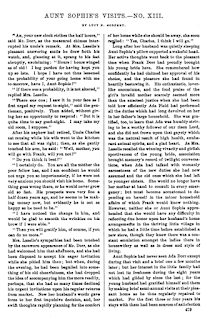
While researching Christmas trees a few years ago, I encountered a series of stories in Godey's. "Aunt Sophie's Visits" were published in fourteen installments between 1857 and 1864. In each story, the eponymous heroine visits a relative, and gives them life advice. They are the sort of didactic story which I find enlightening about household details, so I started tracking them down.

While most of the stories are less useful for material culture than I had hoped, I think they offer some interesting insights into ideals about how families and marriages should function c.1860.

I. (November 1857) Aunt Sophie visits a newly married niece, and advises her on self-care.

II. (December 1857) Aunt Sophie instructs a different niece on preparing a Christmas tree [with strings of parched corn, dyed egg shells, riddles, lace bags of sweetmeats, paper ornaments, and wax lemons.]

III (July 1858) Aunt Sophie helps her nephew and his wife lay foundations for a good marriage and dealing with the loss of a child

IV (November 1858) Aunt Sophie teaches her husband's nephew to save and not to be extravagant with money.

V. (March 1859) Aunt Sophie advises her sister-in-law on being a stepmother, and the family comes together after the death of a child.

VI. (July 1859) Aunt Sophie visits her niece, and helps her niece's new husband realize that a person can be good without being dour. Includes references to picnics (with outdoor dancing), summer amusements, and Fourth of July celebrations.

VII.(March 1860) Aunt Sophie advises her brother and sister-in-law about assessing the character of their daughter's suitor.

VIII. (October 1861)  Aunt Sophie cautions her niece about pride and shows kindness to a worthy friend fallen on hard times.

IX. (April 1861) Aunt Sophie visits her sister, models moderation in diet, and advises her niece on the salutary benefits of anticipating pleasant events.

X. (November 1861) Aunt Sophie helps her niece and her niece's husband to find contentment in their marriage, which started inauspiciously.

XI (February 1862) Aunt Sophie advises her friend(?) to help raise her motherless nephew, to the great improvement of his character.

XII (August 1862) Aunt Sophie visits her nephew's widow, and encourages her to have her children help with the household work--easing their mother's cares while providing structure for the children and helping them develop industrious habits.

XIII:(November 1862) Aunt Sophie advises her niece-by-marriage on balancing household and social duties (with bonus Wholesome Menus for Entertaining).

XIV (June 1863): Aunt Sophie advises her sister-in-law and nieces about choosing good reading material, including a cautionary tale about the dangers of bad novels and positive observations on the sublimity of nature.

*XV: (October 1863) Aunt Sophie, with her husband and two of their children, visit some old friends who have moved away. They discuss finding contentment in old age as in youth, and on the importance of avoiding addictive substances (tobacco and alcohol).

*XVI: (June 1864) Aunt Sophie visits her brother, and helps her new sister-in-law adjust to her new home. Much of the story is told from Mary's perspective, as a poor, but cheerful and hard-working orphan, wife and widow.


In the September 1863 issue of Godey's, a short notice announced the death of Lucy N. Godfrey in her home at Bethlehem, Vermont on May 21, 1863. The June 1863 issue, with installment XIV of the Aunt Sophie stories, would have been delivered the week she died. The announcement mentioned that the editors had one or two more of Mrs. Godfrey's stories on hand; these appeared in the October 1863 and June 1864 issues.

I was curious about the author's life, and how it may have related to her writing, which is focused on ideas for domestic harmony. Lucy Newman Godfrey  (1829-1863) was the eldest of eight children. She appears to have spent her whole life in the vicinity of Brattleboro, Vermont, among a closely-knit family. At age twenty, she married Hartwell Godfrey, a mason five years her senior. Their only child was born in 1857, when Lucy was twenty-six and Hartwell thirty-one. In the only census taken during their marriage, Lucy and her son were living with her parents and siblings, while her husband boarded in New Jersey

Lucy's brother, George Newman Jr., may have had a wife named Lydia who died in 1857, the same year that he married a Sarah Caldwell. The fifth "Aunt Sophie" story, published in early 1859, features the heroine meeting her younger brother's second wife and advising her on relating to her stepchildren.

Lydia K. Newman, Lucy's possible sister-in-law, was predeceased by her daughter, Mary (1850-1853) and infant son, Orrin (1856). Stories three and five (published 1858/1859) include a family coping with the death of a child. The extended Newman family, unfortunately, experienced this grief multiple times in the years to follow.

In January 1863, Lucy's husband died of consumption, leaving her a widow with a 6-year-old son. In the final "Aunt Sophie" story (written by May 1863, published 1864), the character Mary's husband dies suddenly of consumption, leaving her a widow with several young children; her greatest help and comfort is her oldest son, aged 8.  This story differs from the others, in that much of the narration is Mary telling her history to Sophie; most characters' backstories are given by the omniscient narrator, or by Sophie talking with a third party. The story also focuses on a second marriage for two parties: a melancholy widower who is financially secure, and a persevering widow who has always been poor. With a minimum of Sophie's advice (that Mary needed to resume some of her former occupations), the marriage provides them both with stability and companionship. I have to wonder if that's how Lucy hoped her own life might proceed after widowhood.