Showing posts with label originals. Show all posts

Wednesday, July 1, 2026

Original: Brocade Gown, c.1775

 Something that's aged well over 250 years:

French brocade gown, c.1775, in the MET.

The bright fabric initially made this gown catch my eye. According to the Met's write-up, the attached bodice front with button closure (rather than a separate stomacher piece pinned to the overgown) is what makes this garment unique. While I still find panniers a bit ridiculous, they do show off the material very well, especially designs with large motifs. Do follow the link for additional angles: this gown also has a lovely sacque back, and there's also a nice side view which shows the gown's surprisingly narrow profile (compared to its width).

Friday, May 1, 2026

Purple Silk Cross-over Bodice, c. 1840


Purple silk dress, c.1840, from The Met.
 

Looking for 1850s dress inspiration, I stumbled upon this fun c.1840 silk dress with a surplice/cross-over style bodice. At first glance I took it for an early 1860s dress with relatively large coat sleeves, but from the side view, it's more clearly one of those fun shapes that appears post-1836-sleeve-collapse where the sleeve is gathered/shirred down close around the upper arm (and visually smoothed out here with a jockey) then balloons out again a little above the elbow, only to get tight again around the forearm.

In the close-up views, the fabric appears to be a satin; and I'm very intrigued by the small edging detail on the sleeve jockey: overlapping loops of perfectly color-matched satin-covered cording. I'm very curious about whether that was a manufactured-to-match trim, or actually pieced from the same fabric as the dress.


Wednesday, April 1, 2026

Wool "Corset Bodice", First Quarter of the 19th Century

Corset Bodice, c.1800-1825, Snowshill Collection 
accessed through UK National Trust.

I have So Many Questions about this garment. It came up while I was looking for inspiration images for some early 19th century short stays, but thus far it's eluding classification.

At first glance, I took this for a set of short stays with unusually long tabs. On further reflection, I started wondering if it was in fact long stays that had (possibly through later alteration) voids instead of hip gores.  The double bust gores are a very common way of shaping long stays in the 1820s and 1830s, though I haven't seen them in the few short sets I've found. The front laces are also nigh-ubiquitous for those elusive early 19th century short stays; at the same time, I can't recall seeing a single set of longer stays from that period with front laces instead of a front busk. And then there's the fact that there are only 6 eyelets per side, allowing the garment to lace mere inches past the bust itself.

 On the whole I'm leaning towards considering this to be a set of short stays with very weird tabs and a bust treatment more typical of long stays. I'm not wholly convinced they weren't meant to be long stays which was never completed or was turned into short stays halfway through (the lack of additional eyelets is what's keeping me from speculating that they were long stays with later alterations). Or possibly this is something else entirely: an unusual, or perhaps a costume piece meant to evoke 18th century pastoralism with a fashionably raised early 19th century waistline.

I do like the contrasting color along the upper binding at the underarm: though not specified in the description, this would match the places where chamois leather is used on some 18th century stays to deal with a high-wear area. 


Sunday, March 1, 2026

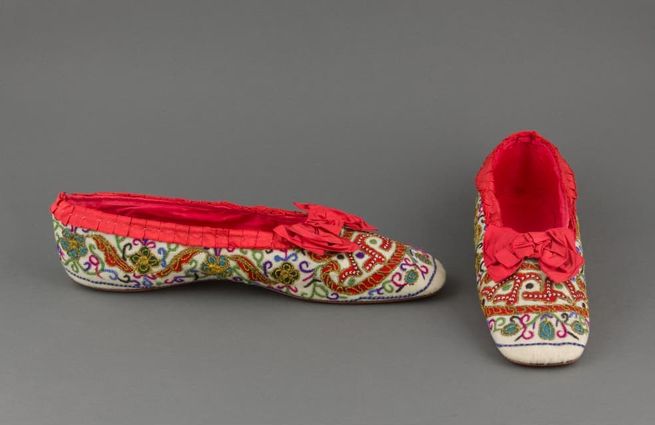
Originals: Bright Embroidered Slippers, 1855-65

 I love these:

Embroidered Wool Slippers, c.1855-1865, from Historic New England.

The description says that these are wool with embroidery and silk lining. I really love the contrast between the white ground exterior and the bright scarlet trim/bow/lining.

Zooming in close (thank you for the high resolution photos!), the embroidery appears to mostly be in chain-stitch, with applique (the red shapes and green and blue rosettes) and gold couched threads. At least two of those chain-stitch lines are done in alternating colors.

Sunday, February 1, 2026

Original: 1840s Adjustable Wrapper


Cotton Wrapper, c.1840s, Kent State University Museum.

Since a direct link doesn't work, a search for item "1984.002.0045 ab" in the Kent State University Museum's online collection is the best way to see the alternative views of this lovely cotton print (especially the final detail view of the printed fabric up close, and the front-on view which shows the diagonal grid of the pelerine front to perfection).

The vivid colorway of the printed cotton fabric is what initially caught my eye about this wrapper: there's two different wavy floral lines, one running horizontally and one vertically, with the resulting squares not only alternating between green and yellow/beige in each horizontal row, but those boxes are dyed in a graduated ombre (darker towards the bottom, lighter towards the top) with a subtle tone-on-tone coral motif in each (possibly a resist-dye effect). The size of the motifs and color differences (high contrast in some places, tone-on-tone in others) make it look striking from a distance but somehow less "busy" than I would have expected.

The second thing that caught my eye was the way the side seam in the skirt is a good half-motif off of alignment, which in such a large print really shows. I liked this because while it's strikingly obvious, the mis-matched print doesn't actually detract from my enjoyment of the dress as a visual object. In a way, it draws more attention to the detailed, bright printed design.

The diagonal grid formed by cutting the pelerine front on the bias also really stands out on this example (seriously, go check out the first image with the front view). Again, the fabric itself has so much going on, that simply rotating the motif 90 degrees in one area but not another makes a dramatic effect.

I do wish there was an interior construction photograph of this dress: the description mentions drawstrings in "both bodice and skirt", leading to the conclusion that this was a maternity dress. Strategic drawstrings are certainly a technique which can help fit an 1840s/50s/60s dress to such a changing figure, though I can't say that they are exclusive to maternity dresses versus wrappers worn at other times. Even more convincing to me, is that looking closely at the side-view waistline, it is appears that the mannequin has been padded out in the lower abdomen (mimicking a baby bump), but between the print and the wrapper's soft shape, it's hard to tell for sure. Which, from what I've read about Victorians, would make it an excellent maternity dress.  

Thursday, January 1, 2026

Happy New Year: 1826 and 1926 Dress Designs

 I do enjoy the difference that a century can make in clothing styles. Here's where we were 100 years ago:

Summer 1926 day dress, House of Paquin. From VAM.

And to the folks of 1926, this style was just as old as their clothing is to us:

Promenade Dress from Ackerman's Repository, January 1826. From LACMA.

It's interesting to reflect on these styles side-by-side. Both eras are playing around with waist-placement: the 1920s have dropped it to an all-time low near the hip, while the 1820s are also moving low(er) from decades of all-time-high waistlines under the bust. They're also at different stages of a major silhouette shift: Empire style of the late 1790s-1810s, like the "flapper" style of the late 1910s-1920s, are remembered as looser, shorter, and simpler styles which directly respond to (and reject) the more elaborate, structured, and formal designs of, respectively, the Ancien Regime and the pre-War/Edwardian period. But our 1926 dress is barely a ten years into its fashion revolution and shows that style in its full development, the 1826 one is nearly three decades into its silhouette, and the metaphorical pendulum is starting to swing back the other way. While the fur muff obscures the lowering waistline (which is creeping back towards the natural waist, allowing for structured bodices to make their return), we're also seeing more visual weight through the shoulders created by the double row of vandykes, as well as a wider, more bell-like skirt, stiffened by its wide fur hem. The trajectory is clear: Empress Josephine is out, and Empress Eugenie's on the (distant) horizon. 

Monday, December 1, 2025

Original: Open-work Stockings, 1855

With all the Christmas presents in progress, I have knit stockings on my mind. This pair of openwork cotton stockings in the MFA is certainly worthy of admiration:

Cotton stockings, 1855. Museum of Fine Arts, Boston.

In addition to being from one of my main reenacting years, the things that caught my eye about these stockings is the placement of the pattern work along the lower calf and top of the foot. While these could have been worn with the popular ankle-boots and gaiters of the period, those options would entirely cover the detailed open-work design. And while plenty of undergarments have decorative elements that would never be seen by anyone but the wearer, it does leave me wondering whether these specific stockings were meant to be worn with a slipper. Such a low, open shoe style would leave all the patterned areas of the stockings visible (should the foot/ankle be seen) rather than specifically covering them.

Saturday, November 1, 2025

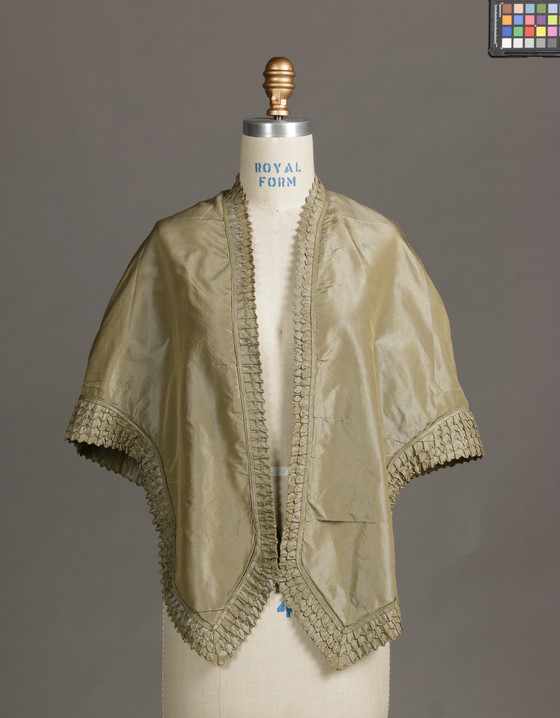
Originals: Silk Mantle, 1850s

Woman's mantle in off-white silk taffeta. This item is listed as a pelerine, though I disagree: the size (down to the elbow on the sides and past the waist in front) and shape more closely resemble a mantle, in my opinion.  


"Pelerine" (mantle), 1850s, in LACMA.
 

It's worth zooming in for a look at that self-fabric trim. It appears to be a variation on puffed gathering; there's a minimum of two rows all around the edges, expanding to four at the elbows, which adds a delightfully subtle extra bit of shaping there.

Wednesday, October 1, 2025

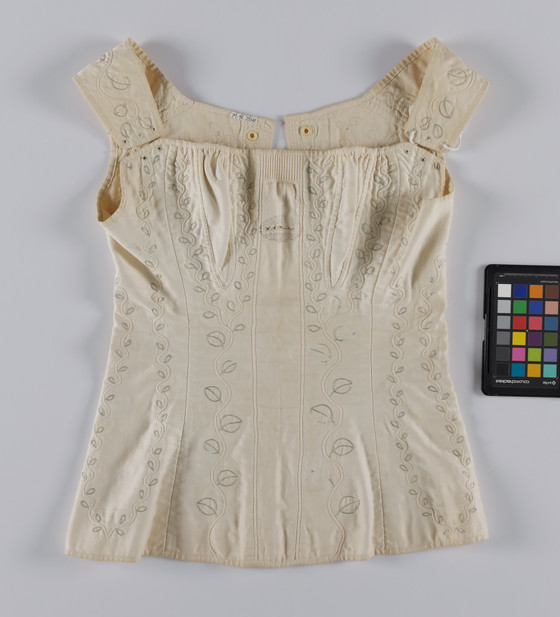
Original: Embroidered Corset, 1830s


Corset, c.1830, in the LACMA collection.

While the small embroidered leaves on this garment were what first caught my attention, what I'm really curious about is the cording or quilting along the top edge of the busk casing. I'd really love to see this one in person and get a better idea of how that part of the corset was constructed, and whether it is actually cording or just close-set rows of parallel quilting. I don't recall seeing anything quite like it, and will need to keep an eye out for whether this is a common feature that I've previously overlooked.

Sunday, September 7, 2025

1919 Corset Ad

I came across an ad-article for Gossard Corsets in the March 1919 issue of Women's Home Companion, and was intrigued by their take on "What the War Has Taught Us About Corsets." Or rather, I was interested in how the conclusion presented is almost diametrically opposed to every modern narrative I've heard about how corsets interacted with women's expanded sphere of activity during WWI. 


What the War Has Taught Us About Corsets 

NEVER in in the world's history has any one article of clothing been so prominently brought before the world as an economic force, as has the corset by the part it played in the Great War. 

It was demonstrated to the Governments of Europe in the early stages of the conflict that women could not stand the burden of their unaccustomed duties unless they were properly corseted. 

Thousands broke down under the strain of the new work and production suffered. When these same women were put into proper corsets, sickness decreased and in many instances production was practically doubled. 

From then on corsets were recognized as an essential in war work and when America's women responded 35,000,000 strong to their Country's call GOSSARD Corsets The Original Front Lacing Corsets [emphasis original] were privileged to contribute, in a large way, to the important duty of preserving their health and efficiency. 

Daily it was demonstrated that the correctly corseted woman was capable of greater and more sustained effort than her uncorseted or poorly corseted sister. The hygienic body support of a correctly designed and fitted corset kept thousands of willing workers well and sustained that splendid woman power that was one of the greatest forces contributing to the conclusion of a successful peace. 

Not only has the war taught every thinking woman the value of correct corseting; it has taught her the wisdon of buying only corsets that are hygienically correct; it has taught her to be fitted carefully and to adjust her corset each time it is worn so she may realize its full benefit and service. 

Gossard Corsets are the complete expression of modern corsetry. If possible, the new Spring and Summer corsets are superior to those of the past season which were generally acknowledged to be without equal in meeting the needs of active womanhood from the stand point of comfort, hygiene and style. 

Even allowing for bias (the whole point of this ad is to sell corsets), the fact that this ad was written in this way indicates that someone in 1919 thought 'corsets help you work better and achieve more' was a plausible and persuasive line or argument for other people in 1919. Which is a useful data point to keep in mind when evaluating the claim that corsets fell out of favor because women started doing a wider variety of active work during the later 1910s.

Monday, September 1, 2025

Original: 19th Century Bathing Costume

 For August, how about a late 19th century bathing costume?


Wool bathing costume bodice with later "skirt"
From Historic New England.

The wool flannel I expected, though I would love to know when and why it acquired that printed 'skirt.' Also impressed that the stockings, trousers, and top have all survived and stayed together so long. I wish there was a photo of the trousers, and one showing the shirt with a sleeve out (to give a better idea of the shoulder position and sleeve shape).

Friday, August 1, 2025

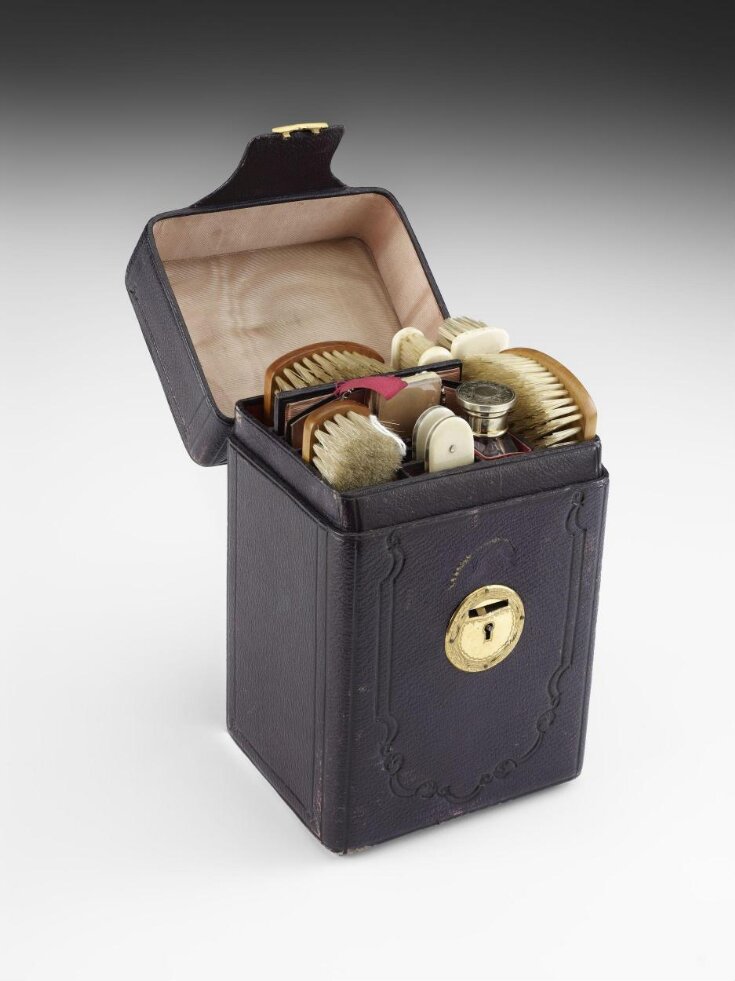
Original: Dressing Case, c. 1850

 And now for something clothing-adjacent: a dressing case from the early 1850s.

Dressing Case, c.1850, in the VAM.

I can across this example while researching period nail brushes for my July program at Nisqually. It was fun finding a surviving example of a dressing case to compare with the illustrated advertisements (such as this 1860 catalog, note the similarities to B49 in the upper left corner). I also appreciated that, while it does not have photographs of the different component pieces, the VAM's description of this case includes dimensions of each piece. While period writings mention the use of a nail brush, finding an illustration or description of one had proved more elusive. I'm still trying to figure out if two-sided brushes were used in the 1850s, but the dimensions at least point to this example having a handle, and a small brush-head similar in size to most modern nail brushes. 

The VAM link has more information, but I wanted to mention than this set includes both personal hygiene items and clothing maintenance accessories (clothes brushes and a button hook), as well as a strop for sharpening razors. And then there's a corkscrew.

Sunday, June 1, 2025

Original: Seaside Outfit, c.1864-1867

Cotton seaside ensemble, c.1864-7, in LACMA.
 

Something summery this month! I selected this sacque-and-petticoat outfit partly for the seasonal theme, and partly because it breaks all the 'rules' (read: general trends) of reproducing 1860s dresses. It's a two-piece outfit; the bodice (sacque) does not closely fit the figure; and the fabric is a solid cotton (no printed design in sight). And it's covered in embroidery! But there are reasons for all of these departures from the norm, which is that this is a very specific kind of outfit, made of a very specific kind of fabric, worn by very specific people for very specific purposes.

In short: this is a rich person's casual summer recreation outfit, intended for outdoor daywear in a "watering place" (read: seaside resort full of other rich people relaxing and having fun outside). The loose fit of the sacque makes the whole thing look relaxed and informal, while the unprinted white cotton should both look and feel cool in the summer heat. And that isn't just any kind plain cotton: it's a cotton pique, which as far as I can recall is only used for summer wear (and is one of the few solid-colored cotton materials to feature in women's dresses of the period). And the white won't be fading or crocking; not that this need be a concern, because the person commissioning hyper-specific garments for hitting the beach on vacation is not someone trying to eke out a meager clothes budget, and can readily replace this outfit when it starts getting dingy or dated. Note also the long train on this skirt: it's meant to be worn over the fashionable elliptical hoops of the later 1860s, despite the ostensibly 'relaxed' show made by the sacque.

Thursday, May 1, 2025

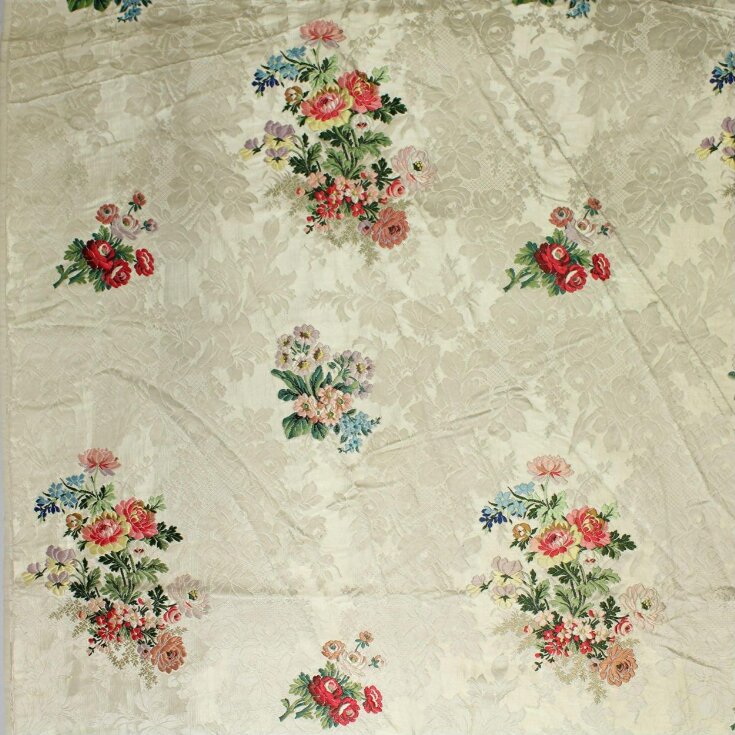
Original: 1840s Brocaded Silk Fabric


English-made silk brocade, 1840s, in the VAM.

It is the month of May, what better time for some English flowers? This Spitalfields brocade caught my eye not only for the bright polychrome floral sprays, but also for how their strong colors contrast with the more delicate white-one-white patterning of the background. The description calls the whole thing brocade, though at high magnification, the colored flowers look like they might be embroidered using satin stitch on a brocaded white ground. That being said, my eyes could be deceived, and all the flowers may be woven in. I do wish I could see the reverse of the fabric to make a better guess.

Tuesday, April 1, 2025

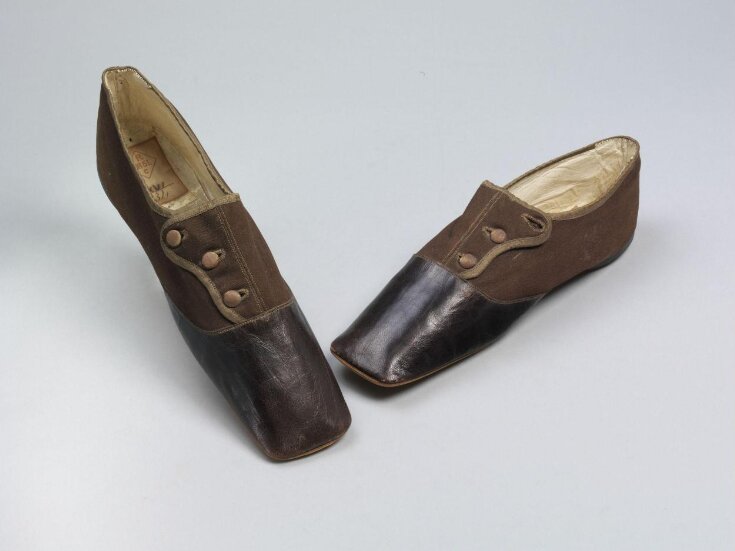
Original: Women's Button Shoes, 1851

Women's shoes, English, 1851, in the Victoria & Albert.
 

This month's antique garment is the other pair of women's non-slipper low shoes which I found while researching my recent shoe project. These are described as serge (wool) and leather, and between the material and date, would have been a better choice for me to try copying. However, I didn't want to make a button shoe this time. 

I did note the asymmetric flap for the buttons, which follows the a similar shape to most of the button boots I've seen from this period, and to the button gaiter pattern in Every Lady Her Own Shoemaker. From the specific date of 1851, I assume these shoes were once part of the Crystal Palace Exhibition, which formed the basis for the V&A's original collection.

Saturday, March 1, 2025

Original: Silk Ankle Boots, c.1855-1865

 I never did get my new mid-19th century boots started last summer, but with my size out of stock at my last supplier, it is a project I need to get busy with. So, time for some more inspiration.


Girl's Boots, made from silk and patent leather, c.1855-1865. LACMA.

Wednesday, January 1, 2025

Original: Silk Reticule c.1825

 A pretty antique to start the year:

Reticule, c. 1825, LACMA.

The purple color is what caught my eye (along with the familiar shape!) I also like the contrasting cording along the seams (which feels very 1820s), the delicacy of the tassels, and of course the elaborate embroidered panel.

Sunday, December 1, 2024

Original: Black Crepe Bonnet, c.1880s

Bonnet, 1880s, from LACMA.
 

I selected this bonnet because I like how the crepe photographed, with its diagonal stripes coming through clearly. The bonnet's plain aesthetic is suited to the purported use as a mourning garment, which is further supported by the extensive (exclusive) use of black crepe as a material.

Tuesday, October 1, 2024

Original: Print Dress, c.1825

I like the stripes on this one: the contrast between the vertical stripes on the bodice and skirt, the horizontal stripe on the skirt, and diagonal of the bias-cut sleeves. The maker even made the effort to align the stripes on the cape and bodice at the center front.


Dress, cotton, c.1825. From LACMA.