Showing posts with label early 19th century. Show all posts

Wednesday, April 1, 2026

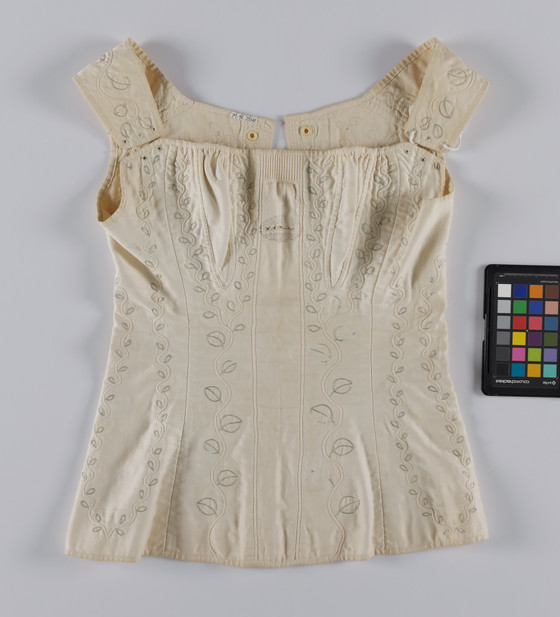
Wool "Corset Bodice", First Quarter of the 19th Century

Corset Bodice, c.1800-1825, Snowshill Collection 
accessed through UK National Trust.

I have So Many Questions about this garment. It came up while I was looking for inspiration images for some early 19th century short stays, but thus far it's eluding classification.

At first glance, I took this for a set of short stays with unusually long tabs. On further reflection, I started wondering if it was in fact long stays that had (possibly through later alteration) voids instead of hip gores.  The double bust gores are a very common way of shaping long stays in the 1820s and 1830s, though I haven't seen them in the few short sets I've found. The front laces are also nigh-ubiquitous for those elusive early 19th century short stays; at the same time, I can't recall seeing a single set of longer stays from that period with front laces instead of a front busk. And then there's the fact that there are only 6 eyelets per side, allowing the garment to lace mere inches past the bust itself.

 On the whole I'm leaning towards considering this to be a set of short stays with very weird tabs and a bust treatment more typical of long stays. I'm not wholly convinced they weren't meant to be long stays which was never completed or was turned into short stays halfway through (the lack of additional eyelets is what's keeping me from speculating that they were long stays with later alterations). Or possibly this is something else entirely: an unusual, or perhaps a costume piece meant to evoke 18th century pastoralism with a fashionably raised early 19th century waistline.

I do like the contrasting color along the upper binding at the underarm: though not specified in the description, this would match the places where chamois leather is used on some 18th century stays to deal with a high-wear area. 


Sunday, December 14, 2025

Mother Orne's Molasses Gingerbread

We're once again survived Christmas at Fort Steilacoom, and I have once again attempted a period gingerbread receipt to serve our volunteers. This year, I was looking for a recipe that would work well with my gingerbread mold, and really let the picture show through.

At Quin's recommendation, I tried making Mother Orne's receipt (approximately dated 1817-1840s), from Sally Fiske Rope Orne's (1795-1876) Recipe Book. The original in now in the Peabody Essex Museum, and they have a very nice blog post about Sally, her family home, and this recipe, including an adaptation for the modern cook.

Unfortunately, I like cooking on hard mode, so I attempted the original recipe as given.

Sally Orne's Gingerbread Receipt, from the Peabody Essex Museum.

My transcription of the recipe: 

Mother Orne's Receipt for Molasses Gingerbread

9 lbs flour, 1 of fat, 2 1/2 of butter, 3 pints of molasses, 1/2 a pint of milk, 1 tea cup of ginger [and?] large tea spoons of pearl ash. Rub the fat and butter into the flour, dissolve the pearl ash in a little milk, mix the molasses and milk together.

Reducing this down to 1/6 scale, that makes 1.5 lb flour, 1/2 lb butter, a bit under 3 oz of fat, 1 cup of molasses, 1/6 cup of milk (or 1 1/3 fl oz), between 2/3oz and 1 oz ginger, and an unknown about of pearl ash.

I took a tea cup as 4 oz, as given in the domestic measures section of A System of Practical Medicine (1842), however that text goes to explain that while a 4oz is the customary measure, a tea cup filled to the brim might actually contain 6 oz while one filled to normal drinking capacity might be closer 4.5 oz to 5oz. Thus the range of "between 2/3 oz" (customary) and "1 oz" (maximum) in my version.

The pearl ash is a bigger problem, because it does not appear to me to actually have an amount in the handwritten original. The "tea spoons" are definitely plural, but the word before "large" appears to be "and" rather than an amount. Furthermore, everywhere else in the recipe, numbers are written as numerals rather than spelled out, so I don't think it's meant to be "three large tea spoons" or "five large tea spoons", but rather "and [omitted number] large tea spoons." 

For comparison, the Common Gingerbread in Miss Leslie's Seventy-Five Receipts for Pastries, Cakes, and Sweetmeats (1832) calls for 1 tsp of pearlash for 2.5 lbs flour, while the Lafayette Gingerbread in the same book can be made lighter with an optional "1 small teaspoon pearlash dissolved in 1 teaspoon of vinegar" for a recipe containing 1.5 lbs of flour. It does caution that using too much pearlash will give a bitter taste, and both receipts advise that if the pearlash is "strong", half the amount will suffice. Extrapolating from these two recipes, we're looking at somewhere between 2/5 tsp and 2/3 tsp pearl ash per pound flour for gingerbread, or 3.6 tsp to 6 tsp for a full batch of the Orne receipt with its 9 lbs flour. Or half that amount.

I'm going to assume that my modern potassium carbonate is very pure and relatively anhydrous, and thus counts as strong pearl ash. So, even at the extreme end of the taking the original as calling for 6 tsp, half of that would make 3 tsp, and my reduced scale version more like 1/2 tsp. [Note: while the modern version calls for apple cider vinegar to replace the cider, I didn't see either of those items in the original. Miss Leslie's receipts calls for vinegar to use with the pearlash; as that is the role given to the milk here, it does leave me wondering whether the writer meant 'sour milk' to be understood. As it was not spelled out, however, I decided to use fresh milk this time and trust to the molasses providing enough acidity to activate the pearlash.]

Math done, I made the gingerbread by cutting the butter and fat (lard) into the flour, to which I added about 3/4 oz of ground ginger. I added the molasses to this mixture, and then the pearl ash, dissolved (more or less) in half of a 1/3 cup measure of milk. There was actually a fair amount of it left in the cup, so I used a minimal amount of additional milk to get the pearlash into the main mixture. It made a soft but workable dough, which I rolled out and then shaped with my gingerbread mold and cutter.

Plate of finished gingerbread.

The dough was much easier to work with than previous attempts. I found that rolling it out to about 1/8" worked with the mold, but I got the best results when I was aiming a bit thicker (trying for 1/4"), pressed the mold deep into the dough, and then used the cutter around the impressed shape. I didn't bother pricking the cakes with a fork, and they seemed to bake just fine (350F for 11-12 minutes). This 1/6 batch produced 49 pieces of gingerbread (3" x 2"). 

I was pleased with how this receipt worked, and with the molasses-ginger flavor. The texture of the cakes is a bit weird: it's not exactly dry, but somehow a bit gritty or powdery, even when it was fresh out of the oven. On the upside, it seems slow to get stale, and pairing it with hot tea goes a long way. I'll probably keep looking for a different receipt or a way to refine this one which gives a more pleasant texture, but to be honest, it did most of the things I wanted it to (taste fine, make a good impression with the mold).

Wednesday, October 1, 2025

Original: Embroidered Corset, 1830s


Corset, c.1830, in the LACMA collection.

While the small embroidered leaves on this garment were what first caught my attention, what I'm really curious about is the cording or quilting along the top edge of the busk casing. I'd really love to see this one in person and get a better idea of how that part of the corset was constructed, and whether it is actually cording or just close-set rows of parallel quilting. I don't recall seeing anything quite like it, and will need to keep an eye out for whether this is a common feature that I've previously overlooked.

Thursday, March 20, 2025

Book Review: The Domestic Revolution

The Domestic Revolution by Ruth Goodman
 

I have a new favorite Ruth Goodman book. Embarrassingly enough, I ordered The Domestic Revolution: How the Introduction of Coal into Our Homes Changed Everything when it first came out in 2020, read it three times, but somehow never actually finished this post. The book is a bit of a departure from the author's previous titles, spanning the 16th to 19th centuries instead of focusing on a single century/reign, and it really delves the changes over that period rather than giving a snapshot of a particular time. As the subtitle suggests, this book explores the causes and effects of adopting coal as the primary domestic fuel in England. 

The book is 302 pages (excluding the bibliography), divided into nine chapters. The first of these discusses the various fuels that were used before the widespread adoption of coal; later chapters explore the factors which led to coal replacing wood as Britain's main fuel coal, the evidence for how/where coal use spread through the island, and the resulting the changes in land-use patterns, cooking methods, house fixtures, and cleaning practices that arose from domestic coal use. The primary sources are eclectic, including wills/inventories, charitable bequests, household manuals, cookbooks, surviving buildings, advertisements, patents; I find their use persuasive and the conclusions drawn from them plausible. The author also describes her own historical experiments where relevant (particularly concerning cooking and the idiosyncrasies of using different fuels) which I think adds a unique practical dimension to the discussion.

This is a fairly text-heavy book. The images, averaging just over six per chapter, are often copied from period sources. There are no color illustrations, and the modern images are mostly simple illustrations or diagrams (including grates, coppices, peat cooking fires, the reconstructed Mary Rose galley.) There were times when I wished I was standing next to a reconstructed oven with the author pointing out the relevant features, but overall the text carries the message and the book doesn't really suffer from having few illustrations. As always, the writing is approachable, and reads like a friend telling you all about their latest historic research project. The text does not use numbered citations, but the bibliography is divided by chapter.

Overall, I found the book enjoyable, and thought-provoking. I particularly like how the author ties the different subtopic to eachother: how land-use affects the availability of different fuels, how those fuels affect cooking styles and oven design; tracing the changes to English cuisine as coal replaced slower fuels; and even the different cleaning methods needed in a coal-burning versus wood-burning households.

*In addition to wood, the first chapter explores the practical aspects of other domestic fuels used in Britain prior to and aside from coal, including peat/turves, heather, gorse/ling, furze, and animal dung.

Score: Five Stars.

Accuracy: High.

Strongest Impression: An interesting synthesis of Ruth's many areas of expertise, this book caused me to seriously rethink the interconnected-ness of housework, energy, land-use, and foodways, as well as offering insight into how fuel choice shapes cooking (and many other things.)

Wednesday, January 1, 2025

Original: Silk Reticule c.1825

 A pretty antique to start the year:

Reticule, c. 1825, LACMA.

The purple color is what caught my eye (along with the familiar shape!) I also like the contrasting cording along the seams (which feels very 1820s), the delicacy of the tassels, and of course the elaborate embroidered panel.

Tuesday, October 1, 2024

Original: Print Dress, c.1825

I like the stripes on this one: the contrast between the vertical stripes on the bodice and skirt, the horizontal stripe on the skirt, and diagonal of the bias-cut sleeves. The maker even made the effort to align the stripes on the cape and bodice at the center front.


Dress, cotton, c.1825. From LACMA.


Saturday, June 1, 2024

Original: Printed Silk Apron, Early 19th Century

Found this intriguing piece in the Smithsonian (Cooper Hewitt, Smithsonian Design Museum to be specific). I wish their collection had more detailed descriptions: as at a first glance I took this for an embroidered silk apron, but the medium is listed as "cotton block print on plain weave." I'm now wondering whether it was printed in its final conformation, or if we're seeing motifs cut out and appliqued into position.

Apron, Swiss, early 19th century. From Cooper Hewitt, Smithsonian Design Museum.


Monday, April 29, 2024

Early 19th Century Pocket

   
Now every outfit has pockets.

Mea culpa for falling behind on posts. Again. I finally made up my long-planned late 18th/early 19th century dettached pocket last month, and then proceeded to not photograph it for some seven weeks.

Anyway, the patchwork is based on this early 19th century pocket from the Met. It uses larger square patches for the bottom of the pocket, and smaller squares and rectangles where the pocket narrows around the opening. As the Met has not kindly provided useful dimensions in their catalog, I used the measurements from a c.1840 pocket in the Old Sturbridge Village collection. I was able to draw a trapezoid from the height and two widths given, round the corners, and add a slit of the specified length. Very handy. I thought that particular example would suit this project, since it incorporates prints c.1790-1835, and mine mixes scraps from my Williamsburg haul with leftovers from a Regency dress (and chintz from a closer-to-mid-century quilting project). I lined the front and cut the back from a cotton ticking; the binding is narrower strips of chintz cut on the straight. Per both originals, I did not bind the outside edges.

I'm quite content with the capacity of this pocket, and have already used that to humorous effect in two museum programs. No one seems to expect me to pull a miniature sword out of my pocket (following the undersleeves, kerchief, hairbrush, sewing kit, knitting project, card case, pocket book, toothbrush, folding parasol, &c. This pocket can hold a lot). I do think I'll switch out the 1/4" cotton tape for a stouter article; it just digs in too much when worn without a corset, and I keep thinking the tape is going to break under the weight of items-that-fit-in-this-pocket.


Thursday, June 1, 2023

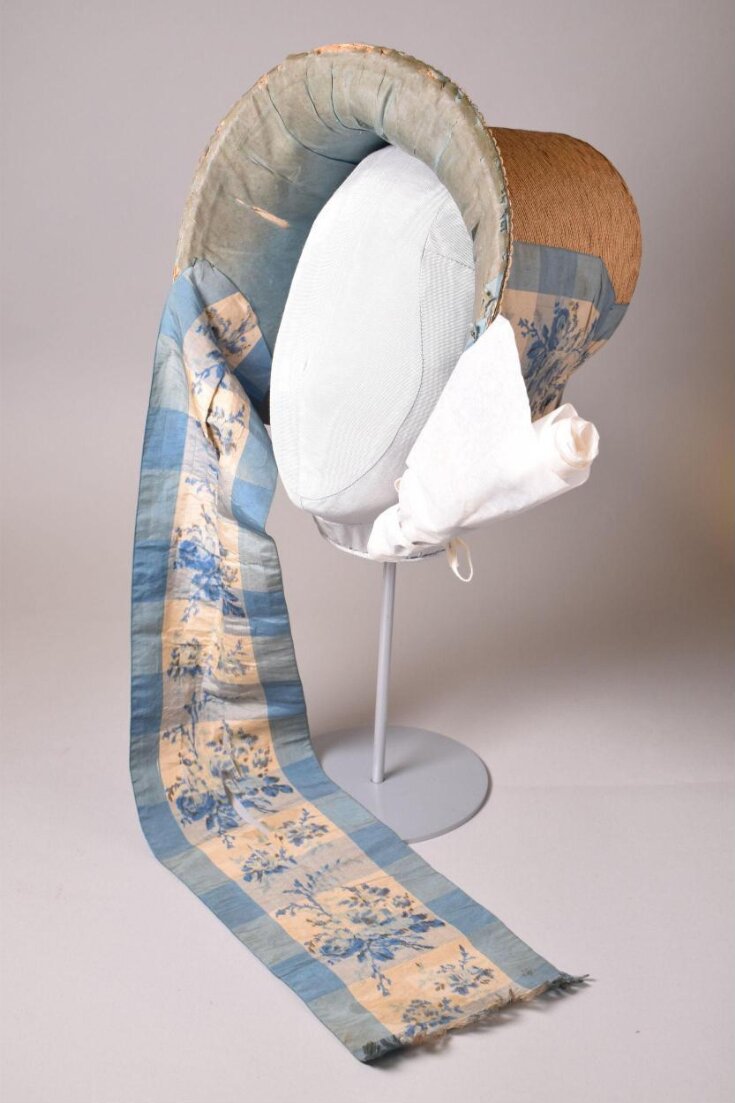
Original: Straw Bonnet, 19th century

Straw Bonnet, 19th century, VAM.
 

I selected this straw bonnet for the lovely figured ribbon. I wish they had more photographs to I could see the brim construction and neck edge better...

Wednesday, June 29, 2022

Apron (Workwoman's Guide)

Another recent project: a bib apron (fig 11 no 11) from The Workwoman's Guide (1838). This is is meant for a friend who has recently taken up tin-smithing, and wanted an extra layer to protect her dress from abrasion and snags. Therefore, I used a heavy cotton shirting fabric from Family Heirloom Weavers. The cotton tape shoulder straps are in the historic instructions, though the design is given as being for a girl or teen. I went this route since the intended wearer strongly dislikes pinner aprons, and it seemed a prudent compromise to get that upper protective layer without pins.


One apron with bib and shoulder straps.

The skirt is made from one panel (~54" after washing), which felt scant from my usual mid-century apron expectations. The instructions, however, insist that one breadth of fabric (as little as 36") is sufficient for working aprons.


Wednesday, April 13, 2022

HFF 5.20: Beverage


The Challenge: Beverage. Make something to drink.

The Recipe: Lemonade from Two Thousand Five Hundred Practical Receipts

The Date/Year and Region: 1837, London

How Did You Make It: I juiced 1 lemon, which yielded a generous 1 oz of juice (maybe closer to 1.5oz, definitely less than 2). To this I added 5 oz of water, 1 Tbsp granulated sugar, 1 oz of gin and about 1/32 tsp baking soda, stirring well.

Total Time: 5 minutes.

Total Cost: ~$1 for 1 lemon and the small amount of gin

How Successful Was It?: Lackluster compared to other lemonades I've made, very good compared to my expectations for a gin cocktail. It tasted like lemon alright, and even had some complexity to it, but didn't have the sharp acidic taste of lemonade. I expect that this was the soda. Making this again (which I might do, because I appreciate the amount of each ingredient being specified), I'd probably omit the soda and gin both, as unnecessary complications.

How Accurate Is It? I'm feeling pretty good, what with the having specific measures and few ingredients. I even managed to find an English gin! Which claims to be made from its original 1880s recipe; this was also the cheapest gin at Trader Joe's, so I didn't have high expectations. Part of the reason I selected this receipt (beyond wanting some lemonade) was because I was intrigued at the inclusion of gin--the spirit has a bad reputation at this period, so I was not expecting to see it show up in a lemonade receipt. The sugar amount was a guess, and if/when I make this again, I'd probably start with 1 tsp and adjust the amount of sugar by taste. I did not research lemon varieties. I used a little more lemon juice than strictly intended, but my gut feeling is that this isn't a game-changer. Making a larger batch would probably allow me to be more precise without wasting any fruit. The one mistake I made was in using baking soda (sodium bicarbonate), which upon re-reading likely meant sodium carbonate (wash soda). The soda I used did not give the desired effervescence in any case.


This is a very complicated recipe.

Lots to see: 1837 lemonade with gin.


Tuesday, March 1, 2022

Original: Silk Sash, 1830s

Woman's silk sash, 1830s, from LACMA.

I really love the multicolored pattern. It's a little jarring to my eye that slightly different shades of gold are dominant in the constructed bow, the tails, and the waistband. However, I think the overall effect is lovely, and is just the sort of jolly, colorful garment to brighten up early spring/late winter/whatever this time of year is trying to be.


Wednesday, December 15, 2021

H.F.F. 5.10: Let Them Eat Cake


The Challenge: Let Them Eat Cake. Make a cake, or cakes, or anything involving "cake".

The Recipe: Queen Cake from Eliza Leslie's Seventy-Five Receipts for Pastry, Cakes and Sweetmeats

The Date/Year and Region: 1832, Philadelphia

How Did You Make It: Half-scale. I used 3 large eggs (for ~5 historic ones), 1/2 lb butter, 1/2 lb granulated sugar, 7 oz flour, 1 tsp nutmeg, 1/4 tsp mace, 1/4 tsp cinnamon.  I  beat the butter and sugar together, then mixed the spices and flour, and beat the eggs separately. I added the flour mixture and eggs to the butter/sugar, then stirred in 2 oz of mixed brandy and white white, and 3/4 tsp rosewater. I baked the cakes in my new queen cake tins. Each tin was buttered and floured before baking.

This half batch made 1 of each shape, large and small, as well as an extra of the large round. Per the period instructions, I only filled each tin halfway, which was felicitous, as each cake basically doubled in height.  I was worried about need to use a utensil to free the cakes, and potentially scraping the tins, but the cakes actually pulled away from the sides like they were supposed to, came free with a few gentle taps to the pan.

I also made the icing at half scale for the icing: beat 1 egg white (rounded down for the size) into stiff peaks, added 6 teaspoons of powdered sugar, and 1/2 teaspoon rosewater. It gave a nice meringue texture, but didn't make enough to cover all the sides of the cakes. So, I probably shouldn't have rounded down the egg size (or possibly only the tops are meant to be frosted). I tried setting the iced cakes in the oven at "bread proof" (100F) to approximate the 'warm place to dry, not too close to the fire' instructions, but after 2 hours the icing was still tacky. Instead, I ended up baking them at 200F for another hour to dry the icing.

Time to Complete: Not counting the week to clean my oven after attempt 1  About 20 minutes to prepare the batter and pans, 15-20 minutes per batch in the oven, another 2+ hours to frost and dry.

Total Cost: Unsure.

How Successful Was It?: Second time was the charm. The cakes have a nice crumb, strong spicy flavor (neither too insipid or overwhelming), and stay fresh for a surprisingly long time. On days 3-5, the remaining cakes were slightly tough, but still quite palatable. 

My first attempt, using the Queen Cakes receipt from The Practical Housekeeper (1855) on a quarter scale was a complete disaster. The batter was fairly light after beating it for a long while, but the batter completely melted when baked (leaving behind only currants in melted butter in the pans and a huge mess in my oven). I also tried using pasteurized egg whites in the icing, but found that 'not suitable for meringues' also applies to meringue-like icings, so I used a regular egg white on the second attempt. Which worked much better.

How Accurate Is It?: I'm feeling pretty good about the tins. I used an electric oven and mixer. I already noted scaling down the eggs. I rounded down the rosewater in the recipe based on the proportions given in the icing receipt: it called for 8 drops lemon essence or 1 Tbsp rosewater in the icing, but the 12 drops of lemon or 1/2 glass of rosewater in the cake. I used the icing proportion instead, and concluded that 1 1/2 Tbsp was the appropriate amount of rosewater, and then halved that as I was working at half-scale.


Test cake has come out of the oven, large pans ready to go in.

Queen cake in many shapes

The cakes that lasted long enough to get frosted.


Friday, October 1, 2021

Original: Green Silk Pelisse, 1828

 Did I select this one just for the color?

Silk Pelisse, English, c.1828 in LACMA.


Mostly. I also like the scalloped trim. I wonder whether the two silks faded the same, or if they originally had more (or less) contrast...

Thursday, June 3, 2021

Kitchen Garden, June 1819

JUNE 
Transplant cauliflower plants, and water them well. Plant out thyme, and other savoury herbs. Sow turnips and brocoli, [sic] and plant out celery in trenches for blanching; also endive. Destroy snails, slugs, &c. 
---Modern Domestic Cookery, and Useful Receipt Book (London, 1819)

Monday, May 3, 2021

Kitchen Garden, May 1819

MAY
Water your beans, peas, &c. occasionally. Destroy the weeds, and hoe between the rows. Sow some small-salading weekly. Sow purslain and endive. Plant a large quantity of beans and peas, and French beans to succeed the others. Plant out savoys, cabbages, and red cabbages; and water them well.. 
---Modern Domestic Cookery, and Useful Receipt Book (London, 1819)

Saturday, May 1, 2021

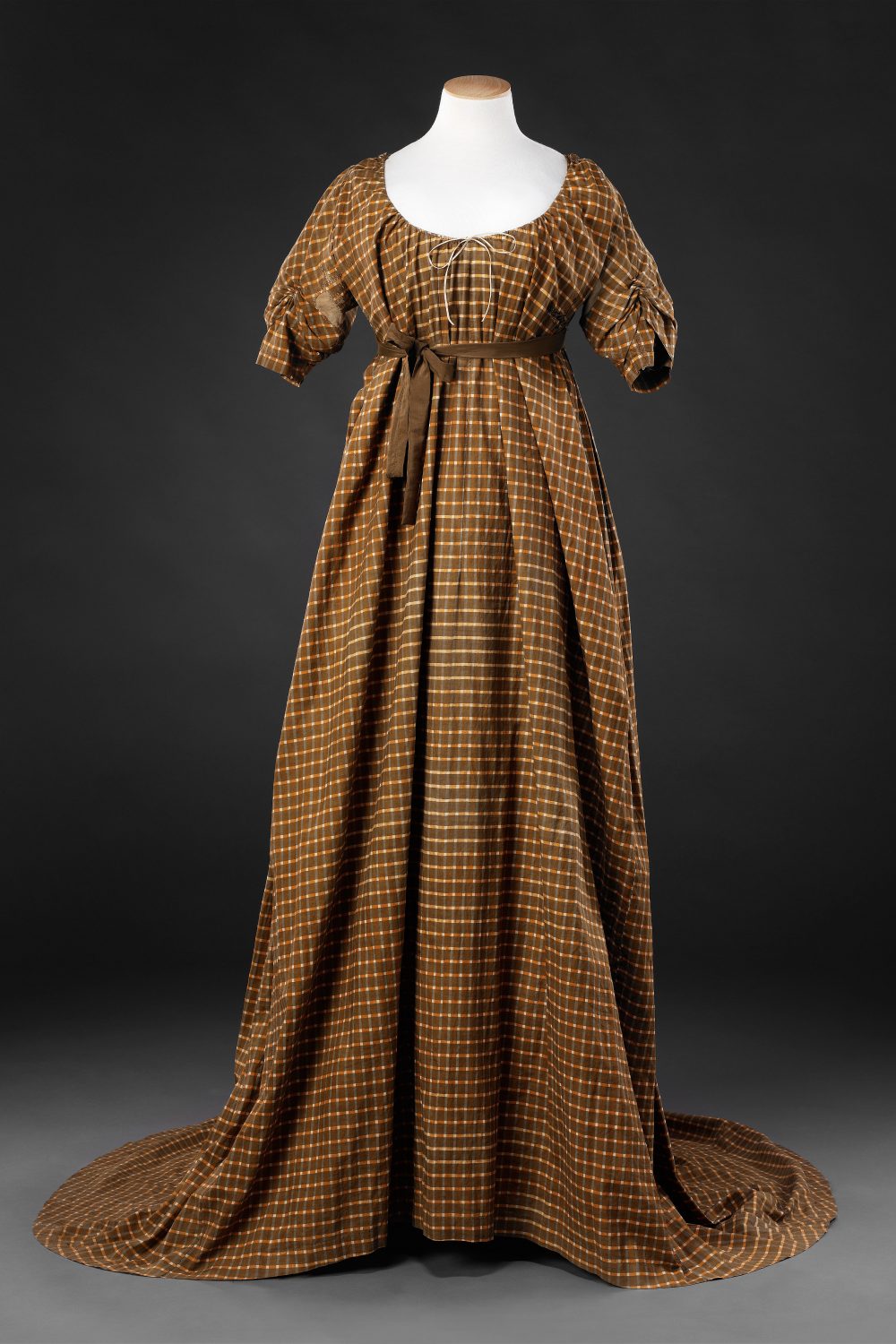
Original: Gingham Bib Gown, c.1800

Silk/cotton gingham dress c. 1800.
In the John Bright Collection.

I picked this dress because it's a lovely example of a bib-front dress that's not in white cotton. Also, I wish I'd found this back when I was making mine, as the the museum obligingly photographed the bodice under-structure (click through for that, as well as a back view). There's also a very interesting layered detail on the sleeve.


Thursday, April 29, 2021

Red Lip Salve, 1850

Revisiting this recipe, I think it deserves its own post. 

RED LIP SALVE. Mix together equal portions of the best suet and the best lard. There must be no salt about them. Boil slowly, and skim and stir the mixture. Then add a small thin bag of alkanet chips and, when it has coloured the mixture of a fine deep red, take it out. While cooling, stir in very hard sufficient rose or orange flower water to give it a fine perfume. A few drops of oil of rhodium will impart to it a very agreeable rose scent. --Miss Leslie's Lady's New Receipt Book (1850)

May I say that I love how Miss Leslie just gives the proportions instead of telling the reader to prepare several pounds of lip salve? 

I previously made this salve with grocery-store (hydrogenated) lard and beef tallow. It technically calls for suet and "the best lard", so I also got fancy and used mutton suet with leaf lard. As previously noted, mutton suet and tallow tend to stink, but also to give firmer final products.

As before, I started a week in advance by chopping up the suet very fine, and picking out any non-fat 'bits'. I then set the suet to soak in water, which I changed every other day. When the suet smelled less like sheep,  I drained it, weighed out 1/2 oz portion, and melted it together with 1/2 oz leaf lard. I added a generous pinch of alkanet (~ 1/2 tsp), removed it from the heat, stirred in 1/2 tsp of rosewater and strained out the alkanet and solid leftovers from the suet. This proved the trickiest part, as the solution started trying to set in the funnel as it was being strained. I think in the future, I could save myself a lot of trouble by putting the alkanet in a cloth bag, and by skimming the solids out while the mixture is being heated. 


Red (pink) lip salve.

The alkanet gave this salve a nice deep pink color, though I'm not sure I'd call it red. As it solidified, salve grew into a paler pink. It ended a lot softer than the other salves and pomatums I've made lately, which I'm attributing to the lack of wax/spermaceti in the recipe. The suet odor, unfortunately, has come through in this batch. I also discovered that some of the rosewater pooled under the surface, and leaked out when I attempted to use the salve.

Since I've made this recipe successfully before, I'm tempted to try again in the future--using tallow for the suet (less straining), rinsing it for two weeks instead of one, and reducing the amount of rosewater. On the other hand, I have a lot of other lip salve recipes that haven't had these problems.

Tuesday, April 27, 2021

Pink Lip Salve, 1825-1856

I took today's receipt from The Dictionary of Practical Receipts (1853), though I found it verbatim in other sources. So far, the earliest (and most detailed) version appears in Mackenzie's Five Thousand Receipts (1825)--a book which goes though multiple editions through at least 1856. Intriguingly, the 1866 expansion to Ten Thousand Receipts omits the rose or pink lip salve, while retaining the white lip salve.

Lip Salve (Pink)-- Put 8 oz of good olive oil into a wide mouthed bottle, and 2 oz of the bloomy parts of alkanet root; stop the bottle, and set it in the heat of the sun till it be of a fine crimson color; strain the oil clear into a pipkin with 3 oz each of fine white wax and fresh well cleaned mutton or lamb suet; melt the whole by a slow fire, and when taken off add 40 drops of oil of rhodium or lavender; and pour it into small pots. 
--The Dictionary of Practical Receipts (1853)

Working at 1/4 scale: 2 oz of olive oil, 0.5 oz alkanet (1/2 cup), 3/4 oz white wax, 3/4 oz lamb suet, with 10 drops of lavender oil. The oil of rhodium imparts a rose scent, which is very popular with lip salve recipes, but I'm interested in trying something different this time (also I don't have any).

I started two weeks ago by soaking the alkanet in olive oil. I've noticed that oil tends to take the alkanet color faster than alcohols, giving rosy pinks after mere minutes, but was I curious about how dark of a tint is possible with this recipe. And maybe forgot about it.  I chopped the suet fine, picked out all the 'bits', and set it to soak in cold water for a week. Every other day, I changed the water. This was a trick I picked up making the 18th century pomade. Both the mutton suet and the tallow stink, so I'm glad the first recipe I tried with any sheep fat advised washing it first.


Alkanet in olive oil, white beeswax pellets with suet pieces.


I strained the alkanet out of the oil, then set it with the white wax and suet in a water bath on the stove over moderate heat. Once melted, I removed it from the water bath, let the mixture cool slightly, then added the 10 drops of lavender, stirred it a bit more, and poured the salve into four small (1/2oz - 1oz) tins to cool.


Pink it is. This is the darkest salve I've managed so far.

The finished salve is fairly solid (as I've some to expect with mutton suet/fat receipts), but has a nice deep raspberry color. I'm not noticing a strong lavender scent about it, but it doesn't smell like mutton fat, which is the important part. It also seems to be fulfilling its job as a lip salve. 


Friday, April 23, 2021

Barbara Johnson Album, 1746-1823

I was very excited to find that the whole Barbara Johnson album has now been digitized by the VAM. The older version of their site only had about four pages, that I could see, and the reprints have been cost-prohibitively out-of-print ever since I started looking for it. The only downside is that the images in the web-browser can't be enlarged to see details--but you can download high-resolution copies.

If anyone is wondering why this is a big deal: this is a 77-year fabric & fashion scrapbook from the mid 18th to early 19th century, with fashion plates and fabric samples which are labelled with the year and type of garment they were used in. It's an amazing primary source.