Thursday, May 7, 2015

HFF #24: Snacky Snackables

I'm late with this challenge, as I was actually travelling this last week (and am unsure whether that's irony or extra credit).

The Challenge: Make something meant to be consumed between meals, on the go, or late at night.

"So when your visiter is about to leave you, make all smooth and convenient for her departure. Let her be called up at an early hour, if she is to set out in the morning. Send a servant up to strap and bring down her trunks, as soon as she has announced that they are ready; and see that an early breakfast is prepared for her, and some of the family up and dressed to share it with her. Slip some cakes into her satchel for her to eat on the road, in case, by some chance, she should not reach the end of her journey at the usual hour."

From The Behavior Book (1853) by Eliza Leslie [Chapter 2, "The Visited", page 29]

As added 'insurance' for following the challenge, I opted to make Tea Cakes... since we all know that tea is ' refection, not a meal'.

The Receipt: Tea Cakes (page 140) from
Cookery, Rational, Practical and Economical; Treated in Connection with the Chemistry of Food
by Hartelaw Reid

Date/Region: Second Edition 1855, London

How did you make it: As described-- worked 4 oz butter, 8 oz flour, 5.5 oz granulated sugar, and 1 egg into a paste, then added about 1-2 tsp cinnamon.  Rolled out to 1/4" thick, cut out with a biscuit cutter, brushed with egg white, sprinkled with powdered sugar, and baked c. 8 min at 400 F.  Made approximately 2 dozen 2" 'cakes'.

Time: About half an hour.

Cost: Ingredients were all on hand.

How successful was it? Tasty and sweet, but simple.

How accurate was it? I cheated by using an electric mixer at first, but ended up working the dough by hand to incorporate everything smoothly.  The size of the cakes is a guess.  If using as actual travelling food, I should omit the powdered sugar.

Cinnamon tea cakes, from an 1855 recipe.
Cinnamon Tea Cakes


Tuesday, May 5, 2015

Red Fanchon, Spring/Summer 1865

And now, the second and final half of the fanchon-drafting adventure (started here, continued here and including the half-crown version here).

Red and black fanchon bonnet, 1865 style.

Crownless fanchon-shaped bonnet, decorated with self-fabric ruffles and ties, and trimmed with lace.
Cap or lace ruffle inside bonnet.

Self-fabric ruffle at back of fanchon.

Based particularly on this original from the Met:
Crownless fanchon in The Met, date 1840-1869, though I suspect 1865-69.
Full entry here
I also briefly messed around with attaching some flowers under the brim and along the crown, as per Peterson's April-May 1865 illustrations, but didn't like the effect.  I'll likely revisit this later.
Bonnet from Peterson's 1865
Nice bonnet, but the disembodied head is creepy
Another bonnet from Peterson's, 1865.
Another concept which was considered.  

And here's an action shot, including the front of my bonnet as worn (thanks to Betsy, who snagged it off of C-SPAN):
Ashley, Betsy, Mom, and I at the 150th Anniversary Lincoln Funeral Reenactment.

The lady in purple with the straw fanchon is, of course, Miss Connolly.  Miss Middleton has the straw bonnet with the black veil thrown back, and the striped parasol.  Mama is on the far right, with the pink bonnet and black plaid dress.


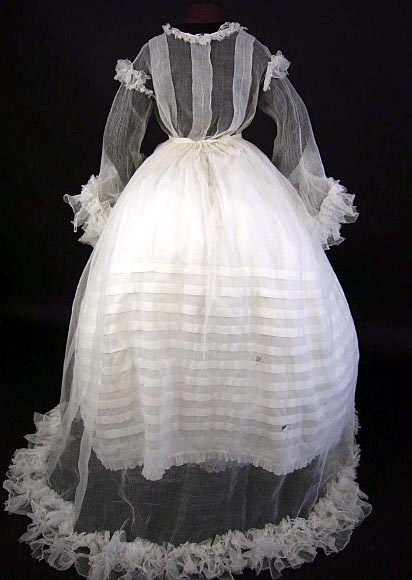
Semi-sheer print dress c. 1865

And now, the final installment of the '65 dress adventure (which included two research posts and was aided by original images from members of the SA).

Reproduction 1865 semi-sheer en tablier dress.
Please excuse the wrinkles; the dress was worn three days in a row and then traveled halfway across the country.
Elements specific to 1865 include:
  • Coat sleeves (open, shirred)
  • Gored skirt, longer and fuller towards the back
  • En Tablier decoration on upper skirt
  • Waistband, slightly elevated
1865 Semi-sheer dress, front view.
Front
Neck ruffle on semi-sheer dress.
Shoulder and neck ruffle
Open shirred coat sleeve.
Sleeve
Upper skirt piece.
En tablier upper
Gored en tablier skirt.
Skirt, side view
The narrow, self-fabric ruffle along the "collar" is seen on some sheer dresses. The bodice and sleeve are self-draped (shirred sleeve design from The Dressmaker's Guide). Gore layout and pocket based on an 1866-1867 dress in Janet Arnold's Patterns of Fashion II; the gore-cutting method is from an 1875 diagram reprinted in the same book--originally from How to Dress Well on 1- a Day, if I recall correctly).  The en tablier piece is my own design, attempting to copy the originals linked previously, particularly this one.

And here's the dress as worn, complete with undersleeves, silk belt, mourning badges, and shawl:
Semi-sheer 1865 dress, worn.
Outside Union Station, Springfield, Ill

Thursday, April 30, 2015

In Springfield

And frantically trying to finish my handsewing between museum visits. Pictures to come!

Monday, April 27, 2015

Pink Bonnet, Winter-Spring 1865

Partial continuation of the fanchon research and drafting posts:

Inspired by this bonnet from Peterson's (February 1865):
Satin "puffed" bonnet from Peterson's Magazine, February 1865.
"Blue Satin Bonnet, Puffed Lengthwise, trimmed with a large blue rose and black lace, with the puffings fastened with black beads."

Pink puffed 'transitional' fanchon, with green ribbons.

Buckram and wire 'fanchon'-shaped base. Covering of pale pink sheer silk, “puffed”, and extended to form an abbreviated soft crown. Self fabric ruffle along the back edge. Ties of green silk taffeta, with back bow of the same. Cluster of white flowers to trim (left side only). Interior lining of cotton crinoline, with cap of vintage lace along the brim interior, gathers concentrated at the top.

The lace edging on the back of the cheek tabs was omitted; with the back bow switched to silk (to better relate the bonnet ties to overall design), a lace edging lacked cohesion, while a matching silk trim in that location looked excessive.

Fanchon cap (interior lace)

Flower and ribbon trim.


Friday, April 24, 2015

Black Plaid Cotton Dress, early-mid 1860s

Partial follow-up from the 1865 dress research post and redux: Mom's dress.

Black plaid shirting dress.
Bias waistband/cuff and pleated skirt details.


I decided to opt for a relatively plain and conservative approach to this dress, various reasons of persona, fit, and the wearer's comfort.

Classic elements of the period:
  • Bishop sleeves
  • Pleated bodice with jewel neckline
  • Manipulating the plaid fabric for self-trim (waistband and cuffs)
  • Piped neck and armsythe
  • Skirts balanced at the waist; faced hem 
 Stylish elements for 1865:
  • Small "stand up" white collar and narrow white cuffs (to be added)
  • Waistband at the elevated 'fashionable waist'
  • Skirts set fuller at the back than at the front; worn over petticoats set fuller to the back than the front (with a small tournure, or "dress improver" to help simulate the elongated cage of '65)
The skirt is knife-pleated (admittedly unusual for a cotton in the early '60s) to emphasize the plaid and to mimic the fashion for pleats in gored skirts, which are apparently ubiquitous by '65.  Gauging is falling out of favor, but pleating a non-gored cotton skirt is still sort of iffy, as far as I can tell.  The good news is that I can easily re-set the skirt with gauging for future re-use.

The front closure uses hooks and eyes.  One side pocket, taken from the design for a '66-'67 dress in Janet Arnold's Patterns of Fashion II.  Bodice and sleeve custom-draped.

Wednesday, April 22, 2015

Fanchon Drafting, Part 1

Continuing from the research post, which got too long.

Bonnets in Der Bazar, May 1865.
Bonnets from "Der Bazar", May 1865
So, spring 1865 fanchons, to recap:
  • Have three corners, like a "half handkerchief"
  • Have cheek tabs
  • Sit close to the face at the sides and peak up at the top (but less than the spoon bonnets did)
  • Have a little trim and some lace under the brim (but less than before)
  • Have soft crowns (description, January, Peterson's)
  • OR appear to be cut in one piece (images showing brim-crown combo; February-April, Peterson's)
  • OR have no crown (May-summer, Peterson's)
  • Have little to no curtain (may have a short ruffle or some trim along the back edge)
  • Some bonnet ties continue either across the middle of the brim, or along the now-curtain-free back edge 
  • Are "easily made at home".  The editor of Peterson's thinks this means the fashion establishment will keep pushing the "empire" bonnet, but didn't think a pattern useful to include.
Some poking around eventually produced a diagram of a '68 fanchon (courtesy of Cornell University's Library) in Harper's Bazaar for May 9, 1868:
Harper's Bazar fanchon diagram, May 9, 1868.
Harper's Bazaar, page 436, 5/9/1868
(Just to annoy me, Google books finally turned up the same page; neither, however seems to contain the elusive "Fashion Supplement XIII", which promises a pattern)

Close-ups:
Fanchon wire diagram, Harper's 1868.
1868 Bonnet wire diagram, Harper's
Fanchon frame diagram, Harper's 1868.
1868 Fanchon frame diagram, Harper's
Der Bazar has some schematics a little closer to the target date (again, without the supplement which promises a cutting diagram):

Fanchon form, Der Bazar January 1865.
Der Bazar, January 1865
Fanchon form, Der Bazar April 1865.
Der Bazar, April 1865
The '68 images are crown-free, but it's still there in the '65 images, however abbreviated.

For the actual drafting, I started by cutting a triangular piece (like a handkerchief folded in half) out of newsprint, and fiddling with the length and depth until it sat properly.  I then drew in the cheek tabs, and tweaked those until a satisfactory arrangement was attained.  This suits for the crown-less "May" fanchons.  For the earlier winter-spring styles, I added a small semi-circular half-crown as in the January image from Der Bazar.  Small darts on the lower edge help to shape this piece.

c. 1865 Fanchon pattern with cheek tabs (self-draped)
The actual bonnet forms are cut of buckram, with millinery wire around the edges to help shape them (cotton crinoline bias tape covers the wires).
Crownless fanchon form.
Fanchon form (no crown)
Partial crown fanchon form.
Fanchon form, partial crown
In comparison to the Der Bazar image, the partial crown should be deeper and a little less abrupt at the transition, but I haven't been about to make that shape work in paper.  Hopefully, the silk and trim will cover these minor sins.