Tuesday, September 19, 2023

14th/15th Century Rosaries

Mostly, I made these because I wanted to do something with the wounds of Christ gauds that Billy & Charlie make. Nevermind that my main early modern impression is Elizabethan, a time and place in which owning rosaries was illegal and had been for two decades.

Anyway.

Related to that above factoid, I have so far found exactly three intact medieval or early modern rosaries in my usual British museum collections. The Museum of London has a very simple version, made as a small loop of wooden beads. This is by far the closest to the usual pictorial depictions (a very small string or loop of beads, usually held in a figure's hand). At the opposite end of the spectrum, the Victoria & Albert has a very elaborate gold rosary from the 16th century. And also this one:
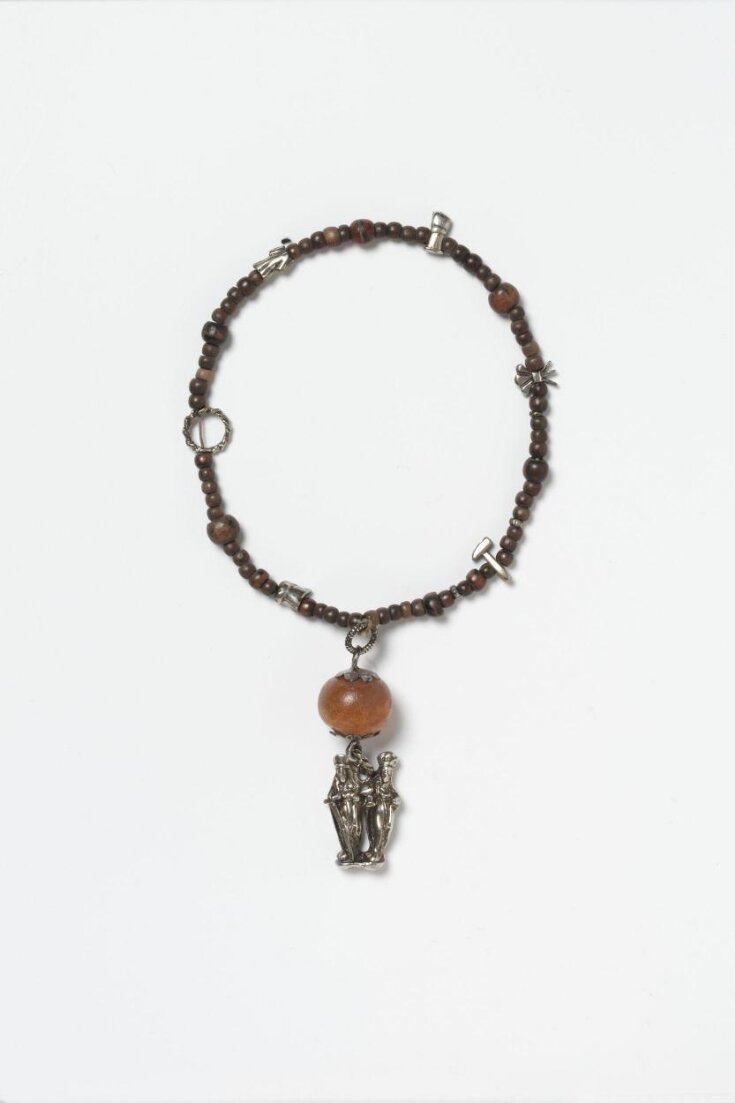
Rosary/paternoster. German, 1475-1500. VAM

According to the museum's notes, this rosary has wooden beads, one large amber bead, and a set of silver gauds representing Christ's sufferings (nails, crown of thorns, etc). The pendant depicts Saints Barbara and Catherine.

Although the country of origin is given as Germany, I decided that this example would be a thematically suitable choice for using the gauds I had in mind (though they are only five in number, and are different shapes: hands, feet, and heart). So, for my first attempt, I tried to copy the original as closely as I could, using two sizes of dark brown wood beads, one larger amber-colored glass bead (the amber itself not being available), and a reproduction 15th century pewter badge of St. Barbara.

For the second--since I accidentally purchased two sets of the gauds--I decided to try a more goth version of the same design. When I was looking for examples of extant rosaries, I came across a number of individual beads, some plain amber or bone, others much more elaborate, including several which incorporate momento mori imagery such as skulls or even multifaceted deaths heads. The Met has a lovely example of momento mori beads in an extant paternoster. My version follows the same form as the first, using small bone beads with a skull-shaped bead half-way between each gaud; the pendant is an image of the crucifixion (based on 14th/15th century examples), with a large carved coral bead.

My replicas. Design from the 15th century VAM paternoster.
Components c. 14th-15th centuries.

For the stringing material, I plaited two linen cords, based on examples of fingerloop braid in Medieval Textiles. The book includes a few fragments identified as possible beading string, some narrow tablet-woven, others finger-looped (including a fragment with beads still on it, which is none other than the amber ones linked above). I couldn't get the woven version consistently round without the weft breaking on me, so I went with the fingerloop braids: one the usual 5-loop round I like for everything, but out of fine linen thread, the other a 3-loop variant of my own devising.

Silk beading cord, 3-loop linen braid, 5-loop braid.


Of course, when I went to string the beads, I found that neither braid was long enough for the wooden beads. Rather than making a 4th attempt, I simply strung those on my go-to size ff beading silk. The extra braid went into my stash of odd bits, and has already found a new use on my ear-scoop (which is really handy for cleaning one's nails of Faire dust).

All told, I like how both of these turned out. I wish I had had five more of the small wooden beads, as I ran out and ended up using a few large ones out of place. Proportionately, I think the bone version looks closer to the original, though the bone beads are almost too small to count by feel. If I was making a another one of these, I'd probably aim for the beads being a size larger than those small bone ones, with the mid-point beads closer to the size of the small wooden beads. Using smaller beads would also make the "amber" piece look larger by comparison, and thus closer to the original.


Sunday, September 17, 2023

HFF 6.15: Travelling Food


Detail from an 1850s painting with a woman's hands gesturing over a table of food.

The Challenge: Traveling Food. Make a food associated with travel, or something convenient to eat on the go.

The Recipe: Stuffed Eggs (a picnic dish) from Six Little Cooks

The Date/Year and Region: 1891,Chicago
 
How Did You Make It: As directed. I boiled 3 eggs for 15 minutes (well, 4, but one broke). The eggs went into some cold water, so that the shells would come off easily. After peeling the three eggs, I cut them each in half, removed the yolks, and beat the yolks with a spoon. To this mashed yolks, I added 1/8 tsp ground mustard, 1/8 tsp black pepper, and 1/4 tsp salt. [This was a mistake: too much salt.] I then packed the yolk-mixture back into the whites. I cut 6"x6" squares of tissue paper, and fringed two opposite edges on each, then wrapped the paper around the eggs, like a candy or a Christmas cracker.
 
Time to Complete: Ten minutes prep; under a half hour including cooking time.
 
Total Cost: Based on the price of eggs.
 
How Successful Was It?: Tasty and easy, except for the salt. The recipe gives a proportion for the flavoring (equal amounts mustard and black pepper, twice as much salt) but not how many eggs this covers. I just grabbed my smallest teaspoon measure (1/8 tsp), without reflecting that 1/4 tsp salt for three eggs would be excessive. Next time (there will be a next time!), I probably half the salt. Though I'd be tempted to make a 1:1:1 proportion of mustard and pepper, since those were not overpowering (the mustard was barely noticeable at all).

The paper worked best used in a double layer (looks nicer and came off easier), where a single layer started sticking to the egg while not holding the halves together nicely. I'd be tempted to try parchment paper next time (especially if anyone other than me is potentially eating them).
 
How Accurate Is It? As noted, the proportion of salt/pepper/mustard to egg was not given, and thus a guess. I also was speculating on whether the eggs should be cut along the short or long axis, though something about the wording made me think the short axis was meant (even if the story/recipe treats eggs as spherical). 

Stuffed eggs.


Saturday, September 16, 2023

Supper Dishes for a Large Company (1850)

Looking ahead to Candlelight, I decided to consult Miss Leslie's Lady's New Receipt Book (1850) for some inspiration. After laying out menus for plain family meals, very nice family meals, company meals, and large dinner parties for each of the four seasons, it gives the following list of dishes suited to standing suppers (functionally a buffet). This is precisely what our event logistics require.

SUPPER DISHES FOR A LARGE COMPANY 

  • boned turkey with jelly 
  • partridge pie 
  • game dressed in various ways 
  • cold ham glazed thickly all over with a mixture of bread crumbs cream and yolk of egg 
  • two smoked tongues one placed whole in the centre of the dish the other cut into circular slices and laid round it 
  • cold alamode beef 
  • French chicken salad 
  • Italian chicken salad 
  • marbled veal 
  • potted lobster 
  • pickled lobster 
  • terrapins 
  • cream oysters 
  • fried oysters 
  • pickled oysters 
  • oyster patties 
  • biscuit sandwiches 
  • charlotte polonaise 
  • charlotte russe 
  • French charlotte 
  • calves feet jelly 
  • trifle 
  • Spanish blanc mange 
  • chocolate blanc mange 
  • coffee blanc mange 
  • maccaroon blanc mange 
  • vanilla blanc mange 
  • pistachio cream 
  • cocoa nut cream 
  • chocolate cream 
  • vanilla cream 
  • lemon custards 
  • orange custards 
  • green custard 
  • red custard 
  • meringued apples 
  • whipt cream 
  • meringues 
  • iced grapes 
  • orange water ice 
  • damson water ice 
  • vanilla ice cream 
  • lemon ice cream 
  • almond ice cream 
  • chocolate ice cream 
  • biscuit ice cream 
  • maccaroon ice cream 
  • preserved pine apple 
  • preserved citron melon 
  • preserved limes 
  • preserved oranges
  • brandy peaches 
  • brandy greengages 
  • port wine jelly 
  • pink champagne jelly 
  • frozen punch &c 
  • plum cake 
  • lady cake 
  • almond sponge cake 
  • frothed chocolate with dry toast

From these may be selected supper dishes for a small assemblage, or for a company of moderate size. 

Based on the usual cast size, I'd rank the Tolmey's party as a "small assemblage." While Miss Leslie does not specify how many dishes to use for each size of group, my old standby extrapolated from other bills of fare is 1/2 dish per course per person; including dessert this tends to work out to 1.5-2x as many dishes as guests.

Monday, September 11, 2023

HFF 6.14: Waste Not, Want Not

Detail from an 1850s painting with a woman's hands gesturing over a table of food.

The Challenge: Waste Not, Want Not. Try a dish that reduces waste somehow, such as re-purposing leftovers or using parts of a plant/animal that you wouldn't normally cook.

The Recipe: Rapes in Potage from the Forme of Curry

Take rapus and make hem clene and waissh hem clene. quare hem [2]. parboile hem. take hem up. cast hem in a gode broth and seeþ hem. mynce Oynouns and cast þerto Safroun and salt and messe it forth with powdour douce. the wise [3] make of Pasturnakes [4] and skyrwates. [5]

[1] Rapes, or rapus. Turneps. [2] quare hem. Cut them in squares, or small pieces. V. Gloss. [3] in the wise, i.e. in the same manner. Self or same, seems to be casually omitted. Vide No. 11 and 122. [4] Pasturnakes, for parsnips or carrots. V. Gloss. [5] skyrwates, for skirrits or skirwicks."

Of the "powdour douce", the editor remarks: "In short, I take powder-douce to be either powder of galyngal....or a compound made of sundry aromatic spices ground or beaten small, and kept always ready at hand in some proper receptacle." 

I'm counting this recipe because it involved making a stock out of the vegetable peelings, which felt very efficient.

The Date/Year and Region: c.1390, England
 
How Did You Make It: On a rather large scale. With no set proportions, I ended up searching through multiple modern soup and stew recipes to get an idea of how many vegetables I needed per serving, and opted to try 1/2 parsnip, 1/2 turnip, 1/2 onion, 1 carrot and 1/2 cup stock per person, and then rounding up the total number of people I would be cooking for (20-25 to 30), so make sure there was plenty for everyone. I then ran out of space in my cooking vessels, and so dropped from 1 carrot to 1/2..
 
I started by peeling and slicing the onions, and putting these in a saucepan to brown with a dash of olive oil. I then set about peeling and chopping the parsnips, turnips, and carrots into 1/2" sort-of-cubes. While I worked, I parboiled the turnips, parsnips, and carrots that were already prepared, and threw the peels and odd ends of the vegetables into a stockpot with water, a head of garlic, 5 green onions, 8 marigold flowers, a generous handful of dried rosemary, and nearly a half-gallon (dry) of fresh herbs: mostly parsley, and thyme, with a bit of sage, chives, marjoram, and oregano. The flowers were used in lieu of saffron for color, based on other recipes from this period which use marigold.
 
Once the vegetables were all parboiled, I strained the stock, added the onions, turnips, parsnips, and carrots, and set the pottage to all cook together in my two largest stockpots. I then set about preparing the powder douce, using 1 Tbsp each of ginger, cinnamon, cloves, black pepper, sugar, long pepper, galyngal, nutmeg, and grains of paradise.*  Since I needed to serve this at an event, I then got to cool and refrigerate the mostly-cooked pottage, transport it to the event, and bring it back up to boiling on a fire (campstove) before serving. I made the spice mixture available for each diner to add as much as they desired (generally somewhere between a half and a whole spoonful per bowl).
 
*The book names cinnamon, mace, cloves, galyngal, pepper, long-pepper, ginger, cubebs (?), grains of paradise, nutmeg, and caraway in difference receipts. Last time I made a recipe calling for powder douce, I noted that Wikipedia gives "grains of paradise, ginger, cinnamon, nutmeg, sugar, and galangal" and "ginger, cinnamon, cloves and sugar [+/-galangal and long pepper]" as other options for the powder douce. I liked how the equal proportions of spices worked in my previous use of this seasoning, so I repeated it here.
 
Time to Complete: A long time. At least 4 hours of peeling root vegetables, while the stock boiled and the vegetables parboiled, another half-hour of cooking the pottage all together, and then about a half-hour to re-heat to boiling before serving.
 
Total Cost: $32 for 30-odd servings (which fed some two dozen people with leftovers).
 
How Successful Was It?: No one died, and everyone who commented said they enjoyed it .So, either it was successful, or this was a very polite reenacting crew. Given the option, 100% percent of diners chose to include the spices. The most common remark was comparing it to different east Asian sweet-and-sour dishes. I noticed that the parboiling step removed some of the bite I associate with parsnips and turnips, leaving a mellow but recognizable flavor. The spices suited it quite well--a little odd to me, but perfectly palatable. I recommend serving it with bread.
 
How Accurate Is It? The main departure I made was combining the rapus and pasturnakes (turnips, parsnips, and carrots) rather than making a pottage of only one of them. Following Quin's advice for getting stronger flavor, I added the step of browning the onion in olive oil, which is neither called for nor prohibited in the text. I also used a home-made vegetable stock instead of a "good broth" (which I'm reading as implying bones) in order to make the whole recipe both vegan and gluten-free, which was needed for the particular group. 
 
On the positive side, I think my decision to add the spices at the end fits with the instruction  to "messe it forth with powdour douce", ie, that the spices are to be added when it is served. As far as the year goes, I made this late 14th century recipe for a 16th century event, BUT, it was served to people portraying Queen Elizabeth I's court, and the antiquarian's note claims that this recipe book was once owned by the queen. Which I thought was nice. Also, all of the ingredients are in season--I have turnips, parsnips, onions, and carrots to be harvest from the garden, just not in the quantities needed, while the other herbs did come directly out of the garden.

Side note: I manged to forget to take pictures of the finished product, but here's the in-progress pictures.

Ingredients assembled.

Stock in progress, as every bowl in my kitchen slowly fills with parboiled vegetables.

Sunday, September 10, 2023

HFF 6.13: In a Pickle

Detail from an 1850s painting with a woman's hands gesturing over a table of food.

The Challenge: In a Pickle. Try your hand at preserving food--pickles, jellies, jams, or any method you choose. Alternatively, make a dish that uses preserves as an ingredient.

The Recipe: Pickled Cucumbers from The Domestic Cookery (supplemented by modern canning methods from The Joy of Cooking):

Pickle Cucumbers a Second Way. Gather your cucumbers on a dry day, and put them into a narrow topped pitcher, put to them a head garlic, a few white mustard seeds, and a few blades of mace, half an ounce of black pepper, the same long pepper and ginger, and a good handful of salt into your vinegar; pour it upon your cucumbers boiling hot, set them by the fire, and keep them warm for three days, and boil your alegar once every day; keep them close covered till they are a good green, and then tie them down with a leather, and keep them for use.

The Date/Year and Region: 1847, London
 
How Did You Make It: With some adaptations. For safety reasons, I mostly used this recipe for the flavor profile, with modern canning methods and times. After sanitizing the jars, etc., I washed and dried the cucumbers and cut off the ends of each (and halved the ones that were a little too big to fit in the jars; then heated up the vinegar and salt; packed each jar with as many cucumbers as would fit, as well as a clove of garlic, a few black peppercorns, a long peppercorn, about a dozen mustard seeds, a small pieces of peeled ginger, and a sprinkle of powdered mace (having no source for whole blades); poured the hot vinegar into the heated and packed jars; and processed the jars in a boiling water bath for 15 minutes.
 
Time to Complete: About an hour, not including all the sanitizing steps. A lot of this also involved waiting for more water to boil, so it would have been more efficient to have more jars going at the same time.
 
Total Cost: About $5 for the pickling cucumbers.
 
How Successful Was It?: Haven't tried them yet. All but one of the jars appear to have sealed properly, so I'm counting at a 4/5 successful rate so far.
 
How Accurate Is It? As mentioned above, I used modern jars, hot-packing methods, and processing times instead of letting the pickles heat for three days in a pitcher. However, I decided on the hot-pack because that seemed the closest to the method referenced in the period instructions. The recipe itself does not specify the strength of the salted vinegar, which I again filled in with a modern value: 5% white pickling vinegar, with a tablespoon of pickling salt per pint for flavor. Also, the receipt's vagueness of how many cucumbers fit into "a narrow-topped pitcher" means that the ratio of cucumbers to garlic, mustard, pepper, etc., cannot be as precise as it ought. I therefore made my best guess based on the jar sizes available to me, though I wouldn't be surprised if the spices are meant to be even more concentrated.

Yep. Pickles.


Saturday, September 9, 2023

Straw Crowns

I couldn't make it to Harvest Home this year, but did finish the new crowns for the harvest king and queen.

The pictures were a bit rushed, I'm afraid.

This time, I plaited both crowns in whole-straw (7-strand Dunstable to be precise) rather than split for a more substantial crown, and worked the decorative elements directly into the plait itself. I also tweaked the fit, and sewed the bands into the crown shape, with the ends plaited in, rather than trying to knot the ends. The effect is a stronger and more substantial than my first attempts, though still light.

The crown on the left has spreuer leaves, and a quilled rosette at the center front, covering a sewn join in the band. The crown on the right has spreuer wheat sheaves in both positions. 

While I haven't found any original straw crowns or depictions of harvest kings/queens, the materials are all appropriate to the mid-19th century, being wheat straw and a bit of cotton thread. The decorative motifs are from Swiss Straw Work: Techniques of a Fashion Industry by Veronica Main, and do show up in period hat-ornaments, though the manner they are used here if my own invention.

Friday, September 1, 2023

Original: Black Lace Bonnet Veil, c.1850-75

Bonnet veil, c.1850-1875. LACMA.
 

This bonnet veil is true silk lace and a lovely example of the fine accessories available in the third quarter of the 19th century. The "spots" over the face are a popular element c.1860, while the border is more heavily decorated with floral designs and intricately scalloped edges. The changing bonnet shapes of the era makes me suspect this half-oval-shaped veil is from closer to the middle of the century (1850-1865) rather than the last ten years of its range (1865-1875).