Tuesday, December 22, 2020

Mid-19th Century Chemisettes In Written Sources

"...we must advert to what the French call chiffons--the absolute accessories of the toilet, and without which no toilet can be complete; collars, cuffs, chemisettes, and, at present, sleeves, constitute the chief of these articles; they vary so much with fashion, that we cannot say much on any particular style to be adopted; they should in general consist of very finely worked muslin, cambric, or lace..."
--Godey's May 1860


A white chemisette with narrow band collar and embroidery on the front. The chemisette is made up the front and back of a shirt, joined together at the shoulder, but sleeveless and open to the side, the front and back pieces tapering toward the waist, where they are joined with narrow ties.
Embroidered chemisette with front-buttoning closure.
American, c.1830. In the LACMA collection.


Back when I started quantifying chemisette styles and decoration in surviving garments, I also started compiling a separate document of magazine descriptions and fashion plates for similar project. That quickly grew unwieldy, so I'm instead posting it here for examples of the breadth of styles available.


Garment Names

While I used the terms "chemisette" and "dickey" to locate artifacts for the garment statistics, contemporary terms for the sleeveless, usually side-less, meant-to-be-seen partial undershirt include "chemisette" and "habit shirt". A full shirt-like woman's garment is also occasionally called a chemisette (like here in Peterson's in 1862, though the other style also appears under that name). The more complete garment is also referred to as a body, waist, guimpe, or corsage--terms also applied to the bodice of a dress. 

The minimal "chemisette" exists to fill in the open front or neckline of an otherwise complete bodice: sides, sleeves, etc. are superfluous to that task. Often the chemisette does have a back, either to fill in the upper back of an open neckline, or else to help anchor the front piece. The full shirt "chemisette" appears more in the early 1860s, worn with jackets, silk/Swiss waists, corselets, and similar accessories. These accessories cover almost the exact opposite of what an open bodice would, leaving the white waist to fill in a combination of front, side, back, shoulder, and/or sleeve areas. I did find one magazine illustration which appears to have sleeves attached to a side-less chemisette. 

"Chemisette" in Godey's May 1858.
Side-less, sleeveless chemisettes appear in the same volume.


Habit Shirts

Florence Hartley's Ladies' Book of Etiquette (Boston, 1860) allows that riding habits may be cut low for wearing with a chemisette, or cut high for use without. An 1857 treatise on equestrianism allows for habits to have necklines with linen collars or low necklines filled in with habit shirts (ideally of embroidered cambric, with a thick collar). An 1846 article on riding clothing concurs: the habit shirt should be 'handsome', and have a collar. In fair and exhibit catalogs (including the Great Exhibition) habit shirts are listed along chemisettes.

The chemisette and habit shirt seem to be largely the same, though there is room for some differentiation. The best example that I've found is in the August 1856 issue of Peterson's, which has instructions for an embroidered muslin habit shirt that is also called a 'chemisette'. The instructions differentiate these based on how the garment's neck is finished: if made up as a chemisette, the neckline should be edged in valciennes lace, but as a habit shirt it should have a matching collar (with instructions for drawing a collar from the scalloped front design). It also gives instructions for altering the given front-fastening pattern to make a back-fastening version. Additionally, there is a suggestion that the pattern is good for  "Swiss work", ie, embroidery on muslin with net insertion filling the voids (French muslin and Brussels net being the best).

"Lady's Habit Shirt and Sleeves of Thin Muslin", Peterson's April 1856. 
Not a full shirt, but two sleeves with a sideless habit shirt.


Shapes

Of the sideless chemisettes, there's a number of possible shape variations. The chemisette is frequently worn high (near the base of the throat), though lower or open necklines are also possible. A surprising number of chemisettes are also fully open down the front, with no apparent fastening mechanism. Chemisettes with high necklines can have collars attached, or may end with a small frill or lace trimming. The garment can fasten down the front or the back, with some low-necked chemisettes not requiring any fasteners. There's also a rare and intriguing possibility of chemisettes with open sides and attached sleeves. Knit, crochet, and guipure chemisettes (to be discussed later) appear in flat V-shape, covering only the front of the body. I've also found this shape once in white cotton, for an embroidered jaconet habit shirt in Godey's (1856).

Two chemisettes of fine muslin, 1854. Anglo-American Magazine.
The one of the right is open down the front, that on the left has a collar.


Half-high chemisette of Brussels net,
for use with a low-necked dress.
Peterson's, June 1855


Decoration: Lace, Embroidery, Frills

The usual embellishments for white cotton accessories appear on chemisettes: embroidery, broderie anglaise, lace, insertion, pleats, and self-fabric puffs and ruffles. Tatted decorations are rare, but do appear. Bows, though far from universal, appear on multiple examples.


The New Monthly Belle Assemblee, July 1846
Muslin and embroidered cambric chemisettes.

This Great Exhibition catalog includes four references to embroidered muslin habit shirts or chemisettes, one of frilled jaconet muslin, and one decorated with tatting.

Sartain's Union Magazine (Jan-June 1851) describes chemisettes of tulle with lace; embroidered muslin; embroidered tulle; bands of lace insertion. It also mentions chemisettes and fichus worn with dresses that are open all the way to the waist.

The Anglo-American Magazine (August 1854) has a fashion plate featuring two chemisettes with matching undersleeves: one is of fine muslin with detailed embroidery, the other of fine muslin with Honiton point lace.

Mrs. Pullen's Treasures in Needlework (1855), includes instructions for making chemisettes decorated in "Irish guimpure" (cut-work embroidery), broiderie Anglaise, embroidered medallions (satin stitch with optional cut-work), and antique point lace (needlelace stitches joining braid).

Guimpure on net, muslin, and linen cambric chemisettes appear in Godey's 1856 fashion descriptions, with somewhat less detailed decoration than in other volumes. 
Arthur's Illustrated Home Magazine, 1858.
Chemisette
    Of fine India muslin. It is made close at the throat, enriched with various tucks down the front, and surmounted with a round collar, edged with a border of oak leaves in the finest possible needlework; inside of this border the collar is dotted with eyelets and a cluster of small pansies, with their foliage, form a second border within the edge. 
    The front trimming is peculiar and for a certain style of person singularly graceful; a length of muslin with a delicately embroidered edge, is placed in a serpentine ruffle from the waist to the throat growing narrower as it descends, but gathered with a fullness very rich and effective. Under every second fold of this trimming a bow of ribbon peeps out, giving brightness to the whole.


Plain tucked muslin (without embroidery) is popular for chemisettes and habit shirts in Godey's 1859 fashion descriptions. The London and Paris Ladies' Magazine of that year mentions chemisettes of muslin, with and without insertion.

Godey's volume 60 (Jan-Jun 1860) includes a girls' chemisette trimmed in ribbon or passementerie to match a dress, and a cambric chemisette as part of a dress for a 14-year-old. As previously noted, it also calls chemisettes and similar small white accessories "indispensable" components of the wardrobe, with "worked muslin, cambric or lace" as the main materials. It observes that open-necked chemisettes give a finished look to low-necked gowns, and advises on fashionable collar shapes and becoming trim placement. A neatly tucked 'habit shirt' appears on page 449.


Open chemisette with puffs and lace.
Arthur's Home Magazine, October 1860


Other Materials

While chemisettes sewn of fine white cotton predominate, but there scattered references to other materials. 

The What-Not (1861) mentions chemisettes of white, scarlet, and blue cashmere; though some of these are in Zouave ensembles, and thus likely to be full "shirt" garments, one of them is a chemisette and undersleeves, apparently separate.

In addition to the open chemisette mentioned above, Arthur's featured two chemisettes of Irish guimpure (lace) and a crocheted chemisette. All three have a triangular shape, reminiscent of an 18th century stomacher. I've found no mention of how these garments should be fastened, though the lacey guimpure likely need to be attached to a fabric chemisette or something similar.

Irish Guimpure Chemisette.
Arthur's Home Magazine, September 1860.


The aptly named The Knitted Lace Chemisette Stomacher Receipt Book (London, 1847) gives three designs in knit, by description more decorative than warm. Interestingly, another book describes a  warm sontag as being 'like a habit shirt' in shape. Miss Lambert's My Knitting Book (1847) includes a warm habit shirt of 3-ply fleecy, and observes that is can be worn over or under the dress. The Ladies Companion (1850) has instructions for a "knit under habit-shirt".

In the October 1860 issue, Arthur's Home Magazine has a triangular 'crocheted chemisette'. The shape is like the Irish guimpre chemisette they ran the previous month: a front piece only, widest at the shoulder and tapering towards the waist.

Monday, December 21, 2020

Muffs and Furs (1850s)

Someone was asking about fur muffs this time last year, so I started compiling a few references on the subject. I was rather intrigued by the 'rules' for which furs are appropriate to which garments and the varying fashions for different colors and kinds.

Muffs. Learning to Think (1856)


The Great Exhibition (1851) catalog has a list of different furs and their uses, which I found rather interesting in its categorization. 

In a similar vein, Learning to Think (1856) has a short question series (almost a catechism) covering muffs, tippets, etc., and the animals from which they are derived: genet, sable, otter, chincilla, and marten. 

Opera cloak of velvet trimmed with chinchilla.
Graham's Magazine, 1856.

Graham's Magazine says of the furs favored in 1856:
Furs do not enter into trimmings this season so much as was anticipated, but instead we have an imitation of Russian sable, which is used pretty extensively for trimming cloaks. We have nothing new in this department--the sable is still the fur par excellence; the shapes are in no wise different from last year, and we must confess they are pretty enough to be retained for another season. The large cap is pointed in the back, and full over the arm, thus preventing any ungraceful drag which might result from the absence of this very important little gusset. They are almost universally furnished with a small collar, which gives them a much more finished appearance. The small cape and its diminutive, the victorine, sweep round the shoulders and fall in long and square tabs in front, ending in three or four tails. The muffs are worn, we are pleased to say, as small as last year. The cuffs are of the same as last year, reaching almost to the elbow. There is another style of cape, circular shape, with arm holes, very convenient for holding a muff. The Russian sable, the scarcest and consequently the dearest fur we have, is, we understand, smuggled into this country, its exportation being prohibited by the Rus government. A small muff of this fur costs four hundred dollars and the entire set consisting of cape, cuffs, and muff is worth $1,400 or $1,500. Next in importance comes the Hudson Bay sable, its price ranging from $200 to $700 the set, its value increasing as its color darkens. Then we have mink, a beautiful fur almost rivalling the sable, and next, "fallen from its high estate", comes ermine, now only a fourth rate fur, of which in the good old times kings had the monopoly. Then again we have chinchilla, fitch squirrel, stone marten, minever; and if our ladies can't be suited, no matter how diverse their tastes may be, it must be the result of the bewildering variety they have to choose from.

A very important department in fur establishments is that devoted to children. There are some furs dedicated to their exclusive use, such as minever and chinchilla, and others which they use in common with their elders, as ermine and the mixed white and gray squirrel. They have entire sets, capes, cuffs, and muffs, and of all sizes suitable for children of every age, provided that the "juvenile world" must form a very considerable item in business calculations. The price for a set of minever is thirty dollars and for ermine from twenty five to forty.


Braided velvet muff with ermine trim.
Godey's, 1856.


There's a lengthy explanation of the winter 1857-1858 fashions for furs in Godey's:
There has never been a season when furs wore so universally worn. The reduction in price, consequent upon the late crisis, and the auction sales of the holidays, have done much to bring this about. A full suit of furs is a cape, or victorine, with cuffs, and muff. Many dispense with the muff, however, and some of those who have full capes with cuffs also. Half capes are most suitable for short figures, or for young girls. Victorines of mink and sable are usually manufactured of more choice and costly skins, so that the value is not greatly lessened. Cloaks of a circular shape, with "arm-holes," to use an inelegant but in this place completely expressive phrase, are in some instances adopted. They have a collar of the same, and are very warm and deep. Russian sables are of course still above the common purse; but some elegantly marked Hudson's Bay have been brought to market the present season. Mink is the next in favor and in price. Ermine is not so much a favorite as for a few winters past, as the prevailing tone of all street dress has been decidedly dark. Muffs are worn still very small, and ornamented with rich lining, cords, and tassels, or a simple bow of velvet, or other costly ribbon. Cuffs rather deep. Sable and mink are used to some extent in trimming velvet cloaks and coin de fero jackets; but plush has a very good effect in open cloaks and dressing- gowns. Ermine is the only fur suited for evening, and is still greatly used for full-dress wraps. Of the less costly and favorite furs, stone marten, Siberian squirrel, and fitch are in demand. Siberian squirrel is the most suitable for children and school-girls; though some excellent imitations of ermine are also seen in tippets, etc., intended for the juveniles.
--Godey's. February 1858 


Small muff of ermine.
Godey's, January 1858


The popularity of furs has apparently increased by the following year, with dark furs continuing to be favored:
Furs are at the height of favor, and were never more universally worn. Ermine bands are used for trimming opera-cloaks, or sorties du bal; dark fur, and sable, and mink for velvet cloaks, etc., intended for the street. A Victorine, or cape with lappets, or a round cloak, with cuffs and a small muff, are considered a full set. The Victorines are usually quite deep, coming half way to the waist behind—the cape to the waist and below it. The cloaks are as deep as ordinary talmas, and, with the capes, have a collar. The muffs are still quite small. Furs are lined usually with quilted silk, and ornamented by rich cords and tassels. Sable, Hudson's Bay, and mink are the favorites among the expensive furs—Siberian squirrel, and a mixture of the gray and white fur in stripes, are among the loss expensive ones.
--Godey's, January 1859


Furs. Godey's, December 1855. (Page 486)


***

For those interpreters unwilling to don furs, muffs also sometimes appear in other materials--these are mostly knit or crochet, or occasionally velvet. There are also knit and crochet patterns "in imitation" of certain fur garments. 

The Winchester Fancy Needle Instructor (1846) has two knit and one crochet muff, meant to resemble chinchilla, sable, or ermine.  

Gems of Knitting and Crochet (1847) gives instructions for a "ermine or chincilla" muff knit in brioche stitch.

A variegated knit muff is given in the Ladies' Work-table Book (1850).

In December 1857, Peterson's gives instructions for a knit muff lined with silk and stuffed with fine wool or horsehair.

The Ladies Complete Guide to Needlework (1859) features two knit muffs, one in imitation sable.

A crocheted child's muff appears in Peterson's in 1864.

A crocheted "ermine" pelerine and cuffs appear in The Lady's Friend (1865), along with a girl's knit muff and a child's muff knit in imitation chincilla. (Peterson's also published the last.)


Child's muff knit as imitation chinchilla.
Peterson's, April 1865.


Sunday, December 20, 2020

Shoe Roses

I cut these out last January to go with the red stripe evening gown, but they were still in my commute bag when the first lock-down began. (Ah, for the days of yore when one carried small hand-sewing projects to work on during bus rides).


Two double-layer rosettes made of bias-cut silk striped with red, mauve, and purple.
Shoe roses, just over 2" in diameter.


They're very simple, and went together laughably quickly once I managed to start: foundation of scrap buckram, covered in white muslin and then knife-pleated strips of bias-cut silk, with a smaller silk-covered buckram round to fill the center. Shoe clips from American Duchess are stitched to the back.

Saturday, December 19, 2020

HFF 4.26: Hindsight Is 2020

That challenge title hits a bit differently than it did this time last year. 

Detail from an 1850s painting with a woman's hands gesturing over a table of food.


The Challenge: Hindsight is 2020

The Recipe: Revisiting the Onion Sauce (A New System of Domestic Cookery) from challenge #12.

The Date/Year and Region: 1844/1805, Philadelphia/London

How Did You Make It: I chopped one onion fairly fine, and put it to boil in 1 cup of skim milk for about 10 minutes. I then strained the onion, and mashed it (with a potato masher). I brought it to boil again in 4 Tbsp of butter with a spoonful of the milk, and stirred in a little white wine vinegar when I took it off the stove. 

Time to Complete: ~30 minutes 

Total Cost: About $2

How Successful Was It?:  The texture's still a little chunky, but it's a pleasant onion flavor that is delicious on mashed potatoes. I'm tempted to try it through a food mill one of these days, though the potato masher was at least less frustrating to use (milk-logged onions just tend to squish instead of breaking down).
I did use a white onion, and the flavor was fine, but had forgotten how strong they can be to cut.  I default to sweet yellow onions (which are always the cheapest option in this area), and they don't have quite the eye-hurting power. I didn't notice a huge difference in taste either way, so I'm tempted to just use yellow onions for this recipe in the future.  

How Accurate Is It?: I don't think I've substantially improved the accuracy on this dish. The proportions seem to be working out, but the one thing I'd still like to nail down is how best to crush the onions. Clearly I need to buy a huge mortar and pestle...


A pink transferware bowl filled with a slightly chunky white onion sauce.
Onion sauce, take II.


Friday, December 18, 2020

Sweets Bag, 15th/16th/17th century

Sweet bag, after a fashion. It's more a sampler for techniques than a proper sweet bag: the few surviving examples of which I can find tend to be much more fully embroidered, and ornamented with tassels and cords.

The bag is white linen, embroidered with red silk after the style of this smock. I started it a few years back as practice for the embroidered coif project, but never finished making it up. The squirrel is copied from the above smock, the other motifs (rose, bee, bleeding pelican, oak leaves, mutant-raspberry thing) are all out of A Schole-House for the Needle. The rose side is work in two strands (starting split stitch, switching to back); the squirrel side in single-strand backstitch.


Squirrel, acorn, and raspberry(?).

The string is "An Endented Braid" (5-loop round braid in bichromatic chevrons) from Tak V Bowes Departed, looped in blue and gold size FF silk.


Rose, bee, and a pelican stabbing itself.

I don't actually like how the ultra-narrow casing works, and wish the motifs were all a bit lower down. I'm already tempted to take out the casing for some added height and re-thread the the strings through the material itself to see if the closure works better. And because that appears to be the more customary method. Maybe add some extra tassels... 


Tuesday, December 15, 2020

HFF 4.25: Yuletide Headstart

Detail from an 1850s painting with a woman's hands gesturing over a table of food.


The Challenge: Yuletide Headstart--Make a seasonal dish for the holiday of your choice, or a food that needs to be prepared in advance of serving. 


The Date/Year and Region: 1655, England

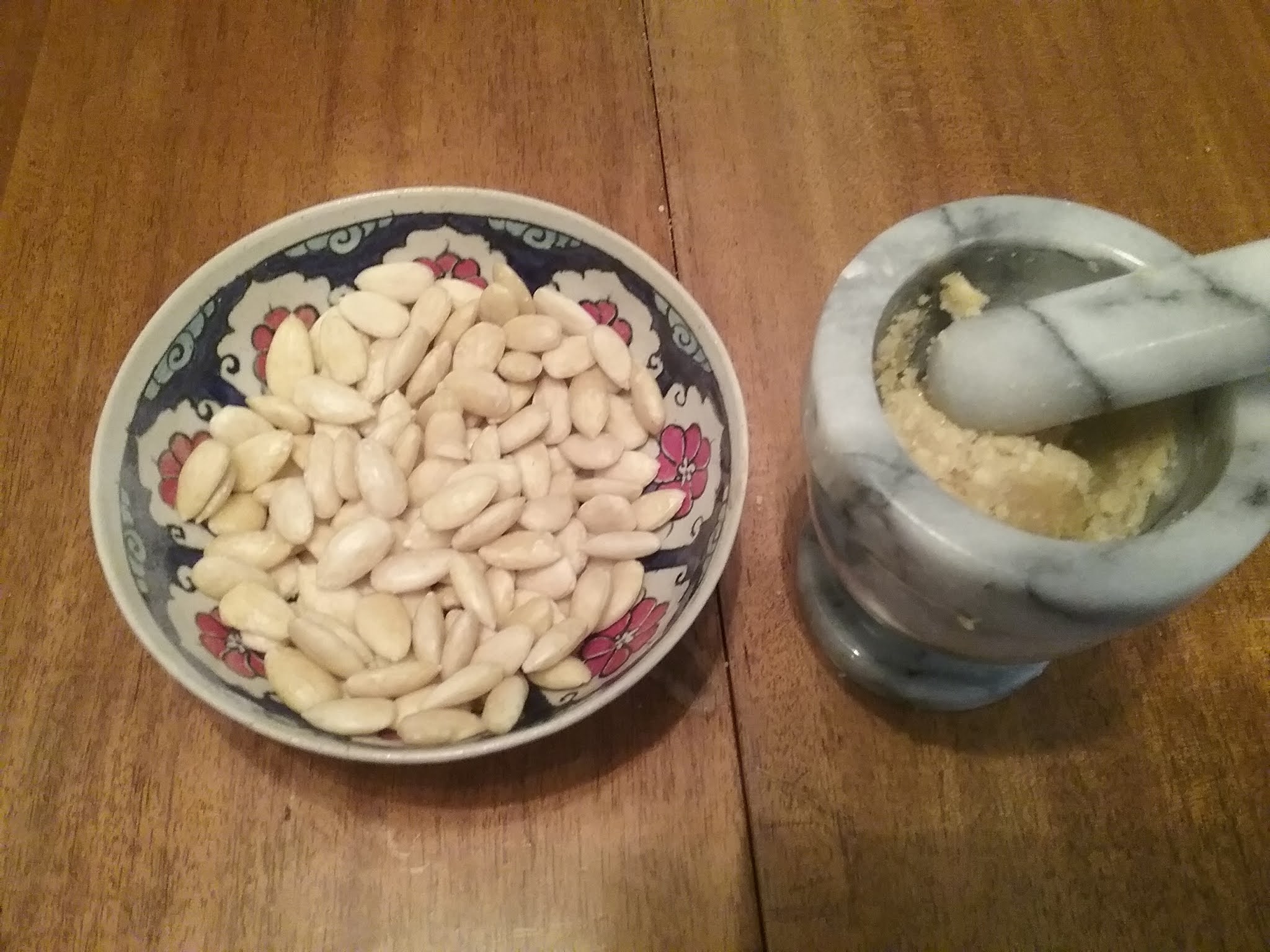
How Did You Make It:  I went for 3/4 scale. I blanched 6 oz of almonds (brought to boil on the stove, then put into cold water). The outer shells worked off easily. Once dry, I crushed the almonds in a mortar, making a paste. I added a few splashes of rosewater as I went along (about 1-2 Tbsp), working the almonds into a paste. This was really slow, so I did try duplicating the effort with a blender (and added 6 oz of pre-blanched, pre-sliced almonds to make 12 oz total). To the rosewater-almond paste, I added 6 oz of pounded granulated sugar of sugar. I tried coloring some of it with a little saffron in rosewater (that being the only coloring-compound in the book I had on hand), but found it made little difference to the already-yellow-hued almond paste. I finally used modern food coloring before shaping the paste, and putting it into a cooling oven overnight (turned off the oven after baking cookies and put the almond paste in).

Time to Complete: About an hour of beating almonds, ~15 minutes to blanch and peel them.

Total Cost: Don't recall.

How Successful Was It?: Not really. The almonds made a paste. The taste isn't bad. But neither the mortar nor the blender really got the last few chunks of almond worked in, and I eventually gave up on the 'fine paste' because I just couldn't get it to incorporate smoothly. The freshly-blanched almonds were much easier to work with than the fully-dried-out pre-blanched ones.

The sweetness is good, and the rosewater is mostly an aftertaste (though very prominent). I think this isn't worth the effort when I can just buy a perfectly smooth box of almond paste for about the same price as the almonds. However, it was interesting to try, and more theoretically straight-forward than expected. I probably won't make this again, but the temptation to try with the food-mill (or a larger mortar and pestle...) exists.

How Accurate Is It?: I did cheat with the mixer and modern food coloring. I think my next step to improved accuracy would be to try some of the historic coloring techniques (though probably not the gilding).


It begins: whole almonds, blanched/slivered almonds,
rose water, and a marble mortar & pestle.

Freshly blanched almonds being worked into a paste.

The world's most awkward almond paste holly.

Monday, December 7, 2020

Fastening Braids, 19th Century

In the 19th century, the most commonly method for tying the ends of braids is to wrap the hair several ties in a string/thread or ribbon and tie it off. If you want to go earlier, there's a really neat iron age wire cone hypothesized to secure plait ends, sewing plaits together in Imperial Roman styles, and the similar hair lacing of the medieval and early modern periods. 

Ribbon Versus Thread

At some point between the 16th and 18th century, functional hairpins supplant the sewing/lacing method of securing updos. But thread/laces/ribbon continues to be used to tied bunches of hair together, particularly at the end of a plait/braid.  William Moore's The Art of Hairdressing (1750) refers frequently to strings--not just on braids, but also on toupees and curls. This isn't conclusive that the braids are fastened off with string (the context tends towards pinning or securing the various pieces rather than making the braids) but it is suggestive. A 1770 poem on The Art of Dressing the Hair names "braided Locks with pleated Ribbon tied". The New London Toilette (1778) describes fastening plaits with packthread--at least for tying in false hair or preparing for horseback riding.

Moving into my usual 19th century range, there are actually very few specific references to how braids are fastened. Most of the hair-styling instructions show braids without describing how they should be tied. The few that mention fastening off a braid offer little more detail about how. An 1855 Godey's article on "How to Treat the Hair" recommends that girls' hair be tied with ribbon:
"We may here mention that it is a great mistake to plait the hair of children under eleven or twelve years of age. The process of plaiting more or less strains the hairs in their roots, by pulling them tight, tends to deprive them of their requisite supply of nutriment, and checks their growth. The hair of girls should only be nipped, and allowed to curl freely. When they are about eleven or twelve, the hair should be twisted into a coil, not too tight, nor tied at the end with thin thread, but with a piece of ribbon." 

[Incidentally, that paragraph was reprinted in 1859, independent of the rest of the article.] I can see two different readings of this passage. The first is that girls' hair needs to be tied with ribbons instead of thread to allow for future growth, and that by implication thread is fine/normal for tying off women's braids that will be pinned up. The second reading is that only ribbon should ever be used to tied off braids and girls are specified because women's updos don't require the braids to be tied off. I'm inclined towards the first reading, given the context of hair-cutting for girls and promoting long-term growth. However, working experimentally, I've found that it's quite possible to just braid a section of hair all the way down, and tuck the ends in when pinning it up. A bit of pomade or hair oil will help the ends stay neat. It's trickier when the hair has recently been cut, and has an abrupt edge rather than tapering down to nothing, but all of the 3+ strand braids I've tried will hold up this way in 1850s-1860s styles.

A young lady's braided updo in Elegant Arts for Ladies (1856) calls for ribbon to be wrapped around the plaits, as well as tying off the ends and flowing behind as streamers. Black velvet ribbon is used similarly in a fashionable coiffure from 1854, though the ribbon is not specified to be tying off the braids as well. Looking to literature, in Les Miserables (1862), the 15-year-old urchin Éponine ties her hair with a string or cord ("pour coiffure une ficelle" 3.8.4).

Later in the century, the fashion magazines give a little more information about tying off braids. In Harper's (1871) hairdressing instructions, the girls' styles all call for ribbons to tie the hair, though the women's styles mostly say to "fasten" without specifying. In one case, however, narrow ribbon is ordered (with a decorative bow applied on top), and in another string is used, at least temporarily (the hair is then fastened with pins).

The Homekeeper (Boston, 1872), among other interesting assertations, warns that "fastening the hair by a string near the roots injures the head by the strain on it, and causes baldness." This suggests that some people probably did tie their hair with thread, apparently to bind sections near the scalp (my guess would be for waterfalls). Campbell's Self Instructor (1867) describes making hairpieces and gives instructions for popular styles, but never specifies how to fasten and clasp the ends of braids, etc. Both ribbon and string are used in the making of the supplemental hairpieces, though.

Girls' ribbons continue to get more blatant attention than women's braids. Styles in Donahue's Magazine, in 1879  show girls' hair tied with ribbon. In February of 1886, Demorest's Monthly discusses general hair-dressing trends, noting that little girls' hair is usually braided and tied with ribbon (worn down or looped up). 


Elastic and Rubber Bands

The earliest reference I can find to an elastic hair fastener is in the 1853 Goodyear catalog. It has two intriguing descriptions:
HAIR CLASP This is an ingenious little article made of gum elastic, with a clasp of polished steel or other metal, and used by ladies as a hair tie. There is also a tape made of gum elastic which is used for the same purpose.... 
HAIR LOOP This consists of an elastic ring or tie looped upon an artificial ivory button It is found useful for fastening ladies hair. 
Unfortunately, these items are not evident in any of the plates included in the catalog. The first could be a basic round hair-tie with metal joining the edges. I've not found any other references to "rubber" or "elastic" hair clasps or loops this early, only to smooth rubber hair pins and crimping devices. [Loops of elastic are apparently favored to metal pins for setting curls overnight.]
 
While rubber bands made of vulcanized elastic date to c.1845, the earliest I can find that technology applied to hair is an 1882 patent. This hair-fastener (a piece of elastic with a metal catch), describes the old method for fastening the hair as ' winding a string several times about the hair and then tying in a knot', and claims that 'fastening the hair with a string is found by most ladies to be a very uncomfortable operation.' It makes no allusion to the vulcanized rubber bands being applied to the hair, nor to the Goodyear clasps/loops.

1882 elastic hair fastener patent

 
A series of designs with straight pieces of elastic closed with metal clasps followed this--a hook and ring style was patented were patented in 1897 in Great Britain, and 1898 in the US. A similar design again appeared in the UK in 1900.

Patent drawing from 1898 showing an elastic hair-holder with hook and loop closure.


A similar arrangement (now adjustable) with elastic joining a halves of a metal clasp and/or ring was patented in 1921-22:
Adjustable hair clasp with elastic-joined metal fittings.
US Patent 1424654A, 1921.

The use of elastic was not universal in hair clasps at this time. Metal devices for fastening braids were proposed using 'spiral wire' (1901), pivoting clamps (1902), and a clamp with a wire loop (1903). A 1909 patent describes a rubber, celluloid or metal ring with teeth, used to hold the hair in a "pony-tail" shape as a foundation for styling.
 
1903 Hair fastener with clamp.


Anton Nagelschmidt filed a patent for 'hair ties' (1901) and a 'magic circle' (1902) hair fastener, though I can't find an image or description of either. They caught my eye for possibly referring to elastic hair bands of modern use, but might just as easily be a metal or hybrid metal/elastic like so many other hair-fastening patents of the time. A 1924 French patent for a "hair tie elastic", likewise with no further information, sounds rather like the modern elastic hair tie; an even more obscure "fastening device" from 1921 does not reference shape or material, though it's function is to tie off plaits or braids. These 1953 patents for a ponytail hair holders and 1955 improved hair tie have intriguing names, but no descriptions or diagrams are available.

It's worth noting, however, that neither "elastic" nor "tie" necessarily means a modern thread-covered elastic loop. From the same time period, there's a 1921 British patent for a "hair clasp" includes an elastic section with a pin and buckle, while an American "hair tie" patent from 1923-4 describes a wire device:

1923-1924 wire "hair tie" patent.

The elastic loop could be too simple to warrant patenting, though the metal closure (or not) and techniques for covering the rubber with thread would seem fertile ground for refinement. The first such patent I found was an 1967 one for a double loop-with-beads fastener, which refers to rubber bands succeeding ribbons as the common way to tie off hair. It appears to describe the prevailing device as a closed loop of elastic with a probably-metal clasp joining the ends ('sharp-corners' being a problem with them)*. A similar two-loop-with-beads design patented in 1972 looks identical to the hairties that were the bane of my childhood.

The most clear mention of rubber bands I've found comes from this 1942 hair braid fastener. It itself is a decorative two piece clasp joined by 'elastic cord or rubber band', though I didn't find clarification on whether the rubber is to be covered with thread/fabric to protect the hair. Referring to the use of rubber bands and development of hair-specific bands, it says:
One type of retainer, replacing the ribbon type has been a common rubber band which has been utilized by stretching it and wrapping it over upon itself several times around a point on the hair body. The rubber band type holder has been found to be generally satisfactory insofar as retaining the desired hair arrangement is concerned, however, two disadvantageous features have somewhat limited its usage...

Various easily dissociable hair holders have been proposed to alleviate some of the dis-advantages of ordinary contractile bands as noted above, but in general they have had too high a unit cost to be widely usable and have necessarily included sharp-cornered contractile band end retaining means into which subjects hairs can become wedged during ordinary usage of the devices with the attendant painful removal of the device as noted hereinbefore with respect to ordinary contractile bands.


Elastic braid fastener with decorative clasp, 1942.
 

Conclusion

From the dates I've been able to find, it is possible that bare elastic rubber bands could have been used by later Victorians to fasten off plaits. However, the literature so far examined does not offer any positive support for this occurring. The reference to rubber bands in an 1940s hair elastic patent, and omission of rubber bands from similar patents of the 1880s-1920s, suggests that rubber bands did not achieve widespread use for fastening hair until approximately the second quarter of the 20th century. Writers of the mid-19th century mention ribbon and thread being used to tie off braids, with the ribbon being particularly recommended for young girls' hair. It is also possible that braids were pinned up in some cases without being tied off first. Further research onto this topic, particularly into the development of thread-covered rubber hair bands, is warranted.