Sunday, March 1, 2026

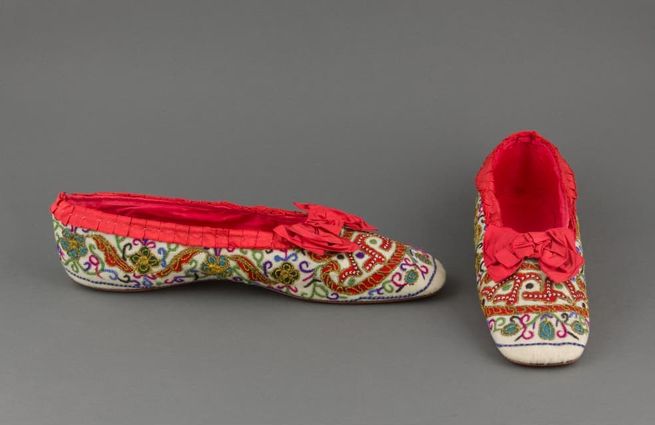
Originals: Bright Embroidered Slippers, 1855-65

 I love these:

Embroidered Wool Slippers, c.1855-1865, from Historic New England.

The description says that these are wool with embroidery and silk lining. I really love the contrast between the white ground exterior and the bright scarlet trim/bow/lining.

Zooming in close (thank you for the high resolution photos!), the embroidery appears to mostly be in chain-stitch, with applique (the red shapes and green and blue rosettes) and gold couched threads. At least two of those chain-stitch lines are done in alternating colors.

Friday, February 27, 2026

Fabric Lengths for Historic Sewing Projects

With the caveat that lots of projects can require more or less fabric, here's the "rule of thumb" measures that I use when I find an interesting fabric for future use. Obviously, if you are looking for fabric for a specific project, the yardage can be more precisely calculated by laying out the pattern pieces.

Given my eras of interest, these measures are mostly based around the middle of the 19th century (1850s into early 1860s); when an era is not specified, it generally means this time period. Most of the values given are minimums that I would need to comfortably make item, with only a little piecing for elements like piping; it may be possible to squeak through with less fabric, but additional yardage will be needed for matching patterns, adding self-trim, or for particularly capacious cuts like trains, flounced or swagged skirt layers and hanging sleeves.

Skirts and petticoats (1850s-1860s) are calculated assuming 3 panels cut 45" long and faced with a different fabric (for 54"-60" wide fabric), or 3.5-4 panels of the same length (if 44" fabric). Linings are not included in the base fabric measures.


Cotton Calico (assumed to be ~44" width)

1/2 yard, fat quarters, or small remnants work well for doll clothes and small crafts

~1.5 yards for a sunbonnet

1-2 yards for an apron 

3-4 yards for an 18th century petticoat (skirt)

5  yards for a Regency/Empire dress

6-8 yards for an 18th century gown (can vary greatly based on style)

7-8 yards for an 1850/1860s dress

Light-weight cottons (such as lawn, organdy, and batiste) 

1/2 yard: collars and cuffs; under-sleeves; or an 1850s cap

1 yard for a basic chemisette

2-3 yards for a fancy apron

2.5-3 yard pieces for blouses (white waists)

3 yards for an 1850s basque bodice or mantle

3.75/5 yards for an 1850s skirt without a bodice (54"-60" wide/ 44”)

4-5+ yards for an Empire-style dress (4 yards min for 60" wide fabric, 5 yards  min 44" wide) 

7-8 yard for a sheer 1850s dress (for a 60" wide fabric, I can get this down to 6 yards)

Cotton broadcloth (44" wide) 

Can be used for collars, cuffs, undersleeves, and aprons, same yardage as “light cottons”

2 yards for Victorian drawers

3 yards for chemises or a corded petticoat (including tucks or a facing for the cording)

4.5-5 yards for a basic 1850s petticoat (increase yardage for decorative tucks, etc.)  

Cotton Coutil/Twill (54”-60” wide)

1-2 yard for a corset depending on size and style


Linen (weights vary by project type, 54"-60")

½ yard – 1 yard pieces of fine linen for caps, coifs, kerchiefs, or ruffles

¼ yd -1 3/8 yd for early modern ruffs

1 yard for a medieval through 18th century apron (1/2 yard if pieced)

2 yards for a Regency chemise; or a large medieval veil or fancy 18th century cap

2-3 yards for a basic 18th century petticoat (3 for an over petticoat)

3 yards for a medieval or Early Modern smock, or a Tudor sleeveless kirtle


Wool (tropical weight suiting 54"-60" wide unless noted otherwise)

As little as 1/4 yard of wool lasting can make the uppers for a few pair of gaiters. 

 ½ yard for a Tudor partlet

1-1.5 yard for an Empire-style spencer

1.5 yards sheer wool for a capeline bonnet (generally green or black)

2 yards will make a square shawl (1.5 yards of 54") 

3 yards of wool flannel will make a flannel petticoat or a man's overshirt 

3 yards will make an 1850s basque bodice or jacket; or a Tudor kirtle or a medieval surcote (no sleeves)

3 yards of heavier coating wool will make a moderate-length mantle, cloak, or coat 

3.75 yards will make an 1850s skirt 

4 yards for medieval cotes and similar garments, Tudor gowns (4.5-5 for a safer margin sleeves), and Regency redingotes or pelisses.

6+ yards will make an 1850s dress (or, if wool flannel, a bathing costume)


Silk (taffetas unless otherwise noted, assume 54”-60” width)

1/4 yard for dancing slippers (often satin) or silk gaiters, small crafts and trimming projects

1/2 yard pieces can be useful for trimming bonnets, most reticules, or making small crafts

1/2 yard organza for a fancy 18th century apron, ½-1 yard for a cap, 2 yards for sleeve ruffles  

1/2-1 yard for covering a Victorian parasol frame.  

1yd makes a bonnet, shaped belt, or trim for a dress 

1.5 yards should be enough for a Tudor front-piece (check finished length of skirt)

3 yards for a 1850s basque bodice, mantle or jacket; or for lining a short cloak or paletote

3.75 yards will make an 1850s skirt 

4 yards for a Regency day dress (may be able to squeak a ball gown with short sleeves out of 3 yards)

4-5 yards for a Tudor gown (4.5-5 for a safer margin sleeves)

6+ yards will make an 1850s dress or basic 18th century gown (more needed for layered effects like polonaises)


Wednesday, February 25, 2026

Red Paisley Wrapper, c.1850s

This fabric has been in my stash for a while, waiting to replace my blue mid-19th-century wrapper. Fortunately, I ended up needing a second wrapper for our recent Victorian weekend in Port Townsend, which gave me an excuse to make it up.

While I didn't actually use a pattern, this wrapper is mostly based off the construction methods in the Kayfig KF611 wrapper pattern. It has a fitted back and side/underarm bodice taken from my most recent toile, but the front is made of two full-length loose panels gathered at the shoulder.

This red paisley could only have become a wrapper.

Because this is my fifth time* time making a wrapper in this style, I wanted to do something a little different. Since my blue wrapper has bishop sleeves, this red one got pagodas (though I did narrow them a little from what I used on the red plaid basque). Instead of a fitted front lining and jewel neckline, I tried to copy a wrapper I remember seeing in the MOHAI collection, which had no cut neckline in the front, and instead used had straight panels overlap to make a moderate V-neckline. Not having the pictures to hand at the time, I tried copying the look from memory: adding piping to the shoulder seam, and using the selvedges to make the center front opening. The closest original image I could find while working on this wrapper was an 1840s fan-front dress from the Met has a similar V-neck arrangement, so the front exterior was a combination of what I could see in that image and what I remembered from the MOHAI wrapper.

The other annoying thing about not having my construction detail pictures was figuring out the lining (the MOHAI catalog image does at least show the V-neck as I remember it, but not the interior). If I recall correctly, the original didn't have a lining in the front at all. However, I was concerned about how to shape the armscyes in that case, and so I opted for a partial lining on the side fronts (really just enough to define the shoulder, side, and armscyes seams.) I copied these side-front linings, again, from my most recent toile, just sloping them from the shoulder seam to the waist so that there was at least 1" to spare around the sleeve. I then laid out the front panel on each shoulder of that partial lining, and filled in the under-arm and front armscye area with scraps of the fashion fabric. 

Each front panel is a half-breadth of the fabric (~22"), with two panels in the back/side skirt. The back/side bodice is piped at the waist and the skirt gauged on; the front panels are obviously cut in a single fall from shoulder to hem. The sleeves are faced with self-fabric. I again opted to use self-fabric ties on this wrapper, because they are so convenient on my blue one. I ended up finding a pastel polychrome cord and tassels, which match all the accent colors in the print and thus makes a perfect belt, and so might remove the self-fabric ties. The belt is stylistically awesome, but I'm not convinced on its ability to hold the panels closed neatly without the ties. The front has no other fastener than those waist ties; they are sufficient, provided one arranges the front panels with care while belting the wrapper, but a brooch or pin at at the V helps it sit more securely.


*Those being wrappers #1 and #4, IIRC. Not pictured on this blog are number #2, my own light blue wrapper, and #3, a very dark blue paisley made for the FNLH wardrobe as a maternity dress. That one was fun because it was the first time I tried using drawstrings on the lining of a wrapper.

Tuesday, February 24, 2026

Plaid Cook's Apron, c.1850s

A straight-forward pinner apron, for our favorite cook. Guess I wasn't quite done with the Christmas presents, after all.

Pinner apron.

The Workwoman's Guide (fig 14, plate 11) calls this a cooking apron, saying:

This is a neat pattern for a housekeeper, cook, or kitchen-maid. The bib is quite plain, and pins to the gown at the corners. The size given in the Plate is suitable for a girl, but the bib should be cut to suit the wearer at once, and not made by guess. The apron is made of check or strong linen. 
For the check, I used a 56" wide medium-weight plaid shirting cotton from Family Heirloom Weavers. As given in the book, it's a very simple apron design: one width of fabric, gathered to a self-fabric band, with a rectangular bib stitched along the top. To move it more into the fifties, the bib is larger and the skirt of the apron adjusted in proportion (waistlines were still a bit high when the Workwoman's Guide was first published in 1838). I also knew that the recipient likes her aprons to properly cover the bodice of her dress.

A slightly better view of the color.

The apron's skirt is narrowly hemmed along the sides (the selvedges weren't suitable to be left as-in), with a deeper 2.5" hem at the bottom edge. The top is gathered into the waistband, and the bib (narrowly hemmed on all four sides) is whip-stitched along the top of the band. Instead of adding tape ties to the back of the apron, I opted to cut the waistband and ties as one. There was plenty of fabric, and it makes a nice bow when tied.

Sunday, February 1, 2026

Original: 1840s Adjustable Wrapper


Cotton Wrapper, c.1840s, Kent State University Museum.

Since a direct link doesn't work, a search for item "1984.002.0045 ab" in the Kent State University Museum's online collection is the best way to see the alternative views of this lovely cotton print (especially the final detail view of the printed fabric up close, and the front-on view which shows the diagonal grid of the pelerine front to perfection).

The vivid colorway of the printed cotton fabric is what initially caught my eye about this wrapper: there's two different wavy floral lines, one running horizontally and one vertically, with the resulting squares not only alternating between green and yellow/beige in each horizontal row, but those boxes are dyed in a graduated ombre (darker towards the bottom, lighter towards the top) with a subtle tone-on-tone coral motif in each (possibly a resist-dye effect). The size of the motifs and color differences (high contrast in some places, tone-on-tone in others) make it look striking from a distance but somehow less "busy" than I would have expected.

The second thing that caught my eye was the way the side seam in the skirt is a good half-motif off of alignment, which in such a large print really shows. I liked this because while it's strikingly obvious, the mis-matched print doesn't actually detract from my enjoyment of the dress as a visual object. In a way, it draws more attention to the detailed, bright printed design.

The diagonal grid formed by cutting the pelerine front on the bias also really stands out on this example (seriously, go check out the first image with the front view). Again, the fabric itself has so much going on, that simply rotating the motif 90 degrees in one area but not another makes a dramatic effect.

I do wish there was an interior construction photograph of this dress: the description mentions drawstrings in "both bodice and skirt", leading to the conclusion that this was a maternity dress. Strategic drawstrings are certainly a technique which can help fit an 1840s/50s/60s dress to such a changing figure, though I can't say that they are exclusive to maternity dresses versus wrappers worn at other times. Even more convincing to me, is that looking closely at the side-view waistline, it is appears that the mannequin has been padded out in the lower abdomen (mimicking a baby bump), but between the print and the wrapper's soft shape, it's hard to tell for sure. Which, from what I've read about Victorians, would make it an excellent maternity dress.  

Saturday, January 31, 2026

January Mending

 Just a few small maintenance projects this month. My red stockings needed darning again, and I also re-attached the outersoles of my low 1840s shoes, which had partially separated over the wet autumn/winter.

Friday, January 30, 2026

Modern Tall Socks

Last of the Christmas presents have found their way home. I did manage a few pairs of not-for-historical reenacting socks in the process. Nothing too technically interesting, because the self-striping yarn is fun enough on its own. 

Orange and pink tones.

Used the 60 cylinder: hung hems, 3-1 mock ribbing, with short row heels and toes. I did 20 rows on the hung hem (makes a nice ~1" hemmed edge), then another 70 rows gradually increasing the tension, and adjusted the foot length to the recipient's shoe sizes.

Tuesday, January 6, 2026

Twelfth Cake, 2026

Camera deleted the pre-party picture, alas.

Repeating the 1857 Godey's Twelfth Cake recipe, because I like it. This year's attempt at a more accurate cake was in the icing: instead of a buttercream, I opted for the more appropriate royal icing. It was still a bit of a departure from original practice, in that I used meringue powder to avoid serving raw eggs, but that's a line I'm comfortable with holding. As with last year, I managed to find candied citron in the appropriate quantity, but also somehow (again) had exactly 10oz instead of 16oz of currants on hand. I did have about 1/4 oz of actual dried currants (red, white, and black) to use, but the rest were zante currants as usual. I did forget to add the small amount of brandy called for in the recipe, but that doesn't seem to have affected the flavor, as I feared it would.

At any rate, it tastes fine (especially with tea), and doesn't quickly go stale.

For next year, I'd like to work on presentation. I always forget how much this batter does not smooth out on its own while baking, so I am making a note to use the proper dough tool and not just try to smooth out the batter with a spoon. I should also use three layers of parchment paper in baking (on all sides), since two wasn't as effective as I'd like, and will hopefully get some more practice with piping the decorations. 


Sunday, January 4, 2026

Gentlemen's Socks, c.1849

Based on the pattern given in The Comprehensive Knitting Book (1849). "For a full size sock:" thirty-six rows ribbing (1-1) or (2-2), then 30 rows knitting plain, heel, plain knitting through the foot, and then close the toe. I used Knitpicks' palette yarn, which is my current go-to for socks and stockings, in the bright red colorway.


Socks.

As the original pattern is for hand-knitting, the changes to make it fit my (current) sock machine abilities were switching the ribbed section to mock-rib with a 2 row narrow hung hem, and then using the short-row techniques for the toe and heel. The overall height and use of both ribbing and plain work are original to the pattern, as is the lack of widening/narrowing through the leg of the sock (which the instructions note is common for socks). I tried latching the gaps of the mock rib into a true ribbing, but there were some tension issues.

Saturday, January 3, 2026

Sontags, Pelerines, Habit-Shirts, and Bosom Friends, c.1840-1860

For the 10th Day of Christmas, some references for a particular variety of warm garment, generally called a sontag in reenacting circles.  As you can see, there's a lot of variation in the terminology, but all of these garments are sleeveless knit or crochet pieces which cover the chest, back, and shoulders (more or less). Some fasten close around the body with ties and buttons, while others have no fasteners at all. All of them appear to be worn between the bodice and and a larger piece of outerwear such as a shawl, though some may also be worn under the bodice instead. I have omitted the more closely-fitted knitted waistcoats, as well as the various sleeved polka-jackets and paletotes, and garments such as a larger shawls which are obviously intended as an outer-most layer. 

Further note on terms: many of these garment names (canezou, pelerine, habit-shirt, handkerchief) are also applied to non-knitted items, which are in some cases rather different from these knitted versions.

Habit Shirt from The Workwoman's Guide (1838/40).

The Workwoman's Guide (1838/1840) includes instructions with illustrations for a "small knit habit shirt" to be worn "under the shawl." It follows the same lines as the later sontag: a flattened V-shape which crosses over the front of the chest, and even includes the cord to fasten the back of the garment around the waist. The most notable departure from later practice is a inclusion of a standing collar, and that the pieces are made separately and seamed rather than knit all-in-one.

The Practical Companion to the Work Table (1844) has instructions for a bosom friend, a warm layer for the chest. This offers less coverage for the back than the above habit shirt, instead consisting of a large block of knitting which covers the chest and much narrower straps over the shoulder. The Illuminated Book of Needlework (1847) goes into greater detail in their similarly-designed gentleman's bosom friend.

Riego's Knitting, Crochet, and Netting, with Twelve Illustrations (1846) gives instructions for a pelerine of the familiar flattened V shape, to be knit in scarlet or blue with a white-spotted-black border "in imitation of Minerva." Except for the lack of explicit ties and the use of "double knitting" (brioche) instead of basket weave, this is basically the 1860 Godey's sontag in both shape and color.

Mrs. Mee's Exercises in Knitting (1847) has a sontag-like "knitted bodice" made in three pieces (one back and two fronts, sewn together) which closes with ties. Made in double knitting with a plain knit border, the garment is explicitly a middle layer: "This is worn outside the dress; and under a shawl or cloak is very comfortable."

Miss Lambert's My Knitting Book (1847) has "a warm habit-shirt, for wearing either over, or under, the dress", which is again knit in that flattened V-shape and has a contrasting color border.

Jane Gaugin's Lady's Knitting, Netting and Crochet Book (1847, 6th in her series) describes two different triangular fichus which seem to follow the shape of the slightly more cape-like sontag (smaller than a triangular shawl, and with some shaping around the neck).

The Winchester Fancy Needle-Work Instructor (1847) gives instructions for "a warm pelerine, to wear under a shawl" in the familiar flat-V shape, with no mention of fasteners.

The Knitters Friend (1847) has an intriguing "kamtschatka body" which is knit back-to-front over the shoulder like so many of these garments, but in a square rather than triangular shape and with the sides stitched together, into more of a sleeveless vest. It's unclear whether this is meant to be layered above or below the dress.

Riego's Winter Knitting Book for 1848 has a knit pelerine, again of the flattened-V shape, but without the waist tie. Another of her titles from the same year, Mlle Riego's Knitting Book focuses on lace knitting, but gives a round Shetland Shawl similar in shape to the 1859 Peterson's sontag (see below), and a canezou which covers the back and crosses slightly in front.

Canezou in Shetland knitting, from Riego (1848).

The Ramsgate Knitting Book (1848) features a habit shirt, in the one-piece flat-V-construction of the later sontag, with a ribbon to secure the waist front and back.

The Comprehensive Knitting Book (1849) has a chemisette/stomacher pattern with instructions for making it into a canezou (by extending the side edges into the classic flat-V-shape), as well as a shaped "pelerine or under-handkerchief" meant to fit close around the neck and shoulders, and be layered under a shawl (I could be wrong here, but the description seems to follow the familiar sontag V-shape, but with a more pronounced point at the center back).

The Ladies' Companion (1850) has a knitted Under Habit-Shirt, which follows the same V-shape, open-piece construction as the earlier habit shirts and later sontag. [Terminology note here that non-knit habit shirts are chemisette-like garments used to fill in an open-front riding habit. While the earlier knit habit shirts I've mentioned here often specify being worn "under the shawl" rather than under the bodice, this example seems more nebulous. The same magazine also gives a tucked muslin habit shirt which is clearly more of the chemisette-style (and inspired by 18th century stomachers) but which specifically notes that it can be made up for wearing under bodice, or extended into an over-bodice garment, with fichu or canezou as interchangeable terms for the later.]

The Royal Victoria knitting book (1851) gives a knitted wool "Victorine" pattern, which differs from a sontag only in that back is shorter than waist-level and the front pieces meet at the center rather than crossing (and thus gives no coverages to the sides of the torso or the back-waist, but does provide an extra layer over the chest).

Victorine from The Royal Victoria Knitting Book (1851)

The Ladies' Work-Table Book (1852) has a habit shirt of identical construction to that in the earlier Workwoman's Guide, constructed as four knit pieces (two fronts, back, collar) sewn together, with ties at waist and neck. Like the earlier work, this book also confirms that a "habit shirt" in this instance is an outer layer worn under the shawl (not under the bodice as a chemisette would be).

Mlle Riego's 1857 Winter Crochet Book has a "Eugenie Collarette" which follow similar (though more dramatic) lines to the Victorine. It has less coverage than some of the earlier habit shirts and later sontags.

In February 1859, Peterson's published a knit sontag pattern with a button front. This version fits over the upper body and arms like a short, pointed cloak (elbow-ish length on the sides, closer to waist-length at the front).

Peterson's 1859 sontag.


January 1860 sees Godey's publish their basketweave knit "bosom friend or sontag" which has become so popular in reenacting circles thanks to Colleen Formby's modern sizing instructions (also on Ravelry, in case the original link ever goes down).

American Agriculturalist, in December 1860, published Martha Pullan's instructions for a knit sontag: it has the familiar cross-over front and distinct belt.

Sontag from American Agriculturalist (1860).

Fun fact: while the name "sontag" (after opera sensation Henrietta Sontag) doesn't seem to come into use for these almost-outer-layer knit garments until 1859, the term shows up much earlier applied to a light knit headcovering. Otherwise known as a cephaline, it appears in Miss Lampert's 1843 Hand-book of Needlework and in her 1845 My Knitting Book, First Series. There's also a sontag cloak in Godey's in 1852.
Friday, January 2, 2026

2026 Costuming Resolutions

Looking ahead to my sewing goals for 2026, it's time to start on a few 'someday' projects in eras I haven't often done. I'll start with the ones which I expect to have opportunities to use this year:

  • Evening dress for a c.1926 event (October)
  • New nightgown for mid- Victorian camping events (February)
  • 16th century wool gown and kirtle, ideally in time for the Two Rivers, which can get cold.
  • A 1776 ensemble (gown or short gown & petticoat) by the summertime America 250 events. I've been accumulating undergarments and accessories, so it's time to finish the main garments.
  • 14th century ensemble (probably cotte and surcotte) for some possible events in that era
  • Sheer 1850s dress for fancier summer wear (July)
  • New early 1800s chemise, as the old is starting to wear out
  • Start on some 19th century tailoring lessons (overshirt and jean trousers).
  • Linen divided skirt. (Summer)
  • 1918 ensemble (November) 

That's a pretty solid to-do list, but just to keep track of them, here's a few more project ideas that I have material for or been hoping to get to.

  • 1912 wrap cape
  • 18th century peignoir

  • 1850s tucked petticoat

  • Red paisley 1850s wrapper 

  • 1848 Oregon Trail dress

  • Victorian dancing slippers

  • Update my 1810s ballgown

  • Re-fit 1810s day dress

  • New 1810s petticoat

As usual, I'd also like to keep trimming the un-posted blog drafts list (aiming for 80 or fewer by the year's end), and not working on projects the night before they're needed. I mostly didn't make the 'completed a week before the event' goal this year, but it helped me avoid staying up late the night before an event sewing (either because I finished the projects a few days ahead of time, or else acknowledged that I couldn't complete the new item and used a back-up).

Thursday, January 1, 2026

Happy New Year: 1826 and 1926 Dress Designs

 I do enjoy the difference that a century can make in clothing styles. Here's where we were 100 years ago:

Summer 1926 day dress, House of Paquin. From VAM.

And to the folks of 1926, this style was just as old as their clothing is to us:

Promenade Dress from Ackerman's Repository, January 1826. From LACMA.

It's interesting to reflect on these styles side-by-side. Both eras are playing around with waist-placement: the 1920s have dropped it to an all-time low near the hip, while the 1820s are also moving low(er) from decades of all-time-high waistlines under the bust. They're also at different stages of a major silhouette shift: Empire style of the late 1790s-1810s, like the "flapper" style of the late 1910s-1920s, are remembered as looser, shorter, and simpler styles which directly respond to (and reject) the more elaborate, structured, and formal designs of, respectively, the Ancien Regime and the pre-War/Edwardian period. But our 1926 dress is barely a ten years into its fashion revolution and shows that style in its full development, the 1826 one is nearly three decades into its silhouette, and the metaphorical pendulum is starting to swing back the other way. While the fur muff obscures the lowering waistline (which is creeping back towards the natural waist, allowing for structured bodices to make their return), we're also seeing more visual weight through the shoulders created by the double row of vandykes, as well as a wider, more bell-like skirt, stiffened by its wide fur hem. The trajectory is clear: Empress Josephine is out, and Empress Eugenie's on the (distant) horizon.