Sunday, December 6, 2020

Roman Hair-Dressing

I may have just binged-watched a bunch of Janet Stephens' hair-tutorials, and decided to start messing around with second/third century AD Roman hair dressing. While many of the styles are complex and benefit from having extra hands, some of them look possible for self-styling. I decided to start with two of the simplest ones:

Empress Faustina the Younger (c.161 CE):

Braided bun sewn with wool thread
Simple braided bun.

The second hairstyle on the Faustina tutorial seemed like a good place to start. It's a braided bun, like I wear most days, so the main novelty was sewing the coil into place with wool thread. That experience was not entirely dissimilar to hair-lacing--I even used the same bodkin. However, I was working entirely by touch so the lighter yarn was a noticeable departure from the linen tapes. Taking it down again was not as difficult as I feared, in part because the thread was so easy to break

Julia Domna (c.211-217 CE):

Ropes into a double braided bun.

I like how the two-strand ropes work on the side hair, and plan to practice this style further. Though still fairly simple, it feels less utilitarian than the first style, and I think it has potential to look well with some practice. I suspect this first attempt would look a lot neater if I was dressing someone else's hair and could see what I was doing, but it came together will little fuss and has held up all evening, so I'm considering it a success.

Saturday, December 5, 2020

Card Games, c.1855

Another from the draft folder. I started compiling period card game instructions for the 2018 CLT, as the evening entertainment was to be a card party.

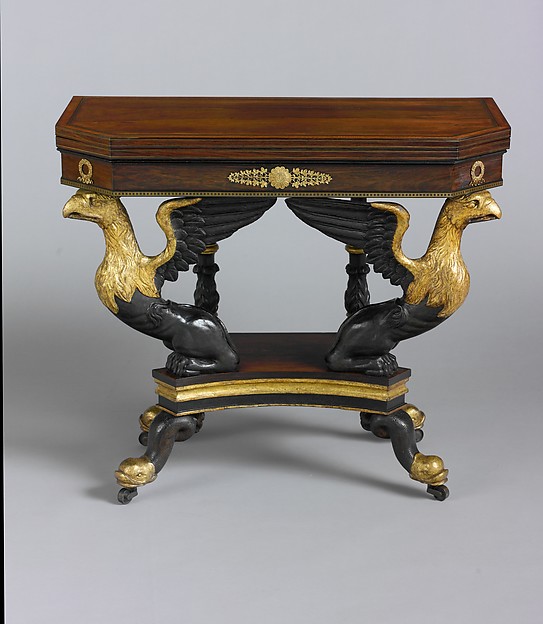
Duncan Phyfe Card Table from The Met
Card table attributed to Duncan Phyfe,
c.1815-1825. In The Met.

At any rate, I ended up teaching a few friends basic whist, and really enjoying Pope Joan/Matrimony. There are a few more games I'd like to try if and when events can ever happen again. A particularly useful reference for the event was Hoye's Games (1857 American edition, original London), which includes the following card games:
  • Boaston (a four-player trick-taking game)
  • Blink Hookey (4-10+ players, game of chance)
  • Whist (four-player, partnered trick-taking game--basically bridge without bidding)
  • Quadrille (four player, with a reduced deck)
  • Snip, Snap, Snore 'Em (any number of players, card matching)
  • Piquet (2 players, deck of 7-Ace)
  • Quinze (2 player, game of chance similar to vingt-un)
  • Vingt-un (2+ players, more commonly called 21 or blackjack in the present day)
  • Lansquenet (any number of players)
  • Pharo/Faro (any number of players, special deck)
  • Earl of Coventry (any number, card matching)
  • Rouge et Noir (any number of players, 6 decks and a special table cloth are needed)
  • Cribbage (2 or 4 players, like the modern game)
  • Commit (any number of players, card matching with 'stops')
  • Matrimony (5-14 players, special board needed)
  • Cassino (2-4 players, 1 deck)
  • Reversis (4 players, specific number of markers/fish)
  • Put (2-4 players)
  • Connexions (3-4 players, trick-taking game with diamonds trump and special rules for black aces and the king of hearts)
  • All Fours (2 players, 1 pack cards)
  • Speculation (many players, 1 pack, whist as a free-for-all)
  • Lottery (many players, 2 packs of cards, game of chance)
  • Pope or Pope Joan (any number of players, similar to matrimony, need special board)
  • Commerce (3-12 players new way, any number the old way; a card-trading game)
  • Pam-loo (4-7 players, best with 5 or 6; sort of like poker with only flushes scoring, but then becomes a 5-round trick-taking game if no one has a flush. Also the jack/knave of clubs is wild.)
  • Brag (4-8 players; three card poker with jacks and 9s wild)

If the fiction of Mrs. Gaskell, Miss Austen, and Mr. Dickens is anything to go by, card parties are a respectable pastime. Even women gambled at them:

The Bingleys and Hursts play loo after dinner in Pride and Prejudice (1813). The Middletons play cards after dinner, with a party of young ladies specifically playing cassino on one occasion in Sense and Sensibility (1811). Both whist and speculation are played by the Grants in Mansfield Park (1814). Whist and Pope Joan are played by mixed company in The Pickwick Papers (1847). Cranford (1853) sees an almost-exclusively female card party playing Preference. Young teens attend a mixed-company evening card party in Wives and Daughter (1865), with the schedule including twenty-one and some sort of round game (both played for low monetary stakes).  Lady Ludlow (1859) even plays cards on Sundays. In The Old Curiousity Shop (1841), Nell's grandfather loses the last of their small savings in an unspecified card game against professional gamblers at an inn; later in the story, cribbage is played by a mixed party of men and women in a private home. A mixed party plays piquet in Domby and Son (1848). Miss Price flirts with Nicholas Nickleby (1839) when they are partnered in an unspecified card game; in the same book, Mr. and Mrs. Kenwigs celebrate their anniversary by hosting a dinner and card party.

In the non-fiction world, 16-year-old diarist Clara Solomon plays Cassino and Quadrille at evening parties with friends and family (New Orleans 1861-1862). Jane Swisshelm refers to a "frontier belle" playing poker with men, not exactly with approbation, in Half a Century (1880, retrospective to 1830). She also associated card-playing with idleness in Letters to Country Girls (1853), in the context of young women presuming to elegance beyond their means. In Richmond, Mary Chestnut mentions friends over to play cards on February 24, 1864.

Additional resources

Friday, December 4, 2020

Fort Auction

The Fort Nisqually online auction ends tomorrow (December 5) at midnight. It's your last chance to bid on Miss Dolly, the pink and green sewing kit, or the Berlinwork card case.

The Fort Nisqually Foundation will mail items (buyer pays postage), or local pickup is available by appointment on December 7-8.

Thursday, December 3, 2020

Kitchen Garden, December 1819

I swear peas and beans get planted every month of the year. And more asparagus!

Plant cabbages and savoys for seed. To do this, dig up a dry border, and break the mould well; then take up your stoutest plants, and hang them up by the stalks five days, and then plant them half way of the stalks into the ground, drawing the earth round them like a hill. Put in another crop of peas and beans to take their chance. Make another hot bed for asparagus. Continue to earth up celery, and cover your endive with pea-straw.
-Modern Domestic Cookery, and Useful Receipt Book (London, 1819)

Wednesday, December 2, 2020

Dress Inspiration c. 1848

I've got a couple of dress lengths intended for late 1840s wear, and assembled this set of original gowns for inspiration. I'll probably aim the first of them for c.1848. It's one of my favorite years in European history, but also would be practical for western USA living history events (peak trail year, Oregon statehood, etc).
 
Silk dress c.1845-9. LACMA.

I'm working in cotton, not silk, but I like the effect of the self-fabric folds/pleats from shoulder to waist.


Cotton fanfront dress, c. 1845. LACMA

I like the fan front on this one, though I'm not keen on those sleeves for this project.


Cotton fanfront V-neck dress, c.1840. The Met.

Stripes! The V-neck is nice, and I like being able to see how the dense pleating through the shoulders works with the busy fabric.

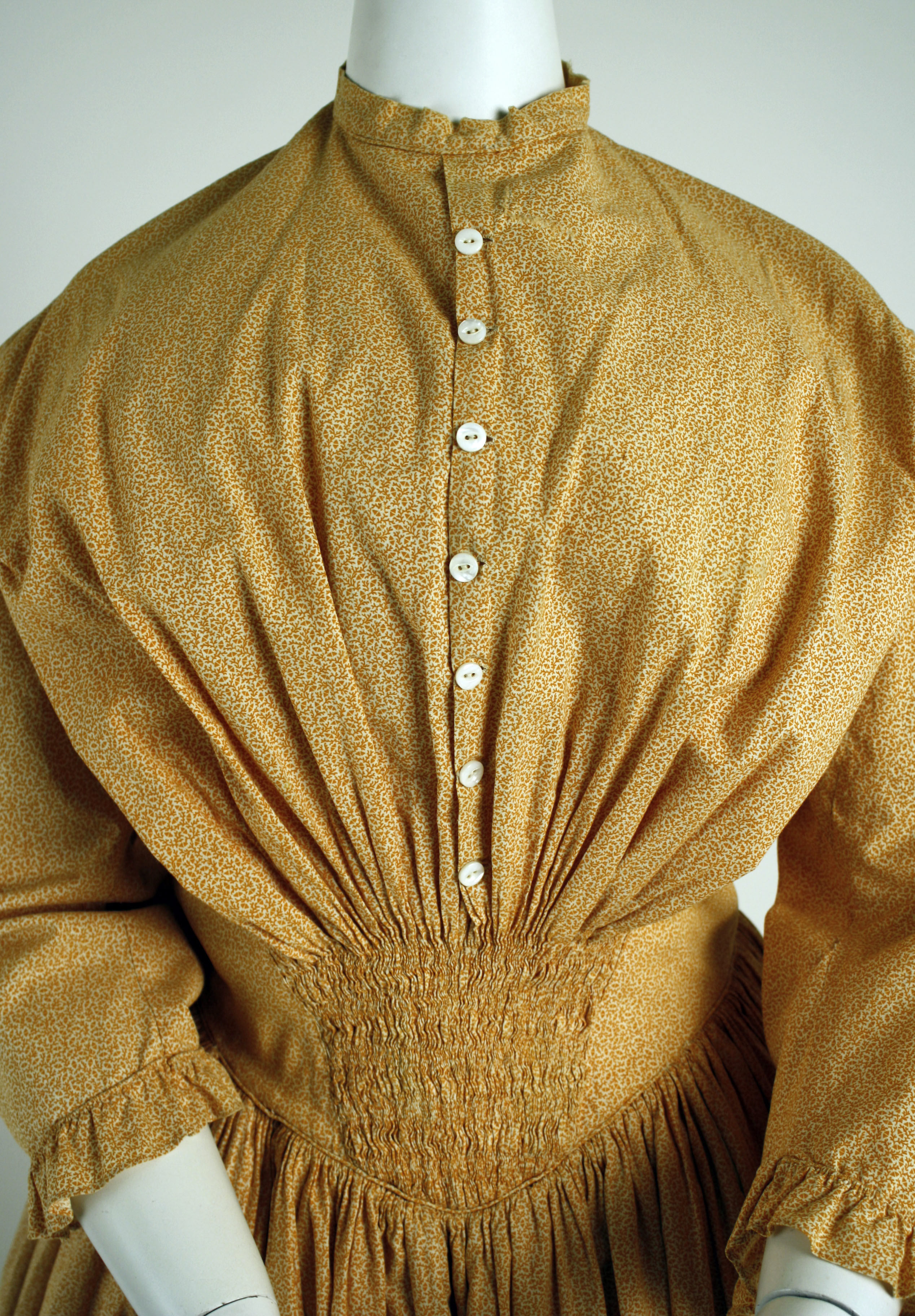
Cotton dress c.1840-1845. The Met.

I sort of hate this one? Not sure if it's the color, those sad little ruffles at the wrist, the standing collar, or the buttons, but this dress just doesn't work for me. The years given are also a bit early for this project, so I can disregard it with impunity. The waist treatment, however, is really cool. The tightly shirred center front is really impressive and it works well with shallow V-shaped waist.


Cotton print dress, American, c.1847. The Met.

I want this. The wild stripe material pleases my heart. The tight bias sleeves are very '40s, contrasting nicely with the fuller sleeves of my '50s clothes. I like the subtlety of the self-fabric epaulettes. The fanfront bodice is a delight (and it's a front-fastener!). I'll need to work out the depth of the V-neck, but this is very promising for the green striped fabric.


Cotton dress, 1840-1850. The Met.

Not going to make this one, because I don't really like either the bodice or the sleeves, but I'm including it because that is some WILD pleating at the waist, which warrants further study. The self-fabric ruffles aren't working for me, though I note their existence.


Dress, 1840-1845. The Met.

This gingham check probably has the best overall aesthetic for what I'll end up doing on the beige foulard: a fairly plain bodice, with the patterned fabric providing most of the interest. I do like how they made the dense gathers work with the front-opening bodice, though I wonder at the sleeve construction, which appears to be a moderate bishop sleeve. This dress wouldn't look out of place in the 1850s.

Dress c.1847. The Met.

A back-fastening, low-neck, short-sleeved cotton print...the 1850s have me trained to see this as a teen's dress, though I should remind myself that some of those features appear in adult daywear earlier in the century. Not that this dress is clearly marked as being worn by a teen (or not). I do like the yoke with the open neckline....


Tuesday, December 1, 2020

Original: Bright Orange Silk, 1864-5

A mid-1860s gown with plain skirt, double-pointed bodice with buttons down the center front, and narrow coat-shaped sleeves adorned with braidwork.
Day dress, 1864-5, in The Met.
I enjoy the striking color of this silk dress, but also how effective it's simplicity it. A bit of braidwork at the cuff and shoulders, coordinated with a row of button and an (unusual) narrow line of cord around the hem, leave most of the surface of the dress empty. This works well with the clean lines of the mid-1860s: the narrowing coat sleeves, single skirt with fullness moving back, and the tailored effect of the double-pointed bodice.

Monday, November 30, 2020

HFF 4.24: Serve It In A Bowl

Detail of an 1850s painting showing a table laden with food, and a woman's hands holding a spoon over a dish.


The Challenge: Serve it in a bowl--soups, stews, broths, ice creams, anything that can be served in a bowl. 


The Recipe: Carrot Soup from Beeton's Book of Household Management

CARROT SOUP. II.

121. INGREDIENTS.—2 lbs. of carrots, 3 oz. of butter, seasoning to taste of salt and cayenne, 2 quarts of stock or gravy soup.

Mode.—Scrape and cut out all specks from the carrots, wash, and wipe them dry, and then reduce them into quarter-inch slices. Put the butter into a large stewpan, and when it is melted, add 2 lbs. of the sliced carrots, and let them stew gently for an hour without browning. Add to them the soup, and allow them to simmer till tender,—say for nearly an hour. Press them through a strainer with the soup, and add salt and cayenne if required. Boil the whole gently for 5 minutes, skim well, and serve as hot as possible.

Time.—1-1/4 hour. Average cost per quart, 1s. 1d.

MEDIUM STOCK.

105. INGREDIENTS.—4 lbs. of shin of beef, or 4 lbs. of knuckle of veal, or 2 lbs. of each; any bones, trimmings of poultry, or fresh meat, 1/2 a lb. of lean bacon or ham, 2 oz. of butter, 2 large onions, each stuck with 3 cloves; 1 turnip, 3 carrots, 1/2 a leek, 1 head of celery, 2 oz. of salt, 1/2 a teaspoonful of whole pepper, 1 large blade of mace, 1 small bunch of savoury herbs, 4 quarts and 1/2 pint of cold water.

Mode.—Cut up the meat and bacon or ham into pieces about 3 inches square; rub the butter on the bottom of the stewpan; put in 1/2 a pint of water, the meat, and all the other ingredients. Cover the stewpan, and place it on a sharp fire, occasionally stirring its contents. When the bottom of the pan becomes covered with a pale, jelly-like substance, add 4 quarts of cold water, and simmer very gently for 5 hours. As we have said before, do not let it boil quickly. Skim off every particle of grease whilst it is doing, and strain it through a fine hair sieve.

This is the basis of many of the soups afterwards mentioned, and will be found quite strong enough for ordinary purposes.

Time.—5-1/2 hours. Average cost, 9d. per quart.

ECONOMICAL STOCK.

106. INGREDIENTS.—The liquor in which a joint of meat has been boiled, say 4 quarts; trimmings of fresh meat or poultry, shank-bones, &c., roast-beef bones, any pieces the larder may furnish; vegetables, spices, and the same seasoning as in the foregoing recipe.

Mode.—Let all the ingredients simmer gently for 6 hours, taking care to skim carefully at first. Strain it off, and put by for use.

Time.—6 hours. Average cost, 3d. per quart.


The Date/Year and Region: 1861, London

How Did You Make It:  I started with the stock, based on the 'economical stock' since I didn't have beef bones, but did have some left-over turkey bones from last week and a bit of frozen pork roast from the fear factor challenge. To these I added 2 oz of butter, two onions with 3 cloves each, 1 turnip, 3 carrots, about a half head of celery, 3 Tbsp + 1 tsp salt, 1 tsp whole black pepper, 1/2 tsp ground mace, and a small handful of sage/thyme/parsley, and let it simmer all afternoon in 4 1/4 quarts of water. [I skipped the leek because there weren't any in the garden; re-reading, I should have omitted the butter since I didn't actually use it to prepare the meat, but Francatelli allows this, so...].

After cooking for 6 hours, I strained it, yielding 4 1/2 quarts of stock (so, either my rough 1 cup was closer to 2 cups, or enough water came out of the vegetables to make up the difference) 

At this point (and I should have started it earlier), I peeled and chopped up 1 lb (5) carrots, and stewed them on the stove in 3 Tbsp of unsalted butter. They browned slightly over the hour of cooking, at which point I put the carrots into 1 quart of the stock, and let it simmer another hour. [Since I accidentally let it reduce by 75% during that hour, I added another 3 cups of water to dilute the stock again.] After an hour, I used my collander-like jam-making thing-that's-basically-a-food-mill on the carrots, then added a generous pinch of cayenne pepper to complete the soup.

Time to Complete: About 10 minutes to assemble the stock, then 6 to boil it. Another 2:20 minutes to make the soup after that.

Total Cost: Unsure.

How Successful Was It?: Decently tasty, reasonable texture. It's like tomato soup but orange and carroty. The flavor was nice--I was a little concerned that the pork and turkey would overwhelm the other flavors, but the mace and cayenne worked well, and different vegetables made for a complex broth and a nice soup.

Making stock from scratch is a bit boring for interpretation, and I don't have a period-style collander, so this probably won't be used in cooking demonstrations. However, I'll keep this in mind for future dinner parties--it would be easy to make in advance, it's reasonably tasty, unfamiliar-but-not-weird, is already gluten free, and could easily be made vegetarian or vegan with a meatless broth.

How Accurate Is It?: No heirloom vegetables this time. The processes--boiling, crushing the carrots--are accurate even if the equipment I used is modern. I think this is a reasonable attempt, though there is room for improvement (mostly tying heirloom vegetables).


Boiling some stock


Stewing carrots in butter


Carrot Soup