 |
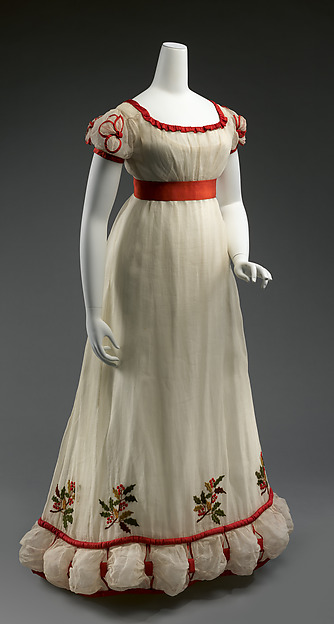
| Dinner Dress, British, 1824-1826 The Met |
Friday, December 15, 2017
Originals: 1820s Christmas Evening Gown

Saturday, December 9, 2017
Christmas Cake
It's the Ft. Steilacoom Christmas Candlelight Tour, so here's a nice Christmas Cake for the young lads and lassies obeying my every command attending the dance. This year, the event is set in 1863; the recipe is from an 1861 book (Beeton), and it looks delicious. The cake, that it. It would be weird to call an event "delicious".
Remember, a teacup is approximately 4 oz of volume (ie, 1/2 cup in modern baking terms). So, we're looking at 2.5 cups of flour, 1/2 cup melted butter, 1/2 cup cream, 1/2 cup treacle, 1/2 cup sugar, 2 eggs,a ton of 1/2 oz ginger, 8 oz raisins, 1 tsp carbonate of soda and 1 Tbsp vinegar. I went with 325F for the moderate oven, and the cake cooked in about 1.5 hours.
Beeton's doesn't say how to decorate the cake (marzipan? icing? flaming brandy? dry?), but other allusions to Christmas cake suggest that icing and sugarplums would not be inappropriate
In the end, I opted for a plain almond icing, with some "holly" for decoration. It turned out quite tasty--slightly plainer than the 12th Night cake I've made before, but full of ginger and raisins. It was sweet, but not overly so; a little dense, as expected; and the almond icing really complemented the cake.
*Another time, I'll have to try Eliza Warren's 1858 Christmas cake receipt, which calls for custard and sherry.
CHRISTMAS CAKE.
1754. INGREDIENTS – 5 teacupfuls of flour, 1 teacupful of melted butter, 1 teacupful of cream, 1 teacupful of treacle, 1 teacupful of moist sugar, 2 eggs, 1/2 oz. of powdered ginger, 1/2 lb. of raisins, 1 teaspoonful of carbonate of soda, 1 tablespoonful of vinegar.
Mode.—Make the butter sufficiently warm to melt it, but do not allow it to oil; put the flour into a basin; add to it the sugar, ginger, and raisins, which should be stoned and cut into small pieces. When these dry ingredients are thoroughly mixed, stir in the butter, cream, treacle, and well-whisked eggs, and beat the mixture for a few minutes. Dissolve the soda in the vinegar, add it to the dough, and be particular that these latter ingredients are well incorporated with the others; put the cake into a buttered mould or tin, place it in a moderate oven immediately, and bake it from 1–3/4 to 2–1/4 hours.
Time.—1–3/4 to 2–1/4 hours. Average cost, 1s. 6d.
Remember, a teacup is approximately 4 oz of volume (ie, 1/2 cup in modern baking terms). So, we're looking at 2.5 cups of flour, 1/2 cup melted butter, 1/2 cup cream, 1/2 cup treacle, 1/2 cup sugar, 2 eggs,
 |
| Christmas Cake |
Beeton's doesn't say how to decorate the cake (marzipan? icing? flaming brandy? dry?), but other allusions to Christmas cake suggest that icing and sugarplums would not be inappropriate
In the end, I opted for a plain almond icing, with some "holly" for decoration. It turned out quite tasty--slightly plainer than the 12th Night cake I've made before, but full of ginger and raisins. It was sweet, but not overly so; a little dense, as expected; and the almond icing really complemented the cake.
 |
| Finished Christmas Cake |
*Another time, I'll have to try Eliza Warren's 1858 Christmas cake receipt, which calls for custard and sherry.
Wednesday, November 29, 2017
1855 Warm Undersleeves, part 2: Frills
To refresh, here are the frill instructions:
Cast on 90 stitches with white wool, and knit 3 rows before commencing the pattern.
1st row Slip1, knit 1, a pearl 1; knit 2 together three times; repeat from a, finishing with knit 2.
2d. Slip1, knit 1, a pearl 1, knit 12; repeat from a.
3d. Like 2d row.
4th. Slip 1, pearl 1, a knit 1, pearl 12; repeat from a.
Repeat rows 1-4 5 times (total of 3 rows plain and twenty rows pattern) in white, and then once (4 rows) in colored wool.
These four rows form the pattern, which must be repeated five times with white, then once with blue, and cast off loosely. Two frills are required for each sleeve: the upper is placed about an inch and a half above the under, which is sewed by the edge of the sleeve.
These frills are a bit problematic, as there's an error in the instructions. The many "knit two together" instructions in line 1 are not balanced by making new stitches anywhere; therefore, the total number of stitches drops by almost half every fourth line. Like this:
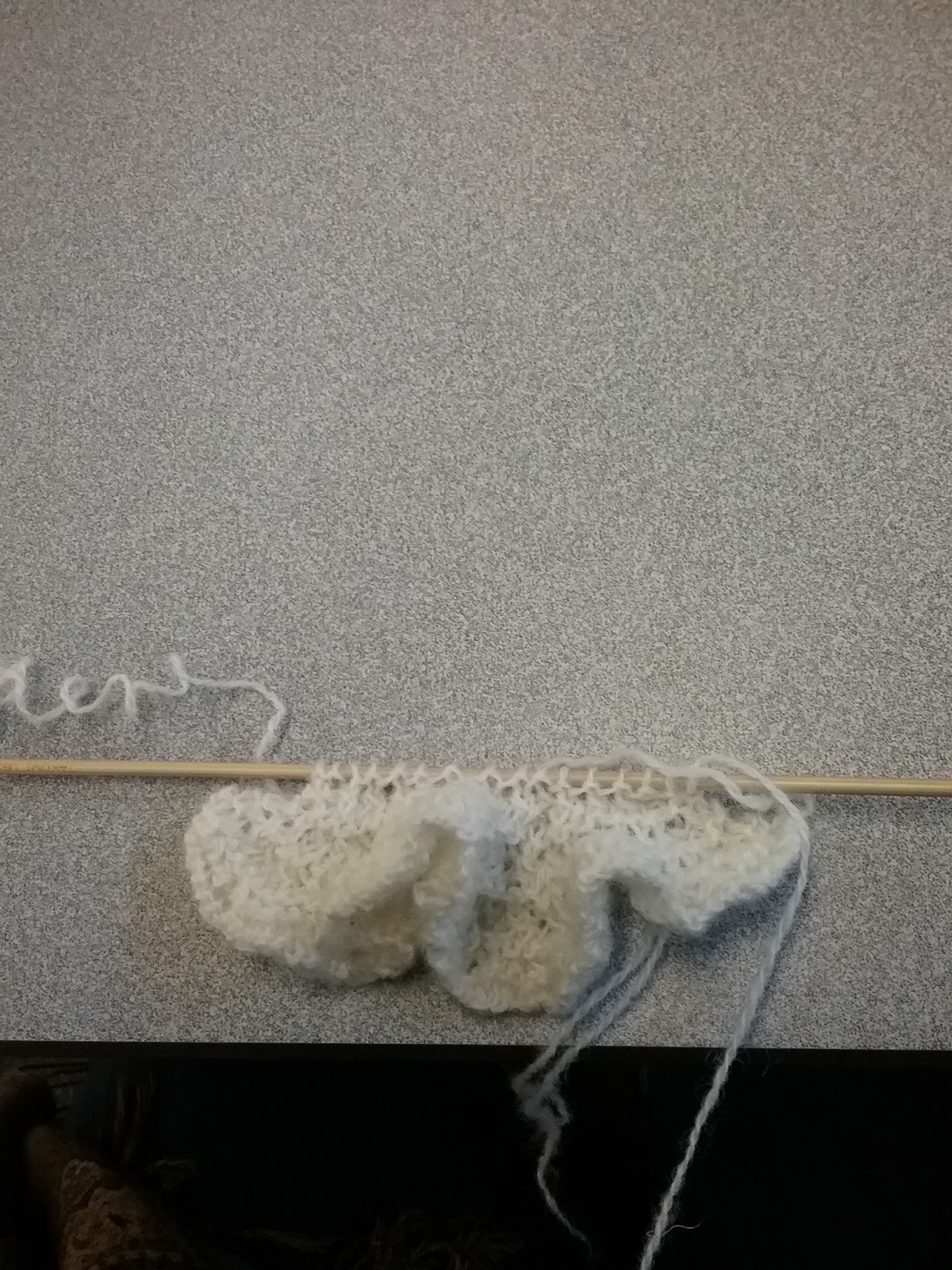 |
| The frill as written: after four repetitions, there's only a dozen stitches left. |
I'm not the only one to notice this problem. My solution to it, in attempting to keep as close to the written instructions as possible, was to simply add a yarn over before each 'knit 2 together'. This creates a series of small eyelets in each fourth row of the motifs. It's not nearly as open as the illustration suggests, but it's a pretty effect, and should be plenty warm (and I'm not a sufficiently experienced knitter to get too creative here). In the interest of making the motifs match-up, I decided to make the first and last 2 stitches into a stockinette stitch, and use sequences of 6 knits (or purls) between "ridges" on rows 2-4 instead of 12 (otherwise you get a 14-stitch repeat in the first row with a 13-stitch repeat subsequently). The purl-heavy fourth row made me suspect that a stockinette effect was intended. I initially tried carrying this through all four rows (first row largely as written, 4th row, 2nd/3rd row, 4th row), but thought that the eyelets tended to disappear; instead, I decided to go with "1st, 2nd, 4th, 2nd", so the three non-eyelet rows give a stockinette stitch with occasional ridges, while the eyelet row is opposite.
So, my revised frills:
Cast on 96 stitches, and knit plain for three rows in white yarn.
Motif:As per the originals, this four row motif is repeated four times in white, and once in color (I used purple instead of blue):
1st row: Slip 1, knit 1, [purl 1, yarn over, knit 2 together] 13 times, purl, knit 2.
2nd row: Slip 1, knit 1 [purl 1, knit 6] 13 times, purl, knit 2
3rd row: Slip 1, purl 1 [knit 1, purl 6] 13 times, knit, purl 2
4th row: Slip 1, knit 1 [purl 1, knit 6] 13 times, purl, knit 2
 |
| Four knit frills. |
The frills are considerably more substantial than the open petals depicted in the magazine, but I think they also look a bit warmer. We'll see how they end up working. If I do this pattern again, I'd like to find a way to make the ruffles look more like the illustration (which will probably involve cookies and bribing a more experienced knitter to help).
Monday, November 27, 2017
Nine Reasons to Sing at Reenactments
[This post has been languishing in my drafts for several years. I think it was originally inspired by Liz's Top Ten Reasons You Need to Make a Petticoat.]
9. Easy to find. Particularly if you're doing the mid 19th to early 20th century, mass-printed sheet music and song books mean lots of originals survive--originals that are old enough to be public domain, and widely available on-line thanks to Google Books, Internet Archive, the LOC, and various other archives and repositories.
8. No equipment required. You can add it if you want: a handwritten page of lyrics, or a pitchpipe and some printed music, all the way up to beautifully-bound reproduction music books and period correct instruments. There are lots of options.
7. Can be added to your other activities. Sing while sewing, while cooking, or while washing up. Start your ladies' meeting with a hymn; cheer the soldiers' parade with a patriotic tune; lullaby the children to their naps.
6. Creates subtle activity: music can add to an event's ambiance, even for people who aren't currently in your area.
5. Attracts attention. Sound carries. A little singing (on its own or for amusement while working) lets people know where you are, without interrupting their current pursuits. It doesn't demand an audience, but invites one in.
4. It's easy to start and end. If you do get some visitors investigating your siren song, you can easily wind it down to engage them in conversation or answer their questions. No dropped stitches, fumbling for book marks, or materials getting ruined because you set them aside.
3. It's free.
2. It's fun.
1. It's authentic. Puritans aside, whatever period you're doing, people were singing. And so can you!
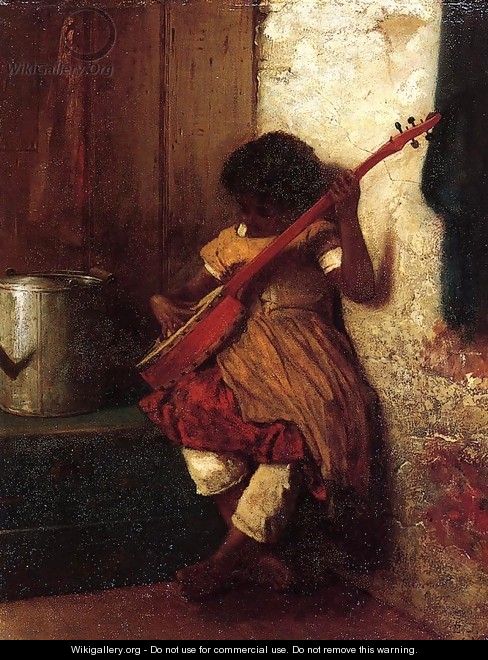 |
| Musical Instinct (1860-69) by Eastman Johnson. |
9. Easy to find. Particularly if you're doing the mid 19th to early 20th century, mass-printed sheet music and song books mean lots of originals survive--originals that are old enough to be public domain, and widely available on-line thanks to Google Books, Internet Archive, the LOC, and various other archives and repositories.
8. No equipment required. You can add it if you want: a handwritten page of lyrics, or a pitchpipe and some printed music, all the way up to beautifully-bound reproduction music books and period correct instruments. There are lots of options.
7. Can be added to your other activities. Sing while sewing, while cooking, or while washing up. Start your ladies' meeting with a hymn; cheer the soldiers' parade with a patriotic tune; lullaby the children to their naps.
6. Creates subtle activity: music can add to an event's ambiance, even for people who aren't currently in your area.
5. Attracts attention. Sound carries. A little singing (on its own or for amusement while working) lets people know where you are, without interrupting their current pursuits. It doesn't demand an audience, but invites one in.
4. It's easy to start and end. If you do get some visitors investigating your siren song, you can easily wind it down to engage them in conversation or answer their questions. No dropped stitches, fumbling for book marks, or materials getting ruined because you set them aside.
3. It's free.
2. It's fun.
1. It's authentic. Puritans aside, whatever period you're doing, people were singing. And so can you!
Saturday, November 25, 2017
Victorian Christmas Songs
 |
| Christmas Visitors (1860) by William MacDuff |
Preparing for some festive seasonal events, I find myself again looking for era-appropriate carols, particularly for the 1850s and early 1860s. This time, I'm going to try making a list, and hopefully won't have to start all over again next year.
I Saw Three Ships
The First Nowell
Hark The Herald Angels Sing
[The first two also appear in Christmas with the Poets (1851), and are said to be seventeenth century]
Popular Music of the Olden Time (1859) adds:
A Virgin Most Pure
The Virgin and Child
The Golden Carol
The Boar's Head Carol
It also lists "current carols" popular in England:
Christians Awake,
Good King Wenceslaus
Christmas Comes
Hark the Herald Angels Sing
Song of the Angels [While Shepherd Watch Their Flocks By Night]
More scored music in The Sunday-school Service and Tune Book (1863):
We Three Kings of Orient Are
Silent Night! Holy Night!
Hark! The Herald Angels Sing
Hark! What means those Holy Voices
Shout the Glad Tidings
Carol, Carol Christians
Hark! What Celestial Sounds
While Shepherds Watched
We come with loud Acclaim
The Son of God, so High, so Great
Bright and Joyful is the Morn
Carol, Brothers, Carol
To us a Child of Hope is Born
Luther's Christmas Hymn
How Precious is the Story
Obscure religious songs in Christmas carols : or, sacred songs, suited to the festival of our Lord's nativity ; with appropriate music, and an introductory account of the Christmas carol (1833):
Christmas comes, the Time of Gladness
Lo! He comes, an Infant Stranger
How blest with more than Woman's Bliss
How bright was the Glory
Once Again the Festal Morning
From the Hallow'd Belfry Tower
When Christ our Saviour came on Earth
When Bethlehem's Shepherds Home Returned
Praise We our God
Star of the East
How glorious is the Morning Sun
Christ the Lord was Born To-Day
What ear shall be closed
O Thou, who bad'st thy Star display
Man's Redeemer
And some sheet music:
The Holly and The Ivy (c.1812-1830)*
Twelve Articles (c.1812-1830)
Auld Lang Syne (1817) [and an 1858 version]
Star of the East (1831)
A Christmas Carol (1838)
While Shepherds Watch Their Flocks By Night (1831)
O Swift We Go: A Sleighing Song (1840)
In Christmas Time: It's History, Festivites, and Carols (1852), we have:
God Rest You Merry, GentlemenI Saw Three Ships
The First Nowell
Hark The Herald Angels Sing
[The first two also appear in Christmas with the Poets (1851), and are said to be seventeenth century]
Popular Music of the Olden Time (1859) adds:
A Virgin Most Pure
Christmas: Its Customs (1860) actually includes musical notations. Traditional carols include:
Adeste Fideles [note: this English translation varies from the modern O Come All Ye Faithful]The Virgin and Child
The Golden Carol
The Boar's Head Carol
It also lists "current carols" popular in England:
Christians Awake,
Good King Wenceslaus
Christmas Comes
Hark the Herald Angels Sing
Song of the Angels [While Shepherd Watch Their Flocks By Night]
More scored music in The Sunday-school Service and Tune Book (1863):
We Three Kings of Orient Are
Silent Night! Holy Night!
Hark! The Herald Angels Sing
Hark! What means those Holy Voices
Shout the Glad Tidings
Carol, Carol Christians
Hark! What Celestial Sounds
While Shepherds Watched
We come with loud Acclaim
The Son of God, so High, so Great
Bright and Joyful is the Morn
Carol, Brothers, Carol
To us a Child of Hope is Born
Luther's Christmas Hymn
How Precious is the Story
Obscure religious songs in Christmas carols : or, sacred songs, suited to the festival of our Lord's nativity ; with appropriate music, and an introductory account of the Christmas carol (1833):
Christmas comes, the Time of Gladness
Lo! He comes, an Infant Stranger
How blest with more than Woman's Bliss
How bright was the Glory
Once Again the Festal Morning
From the Hallow'd Belfry Tower
When Christ our Saviour came on Earth
When Bethlehem's Shepherds Home Returned
Praise We our God
Star of the East
How glorious is the Morning Sun
Christ the Lord was Born To-Day
What ear shall be closed
O Thou, who bad'st thy Star display
Man's Redeemer
And some sheet music:
The Holly and The Ivy (c.1812-1830)*
Twelve Articles (c.1812-1830)
Auld Lang Syne (1817) [and an 1858 version]
Star of the East (1831)
A Christmas Carol (1838)
While Shepherds Watch Their Flocks By Night (1831)
O Swift We Go: A Sleighing Song (1840)
A Christmas Hymn (Hark! The Herald Angels Sing) (1843)
A Christmas Anthem [For Unto Us A Child Is Born] (1848)
'Tis Merry When the Stars are Bright (1846)
The Christmas Sleigh Ride (1849)
One Horse Open Sleigh [Jingle Bells] (1854)
The Sleighing Song (1855)
The Merry Sleigh (1855)
Christmas Carol (1856)
Deck the Halls**
The Bells [I Heard the Bells on Christmas Day] (1870s, poem 1862)
**Finally found a copy. I'm still not sure how popular this one was, as there's that 1849 book review. which makes it sound obscure. For extra fun, The Holly, The Holly! O Twine it with Bay in an 1857 retrospective of Christmas traditions (tune unknown to me).
**There are period references to the Welsh version (Nos Galan) but I haven't seen the original English translation, which Wikipedia dates to 1862. However, I did find this other 1862 translation and an alternative set of lyrics from 1874, complete with ghosts.
A Christmas Anthem [For Unto Us A Child Is Born] (1848)
'Tis Merry When the Stars are Bright (1846)
The Christmas Sleigh Ride (1849)
One Horse Open Sleigh [Jingle Bells] (1854)
The Sleighing Song (1855)
The Merry Sleigh (1855)
Christmas Carol (1856)
Deck the Halls**
The Bells [I Heard the Bells on Christmas Day] (1870s, poem 1862)
**Finally found a copy. I'm still not sure how popular this one was, as there's that 1849 book review. which makes it sound obscure. For extra fun, The Holly, The Holly! O Twine it with Bay in an 1857 retrospective of Christmas traditions (tune unknown to me).
**There are period references to the Welsh version (Nos Galan) but I haven't seen the original English translation, which Wikipedia dates to 1862. However, I did find this other 1862 translation and an alternative set of lyrics from 1874, complete with ghosts.
Thursday, November 23, 2017
Book Review: How to Read a Dress
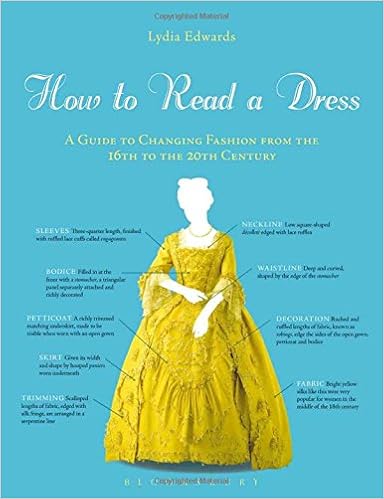
How to Read a Dress by Lydia Edwards
This book is basically an illustrated timeline of western dress, with an emphasis on the "dress". It doesn't really delve into material culture theory or methodology (like The Dress Detective) or the specifics of a particular era, or go into lots of detail. Instead, it's a succinct visual overview of changing silhouettes and styles. The book is arranged chronologically, not divided by region, and focuses only on women's dresses--accessories are only incidentally addressed, while men's and children's fashions are not covered. The commentary is decidedly subordinate to the pictures: while not being left to "speak for themselves", the commentary accompanies the pictures, rather than the pictures illustrating the discussion.
The book is divided into 11 chapters, based on silhouette: the shortest covers a mere 11 years (1918-1929), the longest, almost a century (1610-1699). Each starts with a few pages discussing the popular materials, stylistic trends, and the particular foundation garments in use during that time, liberally illustrated with a mix of portraits, advertisements, fashion plates, and photographs of surviving garments. After the introduction comes 4-12 original garments with commentary. These pages follow the cover design: each dress takes up about 3/4 of a page, with 6-12 comments of 1-3 sentences each, and a short (2-3 sentence) description above. Most examples have a second, inset picture related to the main one--a detail shot, a contemporary accessory, or an old photograph of the dress being worn. Once or twice, a second, full-page image is also included.
I think the strength of this book lies in the many examples--69 featured dresses and extras included in the introductions--and in its neat, chronological organization. Between the examples and the glossary, I think this books is a valuable tool for developing the vocabulary to discuss different fashion eras. I'm also impressed at how much information does end up being included in the single-page allotted to each garment, though I wouldn't mind if the page sizes (and pictures) were larger. Most dresses only have a single picture, but I think the varied use of side-on, front-on, and 3/4-front views allow each dress to be shown to its best advantage. I do wish, however, that the rare two-image dresses used different views*. I think the comments do a good job of pointing out each dress's unique attributes and suggesting topics for further study, without derailing the overall flow of the work.
If you're focusing on a narrow time frame or eager for lots of detail, this probably isn't the book you want. It's worth a chance if you're interested in long-term dress trends, moderate amounts of detail, and/or historic eye candy.
*To be fair, one of the dresses does have a front and back view.
Stars: 4 stars.
Accuracy: High. The pictures are all original dresses--with some original portraits to round out the earlier years--and most of the commentary is annotated. Occasionally, there's a remark or generalization that I would liked to have found a note for, but that's pretty rare.
Strongest Impression: This book is pretty, interesting, and has a lot going for it. I think it does a good job of balancing the level of detail with the scope of the topic, and successfully delivers a thorough, tidy look at four centuries of western dress(es).
Bonus: The cover dress!
Sunday, November 19, 2017
Mood Board: Indian Influence on English Style, 19th Century
The following are visual references related to the VAM's Style Guide: Influence of India.
Kashmir and Paisley
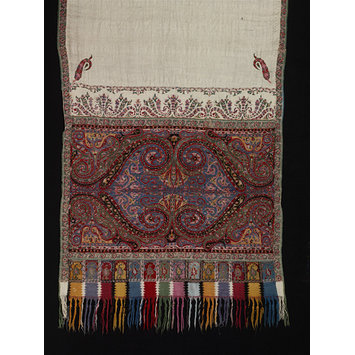
Other Indian styles and decorative elements, while noteworthy, did not have the same wide impact on English dress as the Kashmir shawl. The banyan--worn for gentlemen's undress, like the powdering gown and smoking jacket--in an unusual example of a style of Indian garment being adopted, rather than the decorative motifs being appropriated and applied to English dress. As an example of the opposite, the final piece is an English-style evening gown which had been trimmed with a particularly Indian style of embroidery, incorporating thousands of iridescent eyltra beetle-wings.
Shawls
 |
| Kashmir Shawl, c.1855 Victoria and Albert Museum |
 |
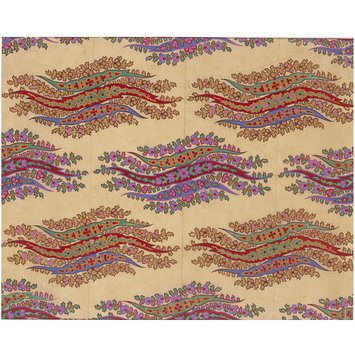
| Kashmir Scarf, 1867 Victoria and Albert Museum |
 |
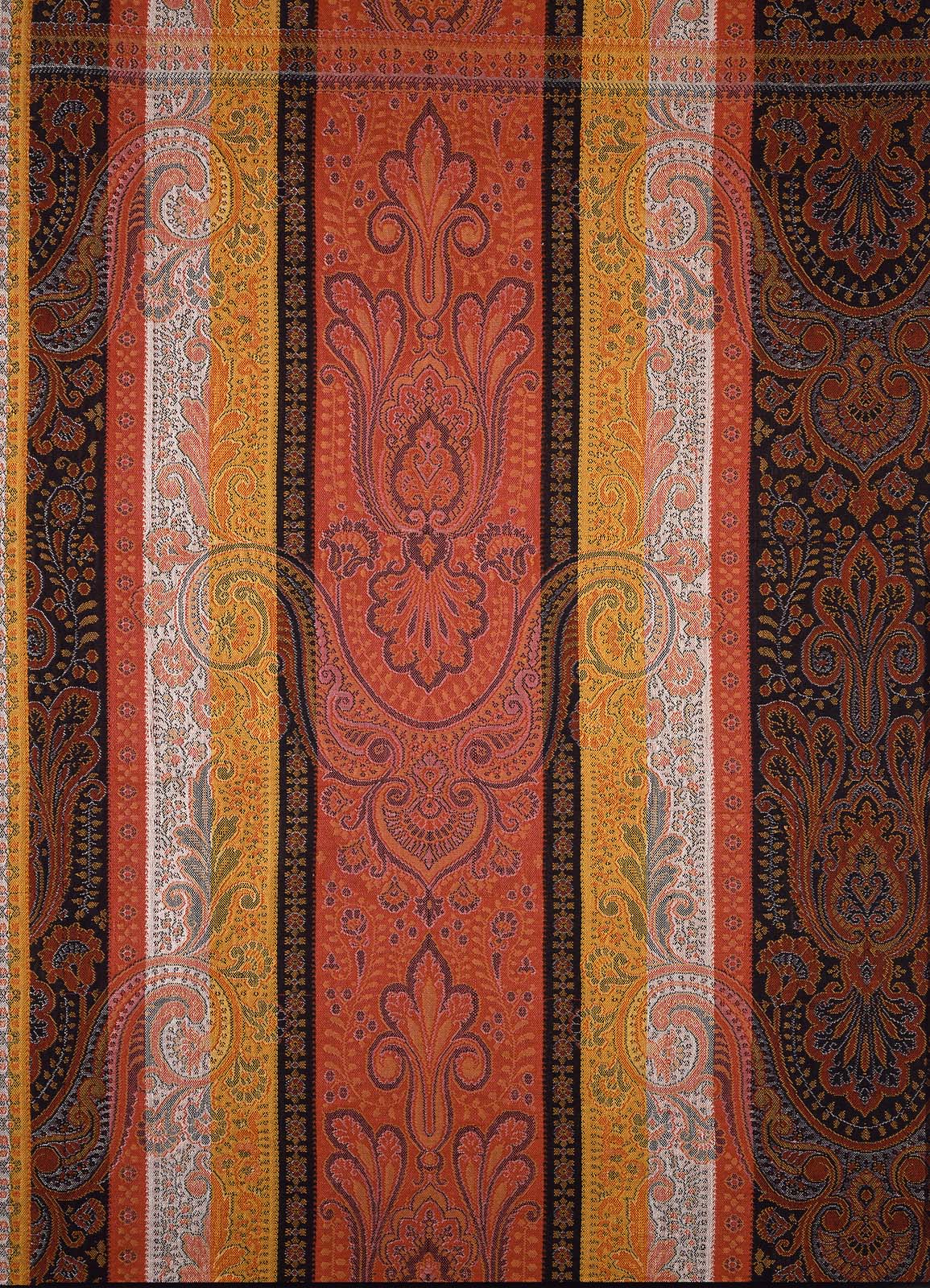
| Shawl design, goache, c. 1850, English Victoria and Albert Museum |
 |
| Paisley Shawl, Scottish, 1865-1870 Museum of Fine Arts Boston |
 |
| Paisley Shawl, Scottish, c.1865-1875 The Metropolitan Museum |
Paisley Dress Fabric
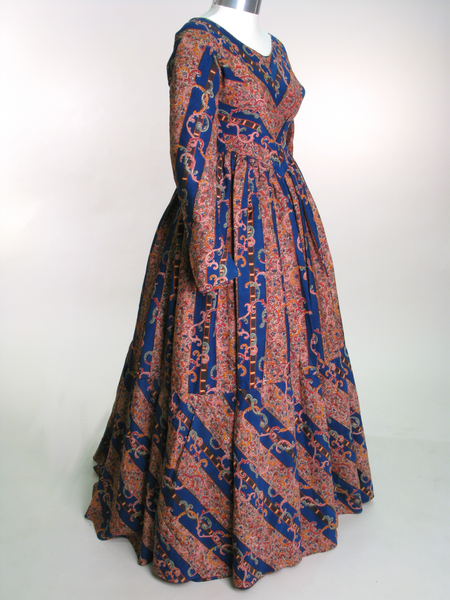 |
| Paisley Print Wool Challis Dress, c.1842-3. Manchester Art Gallery |
 |
| Wool Paisley Print Dress, c.1846-9. Fashion History Museum, Cambridge. |
 |
| Dress of paisley print, c.1850 From the Metropolitan Museum |
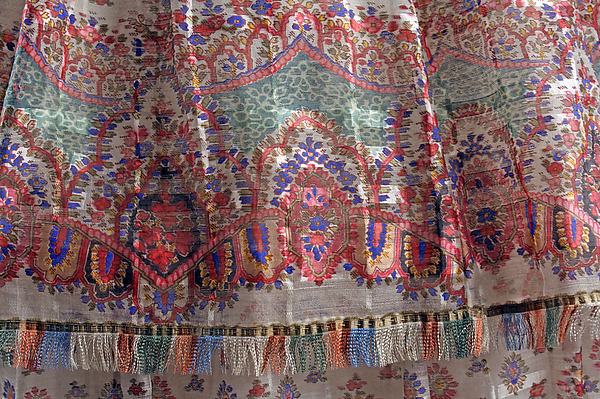 |
| Fabric detail. |
 |
| Dressing Gown, English, 1866. Kyoto Costume Institute. |
 |
| Fabric detail. And those buttons! |
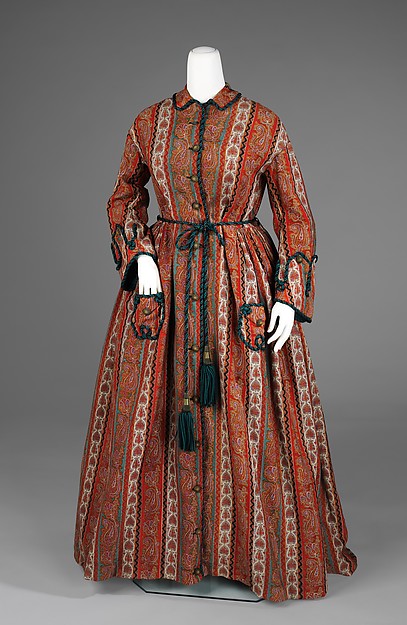 |
| Dressing Gown, c.1875 The Metropolitan Museum |
Beyond Dresses
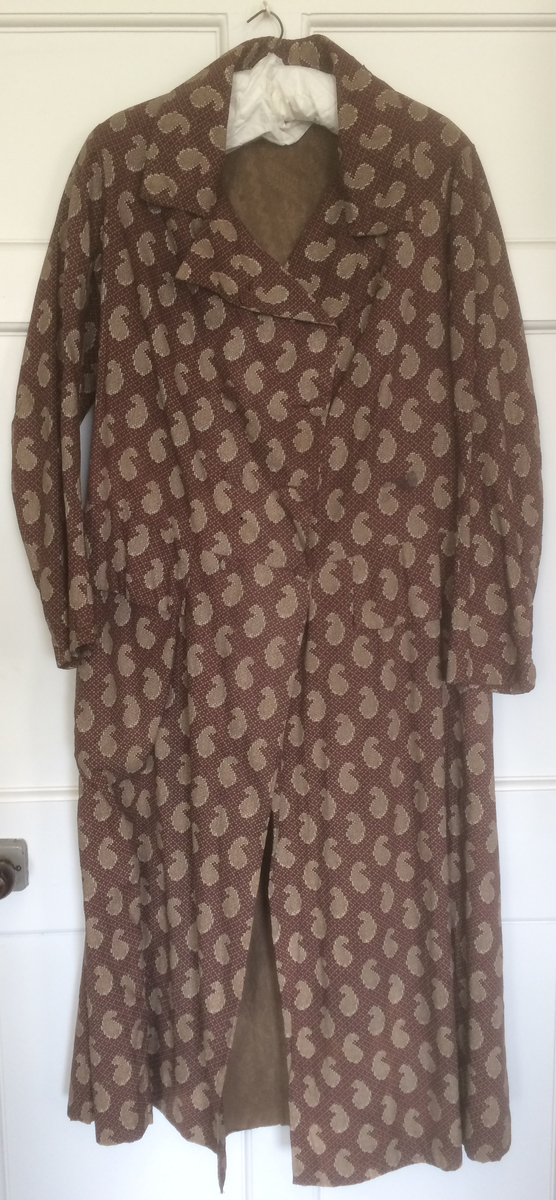 |
| Paisley Print Cotton Coat, c. 1830-1840 Manchester Art Gallery |
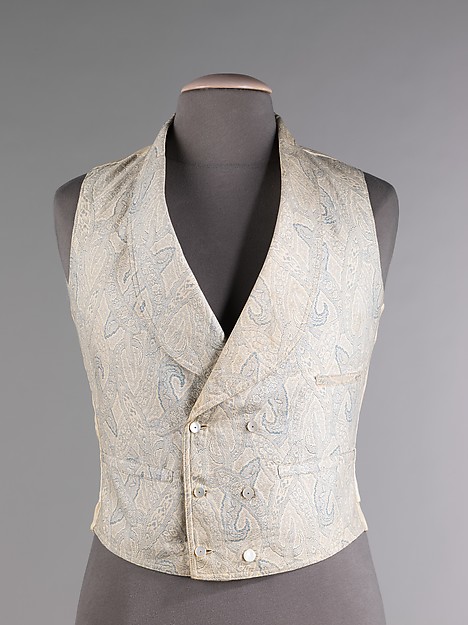 |
| Paisley Vest, c.1860-69 The Metropolitan Museum |
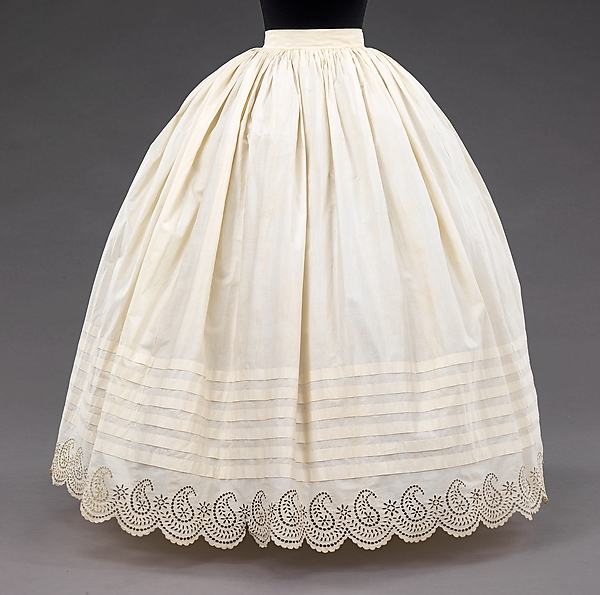 |
| Petticoat with broderie anglaise boteh pattern, c.1855-1865 The Metropolitan Museum. |
 |
| Dolman with embroidered botehs, c.1883-1890. The Museum of Fine Arts Boston. |
Recycled Shawls
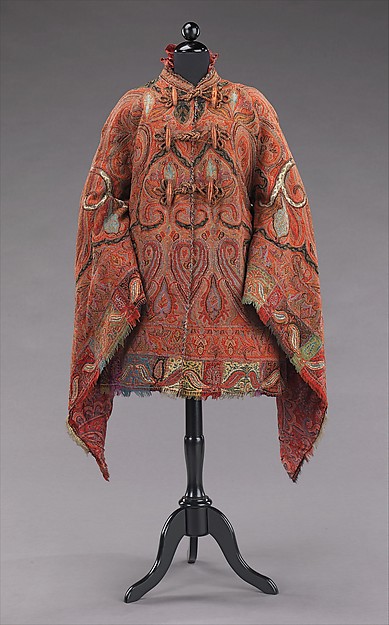 |
| Dolman, c.1875 The Metropolitan Museum |
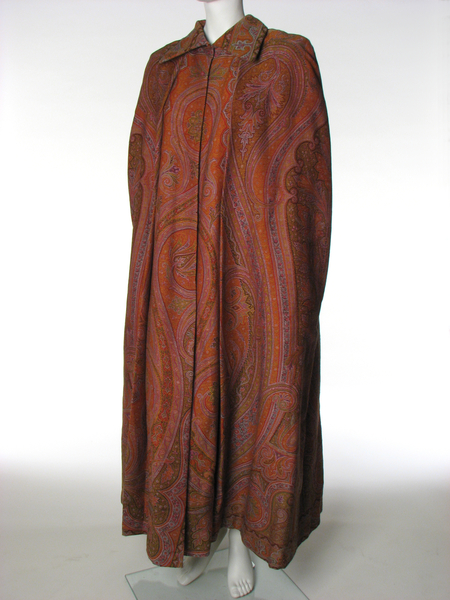 |
| Cloak, c.1880-1890, made from an 1860s shawl. Manchester Art Gallery. |
 |
| Tea gown, c.1891, made from a cashmere shawl. The Metropolitan Museum |
Banyan
 |
| Banyan, c.1880 Los Angeles County Museum |
Elytra
 |
| Evening Gown, c.1850, possibly from India. Kyoto Costume Institute. |
 |
| Detail of the elytra beetle-wing embroidery. |
Subscribe to:
Posts (Atom)