Saturday, August 2, 2025

Pickled Asparagus, 1847

It's been a summer of pickling and making preserves. Back in June I put up three pints of pickled asparagus, based on the 1847 recipe in The Whole Art of Curing, Pickling, and Salting Meat and Fish. I also consulted a modern recipe to ensure that I was meeting safe levels of acidity and determine appropriate processing times.

The two jars of pickles not already eaten.

The big surprise was how little asparagus actually fits into each jars. Even after breaking off the tough portions, I ended up trimming most of the edible stem off each asparagus piece to get a spear short enough to fit in the pint jars. I am now less surprised at 10 lbs being needed to get 6 pints worth of pickled asparagus tips. The 2 pounds of asparagus I had nicely filled one jar with asparagus tips; a second was mostly filled with tips but needed to be supplemented with some of the extra stems to pack fully. 

I used the remaining stems in a third jar, which I opened and used over July 4. Despite being all-vinegar, I actually found these more mellow than most other period pickles I've tried. The mace/nutmeg/cloves flavor combination worked very nicely; I had been slightly concerned about those spices' association with sweetness conflicting with the asparagus. I'd like to try the modern receipt in full next year (garlic and dill is a classic for a reason), but I think this historic flavor profile is also a winner.

Friday, August 1, 2025

Original: Dressing Case, c. 1850

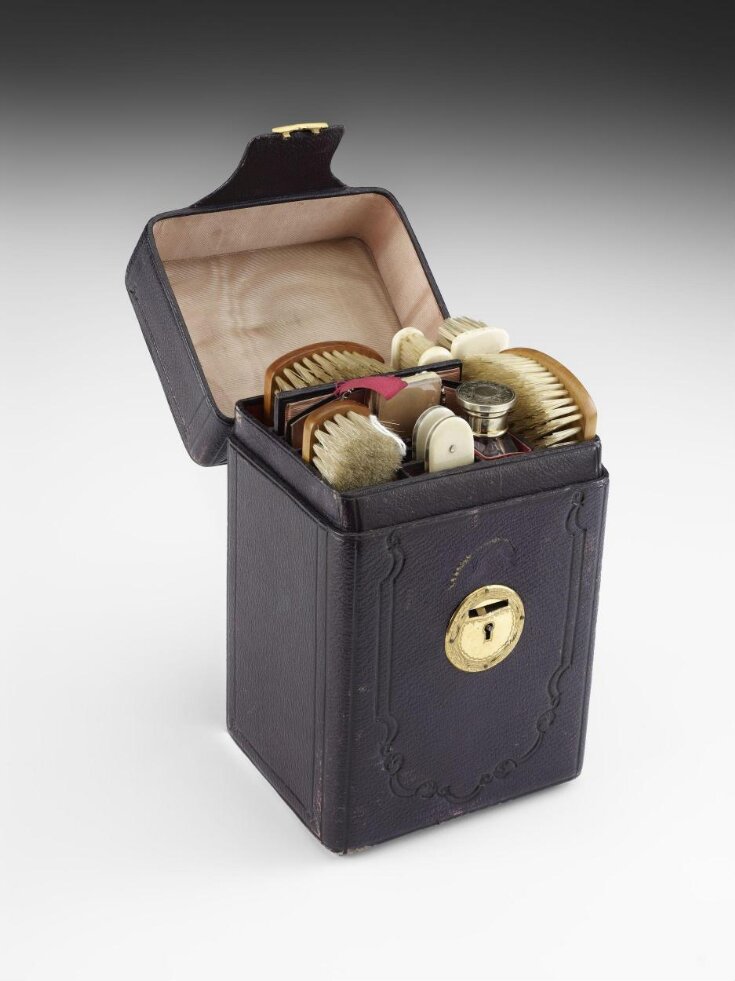
 And now for something clothing-adjacent: a dressing case from the early 1850s.

Dressing Case, c.1850, in the VAM.

I can across this example while researching period nail brushes for my July program at Nisqually. It was fun finding a surviving example of a dressing case to compare with the illustrated advertisements (such as this 1860 catalog, note the similarities to B49 in the upper left corner). I also appreciated that, while it does not have photographs of the different component pieces, the VAM's description of this case includes dimensions of each piece. While period writings mention the use of a nail brush, finding an illustration or description of one had proved more elusive. I'm still trying to figure out if two-sided brushes were used in the 1850s, but the dimensions at least point to this example having a handle, and a small brush-head similar in size to most modern nail brushes. 

The VAM link has more information, but I wanted to mention than this set includes both personal hygiene items and clothing maintenance accessories (clothes brushes and a button hook), as well as a strop for sharpening razors. And then there's a corkscrew.

Thursday, July 31, 2025

July Mending

Too busy to post most of the month, but I did get some mending done this month. My 1850s underthings needed several small repairs (loose seams, a button replaced), and I also got to darn my red stockings in three places.

This break appeared as soon as I finished darning the first two. :(

Wednesday, July 30, 2025

Foods in Season: July, 1861

Late, but technically still in the right months, let's see what Beeton's Book of Household Management has in season in July.

Fish- Carp, crayfish, dory, flounders, haddocks, herring, lobsters, mackerel, mullet, pike, plaice, prawns, salmon, shrimps, soles, sturgeon, tench, thornbeck

Meat- Beef, lamb, mutton, veal, buck venison.

Poultry- Chickens, ducklings, fowls, green geese, leverets, plovers, pullets, rabbits, turkey poults, wheatears, wild ducks (called flappers).

Vegetables- Artichokes, asparagus, beans, cabbages, carrots, cauliflowers, celery, cresses, endive, lettuces, mushrooms, pease, radishes, small salading, sea-kale, sprouts, spinach, turnips, vegetable marrow, -various herbs.

Fruit- Apricots, cherries, currants, figs, gooseberries, melons, nectarines, pears, pineapples, plums, raspberries, strawberries, walnuts, in high season and pickled.

More changes in fish this month (seven new varieties, two removed), but none to meat, and only one addition to poultry (the wild ducks). Cauliflower and cresses are back in the vegetables, also joined by sprouts, mushrooms, turnips, and marrow, though I'm confused at the loss of cucumbers (as my own garden has been producing them in adundance all month) and potatoes (also producing well this month, though starting to wind-down). For fruit, peaches and rhubarb are out, replaced by figs, plums, and walnuts.


Wednesday, June 4, 2025

Foods in Season: June 1861

Let's see what Beeton's Book of Household Management tells us is in season in June.

Fish- Carp, crayfish, herring, lobsters, mackerel, mullet, pike, prawns, salmon, soles, tench, trout, turbot.

Meat- Beef, lamb, mutton, veal, buck venison.

Poultry- Chickens, ducklings, fowls, green geese, leverets, plovers, pullets, rabbits.

Vegetables- Artichokes, asparagus, beans, cabbages, carrots, cucumbers, lettuces, pease, potatoes, radishes, small salads, sea-kale, spinach, -various herbs.

Fruit- Apricots, cherries, currants, gooseberries, melons, nectarines, peaches, pears, pineapples, raspberries, rhubarb, strawberries.

We start with more changes in the fish category (two new, five removed since last month). Instead of a separate game category, venison is added to the otherwise unchanged meat list. Pigeons are out of the poultry category, replaced by plovers, turkey pullets, and wheatears. There are new additions in the vegetable realm with artichokes, radishes and spinach replacing cauliflower and cresses;  I'm confused by the cresses disappearing, since multiple varieties are flourishing in my garden just now (the curly cress has been doing well since mid-May while the nasturtium or Indian cress is just starting to reach useful size). There's even more expansion in the fruit category, losing only apples while apricots and currants come into more general use and peaches, pears, pineapple, and raspberry are all starting.


Monday, June 2, 2025

Revisiting Tea Cakes (1855)

Needed something sweet for Steilacoom, so I decided to revisit the tea cake receipt from Cookery, Rational, Practical and Economical (1855). This time I tried increasing the spices to 2 tsp cinnamon and 1 tsp allspice, the combination of which made for more flavorful cakes. I like that this recipe is already on a small scale (8 flour, 5.5 oz sugar, 4 oz butter, 1 egg; makes 2 pans of cookies), though I had forgotten just how dry the dough is. It takes a lot of hand kneading to get all the dry ingredients worked in, and ends up making a rather grainy dough as a result. The cakes were a bit dense (as usual for this kind of biscuit/cake/cookie), but are perfectly serviceable for serving with tea.

Small tea cakes flavored with cinnamon and allspice.

Being pressed for time, I tried just shaping these cakes with my hands (roll into small balls and flatten rather than rolling out a sheet and cutting them). It worked tolerably well, and made 3 dozen ~1.5" diameter cakes. I do think the texture could be improved by letting the dough chill overnight and then rolling them out, which is what I will plan to try next time.

Sunday, June 1, 2025

Original: Seaside Outfit, c.1864-1867

Cotton seaside ensemble, c.1864-7, in LACMA.
 

Something summery this month! I selected this sacque-and-petticoat outfit partly for the seasonal theme, and partly because it breaks all the 'rules' (read: general trends) of reproducing 1860s dresses. It's a two-piece outfit; the bodice (sacque) does not closely fit the figure; and the fabric is a solid cotton (no printed design in sight). And it's covered in embroidery! But there are reasons for all of these departures from the norm, which is that this is a very specific kind of outfit, made of a very specific kind of fabric, worn by very specific people for very specific purposes.

In short: this is a rich person's casual summer recreation outfit, intended for outdoor daywear in a "watering place" (read: seaside resort full of other rich people relaxing and having fun outside). The loose fit of the sacque makes the whole thing look relaxed and informal, while the unprinted white cotton should both look and feel cool in the summer heat. And that isn't just any kind plain cotton: it's a cotton pique, which as far as I can recall is only used for summer wear (and is one of the few solid-colored cotton materials to feature in women's dresses of the period). And the white won't be fading or crocking; not that this need be a concern, because the person commissioning hyper-specific garments for hitting the beach on vacation is not someone trying to eke out a meager clothes budget, and can readily replace this outfit when it starts getting dingy or dated. Note also the long train on this skirt: it's meant to be worn over the fashionable elliptical hoops of the later 1860s, despite the ostensibly 'relaxed' show made by the sacque.