Wednesday, November 25, 2020

Book Review: Fashion Victims

by Kimberley Christman-Campbell.


This is one beautiful, big book. It combines the lavish illustrations of a coffee table volume with the research of an academic journal, and a highly readable narrative voice.

Fashion Victims runs 319 large (9.5" x 11") pages, exclusive of notes/bibliography, with 245 images (all in color, and up to a whole page in size). The images are largely contemporary portraits and fashion engraving, though a fair number of original garments also appear--all beautifully mounted museum specimens, including one of the only surviving examples of a chemise ala Reine.

The book is divided into twenty chapters in four roughly thematic sections. Some chapters focus on the sociopolitical and economic contexts for 18th century French high fashion--such as the rise of celebrity fashion designers and fashion publications, or the traditional divisions between royalty and fashion fads. Other chapters explore particular stylistic fads (orientalism, fashions ala Figaro), or clothing for specific occasions (mourning, court dress), or iconic garments (the pouf, the chemise dress). The book is very specifically focused on the 1770s-1780s in alignment with the 1774-1792 reign of Louis XVI and Marie Antoinette. The final chapter explores the affect of French emigres on European fashion in the 1790s-1800s, up to the 1814 Bourbon restoration.   

If you were curious about the development of fashion culture in and around Paris in the latter 18th century, this is the book for you. It looks at not only how fashion developed as a career/hobby/lifestyle, but also how fashion was perceived in the wider society, and how fashion affected and was affected by politics. The book covers people as well as trends, and philosophies. So if you want to see a ton of lovely Vigee-Lebrun portraits, learn about the origins and applications of the 'pouf', and better understand Rose Bertin's career trajectory, this is an excellent book for it.

My only caveat is that it's not a quick and easy read nor is it a flip-through reference. I found the individual chapters suited to pleasure reading, though the book itself is a bit too large and heavy for reading on the go.

Stars: 5

Accuracy: A thoroughly-researched book with full citations.

Strongest Impression: Thoughtful, informative, and beautiful. An excellent resource for those doing late 18th century costuming, or otherwise studying/writing about the period. 

Monday, November 9, 2020

Hair Lacing, Medieval/Renaissance

I decided to try properly lacing my hair (not just tying the braids), since the Tudor Tailor has spent quarantine producing a series of videos about this very topic, and it looked like fun to try. 

The author, wearing her Tudor kirtle and smock, with hair laced and stitched into a coronet at the back of the head.
Solo hair lacing, day three attempt.

The whole style, after combing/parting, took 6:55 to complete. Two minutes of this was braiding, one minute was pushing the braids around on my head pointlessly, and the remaining 3:55 sufficed to thread the bodkin twice, stitch down the hair, and tie the ends of the laces. I expect to speed up with practice. I didn't use a mirror or modern styling tools, because that felt like cheating (and probably wouldn't have helped anyway).

The author, as before, holding a two-sided wooden hair comb and a blunt 4-inch needle made of bone.
Tools used: bone bodkin, wood comb, 2 2-yard linen tapes.

I found, experimentally, that the one of the just-over-two-yard tapes I wove for tying up my hair isn't quite long enough for this technique on it's own. Which makes a certain sense--I made the pair with the intention of using both to braid and tie my hair in this exact style. The Tudor "hair fairies" recommend a single 3-yd lace, which I was able to emulate by overlapping the two laces--instead of knotting them together, I braided a short length of each into the opposite braid, letting them cross at the back of the head. This anchored the tapes soundly, leaving a long tail to lace each braid with, and securing the extra ends away within the braids themselves.

Other initial lessons: this style is very convenient for tucking the hair away to sleep, with no lumps at the neck/back of head (even if it looks awful the next day--though I should see how it works with a coif overnight...). It will stay up for a whole day, including exercise, and doesn't have the 'strain' that a modern bun held with elastics develops over that time. My first attempts tended to stay "up" but slide back and forth on top of the head. I'm not sure whether this was because I was stitching through the braid or not starting at the hairline, but once I took my stitches from the far front and around the whole braid(s), everything stayed better in place. Two overhand knots (half hitches) work great for tying the end of the braids. Also, my hair is at a slightly awkward length for concealing the braid ends (they wind up just past the roots of the opposite braid), so I'll need to practice tucking those neatly or catching them in the opposing lace. 

Thursday, November 5, 2020

HFF 4.23: Comfort Food

Detail of an 1850s painting, showing a woman's hands arranging a table full of beautifully plated food.


The Challenge: Comfort Food--make a dish that's comforting to eat or comfortable to make.


Gingerbread, Poor Man's--Molasses, 1 cup; sugar, 1/2 cup; 1 egg; buttermilk, 2/3 cup; lard or butter, 1 table-spoonful; ginger, 1 table-spoonful; cinnamon, 1 tea-spoonful; soda, 1 tea-spoonful; flour, 2 cups. "A.Y.E." of O'Brien, Iowa, says of it "Good and very cheap. [See, also, "Poor Man's Cake."] 

New recipe, but gingerbread was my first solo foray into period cooking, so it always feels a bit like coming home.

The Date/Year and Region: 1887, Detroit, Michigan

How Did You Make It: Here's a book that doesn't even bother to tell you to "make in the usual fashion"--you get an ingredient list and maybe some anecdotes about how good the editor is at assessing new recipes. That's only a slight exaggeration.

I mixed the ginger, cinnamon, sugar, and molasses together, added the egg and butter, dissolved the soda in the buttermilk and added it, then finished by mixing in the flour. The soda and buttermilk reacted enough to get some bubbles going; the mixture ended up making a moderately viscous batter.

I baked the gingerbread in a glass loaf pan at 350F for ~35-40 minutes (I did 15, but lost track of the times I added 5 minutes since the center would not set). [Edited to add: I tried a second batch, to use up that buttermilk, and baked it for  ~ 1 hour at 325F with parchment paper lining the loaf pan. It cooked through as before, without the edges getting overdone.]

Time to Complete: On the order of 50 minutes to mix and bake.

Total Cost: About $7 for buttermilk and molasses, though I could get three batches of gingerbread out of those quantities.

How Successful Was It?: Tastes just like my family's Christmas cookies: molasses and ginger and cinnamon. The texture of this gingerbread is soft and fairly moist--almost a little too much, so, as though the center didn't quite cook through. The edges were starting to overcook when I pulled it, so next time I'm tempted to line the pan with parchment paper and try for a longer bake. Or maybe just put it into a larger pan so it's less thick; I observe that one recipe-batch does neatly fill a loaf pan.

How Accurate Is It?: I'm not sure how modern buttermilk compares to traditional, but I didn't make any intentional substitutions or notice any unintentional errors.

A loaf of gingerbread on a transferware plate. Two slices have been cut off the loaf and placed in front of it on the plate.
Tasty on its own or with tea.


Wednesday, November 4, 2020

Berlinwork Card-Case, 1861

Here's my final contribution to the Fort Nisqually Foundation's fundraiser auction


Berlinwork Card Case, 1861 Style

It's a Berlinwork card case, from instructions in Peterson's Magazine in November 1861. A decorative card case, usually carried in the hand, holds a lady's cards when she goes out visiting (see Virginia Mescher's article for more details). For the reenactor, the case will also conveniently hold business cards, a driver's license, bank card, etc.


The embroidery schematic in Peterson's.


Per the magazine instructions, the embroidery is worked in red, black, and two shades of blue wool, with yellow silk floss, and the beading in alternating white and clear glass seed beads. The total design is 4,602 cross stitches, with 348 beads (excluding the edging).


Modern business cards fit neatly inside.


Back of the case, showing the motifs.


I originally made one of these cases back in 2013, using cotton DMC on regular needlepoint canvas. It turned out just fine (and I've been using it ever since), but I think I prefer the warmer look of the wool embroidery. The bead edging went much more smoothly the second time around, too. However, I think the contrast between the two blues is clearer on the cotton case (a benefit of being able to choose the floss in person).

The wool/silk case (left) and my cotton floss prototype (right).


Tuesday, November 3, 2020

Kitchen Garden, November 1819

Harvesting, but also planting for next spring. I really love the details of how microclimates are used to ensure fresh vegetables through the winter, and which vegetables those are.

Carefully weed all late crops. Dig up a border under a warm wall, and sow carrots for spring--also some radishes, in such another place. Turn the mould that was trenched up. Prepare hot-beds for salading; cover them five inches with mould, and sow upon them lettuces and small salading. Plant another crop of beans and peas. Trench the earth between your artichokes, and throw some earth over the roots. Make a hot-bed for forced asparagus. Take up carrots and parsnips, and lay them in sand for use. Give air occasionally to plants in hot-beds, and under hand glasses. 
-Modern Domestic Cookery, and Useful Receipt Book (London, 1819)

Monday, November 2, 2020

Mid-Victorian Mourning Practices

This All Soul's Day seemed timely occasion to update and re-publish my 1850s-1860s mourning research. This work was originally posted to the 4th US blog back in 2015. The focus is on European-American mourning practices c.1855-1865, with some earlier/later and foreign sources (primarily British). 

***

Given the strongly negative depictions of Victorian mourning practices in modern media (for which I continue to blame Margaret Mitchell), I think it's worth starting any discussion of the topic with this premise: most people mourning a death during the 1850s and 1860s were, in fact, mourning. They might be mourning a close relative or companion, someone they had lived beside for years. They might be paying a token of respect to a distant cousin, a fellow member of an organization, or a benefactor. They might be briefly altering their behavior and dress to show compassion for a friend or neighbor who has experienced a loss. These were real emotions felt by real people, and the mourning rituals of the mid-19th century developed to support them. Our interpretation of mourning as living historians should respect those experiences and the people who had them. Once again, I will link to Betsy's insightful post On Mourning Impressions, which discusses interpreting this topic with delicacy.


A painting of two women wearing black mourning attire in a church; one stands to light a votive candle, the other sits beside her.
In Memoriam by Alfred Stevens, c.1861
Museum of Fine Arts, Boston

At their heart, mourning rituals offer an outlet for grief, allowing the living to express their respect for the dead and their emotions about the loss. As a social custom, mourning attire and practices signal to other people that a death has occurred, allowing them to modify their behavior towards the bereaved. This is known and spelled out in the literature of the mid-19th century:

"The chief use of mourning attire is to express our grief and humiliation, and to remind us of our bereavement on those occasions, when we are liable to be gay and thoughtless. It is also a caution to others, not to converse on light or mirthful topics in our presence; yet we should not speak of death to one who wears a weed." 
-George W. Hervey, The Principles of Courtesy (New York, 1856)

As referenced before, people mourn for various reasons and relationships--and so the form that mourning takes also varies.  I think this variety is part of the reason why mourning comes across as a complicated and baroque institution. The minute gradations in mourning are perceived as dictating how one is supposed to feel and time limits during which one must display accordingly. I find it more helpful to frame the topic as there being an array of options to express the depth of one's bereavement, as well as a built-in ritual for resuming normal costume and behavior.
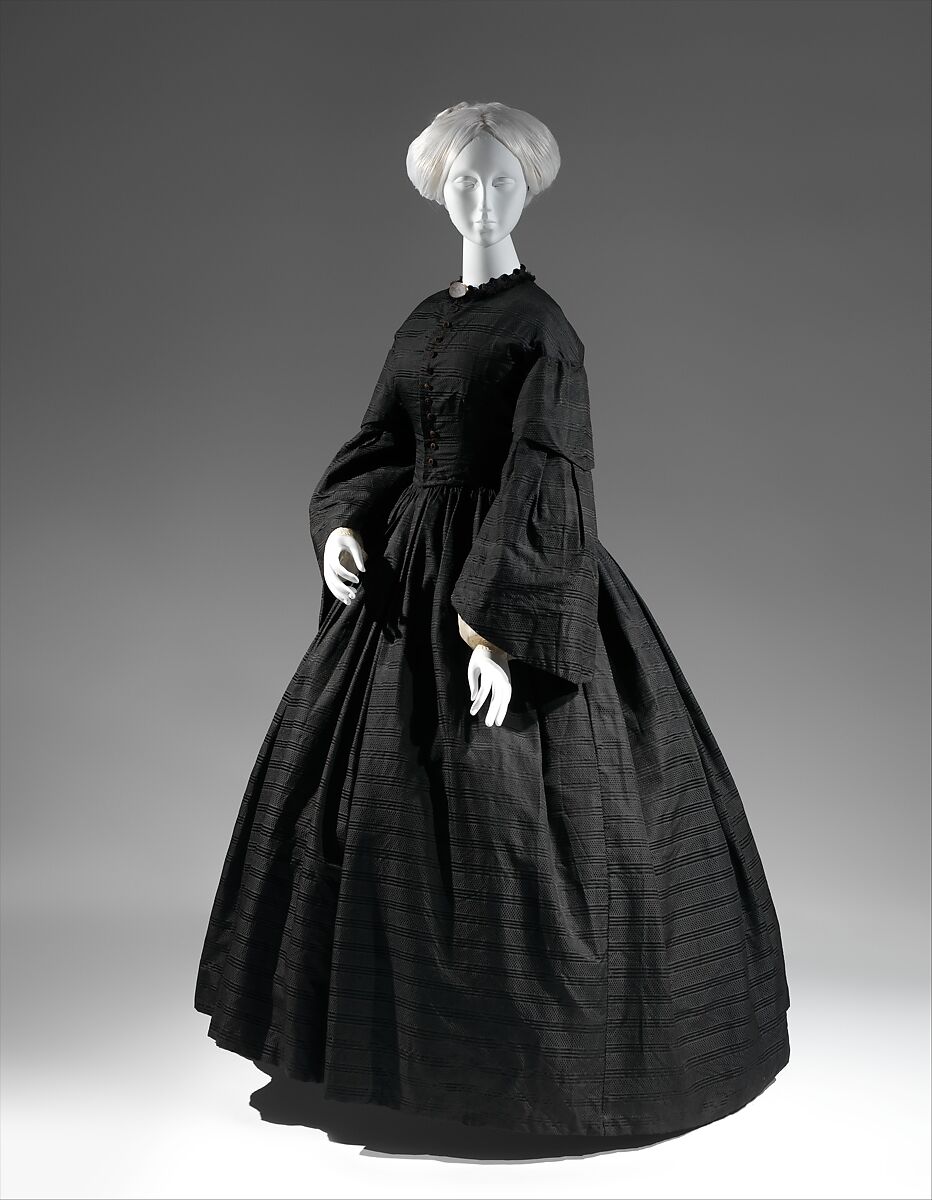

Mourning Dress, 1850s, from the Met

Duration

There are numerous terms and gradations used to describe nineteenth century mourning attire. As a general rule, they all come down to 1) the darkest and most somber mourning is worn by the people who were closest to the deceased, and 2) those people most severely affected by the loss take some time off of society to mourn, and signify their return to normal activity through gradual changes in dress. Generally speaking, a person who loses a close relative and goes into deepest mourning will begin the process by wearing matte black fabrics (especially crepe/crape and bombazine*), and slowly add in white, more lustrous blacks, and black/white ornaments, then shades of purple and grey, easing back into full colors over time. A less close relative will progress more rapidly through each stage, while distant relations and friends forgo the 'deepest' stages at all.

"Among all civilized modem nations there is a great similarity in mourning customs, and black is universally considered the proper color to be worn, although in the fashions for ladies' dresses modern refinement has gone so far as to symbolize the gradual change from the depth of affliction to a normal state of cheerfulness by a gradual return from black to the gay colors through the intermediate hues of purple and violet, which are recognized as 'second mourning.' The material of a mourning dress is also prescribed by fashion, being for ladies generally crape. The time varies, according to the degree of relationship of the deceased, from a week to a year, the latter being the period fixed by custom for a widow."
-The New American Cyclopedia (1861)

*Both crepe and bombazine are very matte materials with pronounced diagonal patterning. Colored crapes and bombazine were available for general wear, but black crepe and black bombazine were highly associated with mourning, to the point of being iconic. Bombazine is a 2,1-twill woven with a silk warp and wool weft. Crepe is a gauze weave made of raw silk, the twisted threads giving its diagonal pattern effect. Per Textiles in America, wool or wool-silk crepes were also available. The closest modern equivalent, to my knowledge, is a crinkle chiffon, though it needs to be chemically stiffened and cut on the bias to imitate the body of a crepe and its distinctive diagonal lines. 


Crepe or bombazine, 1870s. UK National Trust.


How long one wears the different degrees of mourning varies based on age, gender, relationship to the deceased, means, place of residence, and personal sentiment.  Again, generally speaking, the closer the relationship the deeper the mourning; men aren't expected to display their mourning as long or as elaborately as women; poor people will display less than wealthy; and persons who feel strongly may choose to draw out their time in mourning attire (and conversely, people who can wear mourning and do not may be perceived as unfeeling). 

The most comprehensive period reference I've found for duration and types of mourning attire is an editorial in Godey's from September 1854.  This article emphasizes the need for one's own sentiments to dictate the terms of mourning apparel, and suggests that white be worn both to mourn children and by children in mourning. Though condemning codified mourning, it give as an example "one year for a parent, husband, brother, sister, or child. Six months for grandparents, uncles, or aunts. Three months or six weeks as a token of respect to the memory of a cousin, friend, or remote relative, or anyone who leaves the wearer a legacy." Beyond this article's emphasis on sentiment, the same issue of the magazine features a lampoon of these sorts of codifications in mourning.

The Workwoman's Guide (London, 1838/40) is another which lists time ranges for wearing mourning clothes: 1-2 years for a spouse, 6 months to 1 year for a parent or a child over 10 (3-6 months for a younger child, and 6 weeks or more for an infant), 6-8 months for a sibling, 3-6 months for an aunt or uncle, six weeks to 3 months for a cousin or an aunt/uncle by marriage, and three weeks or more for friends and more distant relatives. Thirty years later, The Art of Dressing Well (1870) would concur on the upper end of this scale. It specifies that widows should wear mourning for two years (one year in deepest black, half a year in less severe black, and half a year in grays/purples). It goes on to explain that mourning is worn for one year for parents and children; six months for grandparents, siblings, and friends who left bequests; and three months for aunts, uncles, nephews and nieces.  The last is done in second mourning only (white, black, grays and purples); for the rest, half of the mourning period is spent in the deepest blacks, then a quarter in black/white, and the last quarter with greys and purples.

The Principals of Courtesy (1856) differentiates between widows wearing mourning attire for 1 year and 6 weeks after the death of a spouse, while widowers do so for only 6 months. In either case, the mourning period ends early if the survivor remarries--though the second wedding should be more somber than the first was. As previously noted, The New American Cyclopedia (1861) assumes widows will wear mourning for one year. The one thing all of these sources agree on is that the longest duration of mourning is the widow's.

For public figures, or classmates, or fellow members of clubs, mourning badges might be adopted for a short time. These may be devices made of crepe or simple armbands, generally worn on the left. They are also used for official purposes: worn by soldiers on parade at funerals, or public servants following the death of a president. In some public instances, as for royalty, slight mourning may be worn widely; "court mourning", for those attending on the royal family, can be highly formalized 
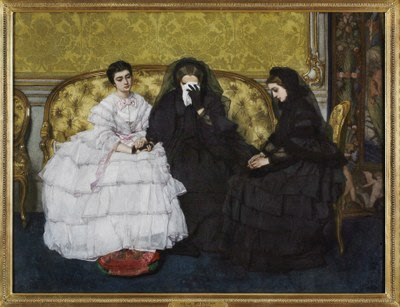

An 1857 painting of three somber women sitting on sofas: two are dressed in black mourning attire and the third in white.
La Consolation ou La visite de condoléances, by Alfred Stevens, 1857
(Consolation or The Visit of Condolence) Musée d'Ixelles

Activities

A defining feature of mourning is the lack of social activities. Men must still go to work, but women are granted a sort of 'bereavement leave' from society and hosting.  Balls, dinner parties, and amusements are right out...with some exceptions. In lieu of the usual social visits, friends and associates make visits of condolence to the grieving household. Who exactly attends the funeral is a slightly controversial subject, which varies over time and locale.

The Principles of Courtesy (1856) specifies that visits of condolence, made in the week after the funeral, should be short, somber, and sensitive to the bereaved. The Young Lady's Friend (1857) concurs, stressing the need for sympathy and compassion, and the difficult line between not distressing the bereaved further, and not being too cheerful. The Habits of Good Society (1859) deplores these visits, but concurs about the time frame and the difficulty in making appropriate conversation. Etiquette, Social Ethics, and the Courtesies of Society (1854) recommends the visitor on such an occasion wear "black silk, or plain-coloured apparel" to show sympathy with the family; it also advises that 'slight acquaintances' make their visits of condolence after the family has resumed attending church services.

The Art of Dressing Well (1870) advises that "Ladies invited to funeral ceremonies should always wear a black dress, even if they are not in mourning, and it is bad taste to appear with a gay bonnet or shawl, as if it were a festive occasion." This supports the attendance of women at funerals by 1870, though I've found fewer solid descriptions from the 1850s-1860s for what these women were wearing.  The Principles of Courtesy (1856) confirms that female relatives and non-relatives attended funerals. Contrary to the above, The Hand-Book of Etiquette (1860) claims that "according to modern etiquette, ladies do not attend funerals", which are "too mournfully exciting" for them. This is qualified with the acknowledgement that some women "brave the excess of grief", and goes on to describe female relatives (both gentry and working-class) wearing black hoods and capes when they do attend funerals. The former, apparently, only rarely attend funerals, while working class women are said to do so regularly. An account of British nurses in the Crimean war mention the female nurses attending a colleague's funeral in their "black capes and hoods", some even acting as pall-bearers.

[To be continued in Part II: Mourning practices in contemporary literature and fashion magazines.]


Sunday, November 1, 2020

Original: 1843 Silk

An off-white silk dress with faint stripe pattern. The skirt is floor-length and full; the sleeves full-length and tight; the bodice has a deep V neck and is arranged in a series of vertical tucks stitched flat near the waist and opening up towards the shoulders.
Silk dress c.1843, in The Met


I do like it when I find a dress that challenges my assumptions of an era. For instance, I generally dislike 1840s attire, from the overall droopy aesthetic (having spent too long in the floofier 1850s) to the tight sleeves (which do not flatter me), to the way the bodice fullness is handled over the bust (which can get very awkward). This dress, however, has really lovely clean lines which show off the silken sheen to perfection.