Wednesday, July 1, 2020

Original: First Empire Hat, c.1811

Hat, French, c.1811. From the Met.

This hat is perfect. I love the contrasting colors, the helmet shape with tiny brim, the plume-like fabric rosettes, and especially that chin-strap. It's trying so hard to be a military hat, and makes me want to assemble a Regency/Empire-themed marching band. I very much want to see hats like this appear in more Jane Austen adaptations: it's just too much, and I love it.


Monday, June 29, 2020

Renovated Renaissance Smock

After four years of wear, I decided to remake my first 16th century smock.

The problem was that the sleeves were too short by an inch or two. It was wearable, but any sort of arm extension would leave the cuffs tight below the wrist, and putting strain on the side seams below the gussets. Unfortunately, I really like how the buttons and cuffs turned out, so lengthening the sleeve ended up looking like:
  • Remove sleeve from smock.
  • Remove gusset from sleeve.
  • Piece 3" strip of linen to upper sleeve (and fell the seam; piece width includes extra allowance for felling).
  • Reattach gusset to longer sleeve and close the extra underarm seam length (and fell the seams).
  • Reattach sleeve to smock (and fell the seams).
  • Take apart the side-seam at the same time, and re-do it with proper felling so the allowances stop fraying.
  • Decide that the collar pulls weird, and add the shoulder gussets omitted last time.
  • Piece neckband to fit the larger opening.
  • Realize the neck is now too large, revert to earlier size, but add small tucks to ease the fabric. 
  • Make new thread loop fastener, replace broken thread reinforcement at center front slit.

Close up of a white linen shift, showing piecing at the upper sleeve.
I'm more excited for this shift than I probably should be.

The process ended up more involved than it's appearance would suggest, but it's now more comfortable and fits better (and hand-sewing linen is always a treat). I think the most surprising thing was how large and awkward the collar stitches looked to me as I was undoing them--my default stitch to reattach the collar was about half the length of the previous work.

Saturday, June 20, 2020

HFF 4.12: Get Saucy

Detail of an 1850s painting showing a table laden with food, and a woman's hands holding a spoon over a dish.


The Challenge: Get Saucy--Make a sauce, relish, or topping.

The Recipe: Sauce d'Oignon/Onion Sauce from A New System of Domestic Cookery

The Date/Year and Region: 1844, Philadelphia [from 67th London edition; 1st London edition 1805]

How Did You Make It: Boiled half a onion in 1 cup of milk. Attempted to crush the onion, then boiled it a second time in 2 Tbsp butter, with a splash of the milk. Added a splash of white wine vinegar, and served hot.

Time to Complete: About 40 minutes

Total Cost: All ingredients on hand already.

How Successful Was It?: Tasted fine--basically just of onion. I served it over chicken and mashed potatoes, and thought it was very tasty. The texture was a bit chunky, however. I think if I were trying this again, I'd cut the onion much finer to start, and try to have an appropriately-sized mortar and pestle for the crushing. The boiled onion pieces were so soft that neither a knife, nor any of the other implements I tried was very effective on them. 

How Accurate Is It?: The texture, as noted was less sauce-like than I think it is intended to be. I used skim milk and a local yellow sweet onion, though I think a white onion would work very well. As none of the other proportions were given, I just sort of guessed. I think it turned out pretty well, though I probably could have gotten by with less milk and a little more vinegar.

A dinner plate with chicken, mashed potatoes, and bread. A chunky onion sauce is on the chicken.
Onion sauce on chicken and potatoes.

Monday, June 1, 2020

Original: Early Worth Gown

Worth & Boberth Gown, c.1862-1865. The Met.
I love the pale purple color of this dress, and the interesting placement of the self-fabric trim. Not so sure about whatever's happening with the tails(?) on the front bodice, though...

Sunday, May 31, 2020

HFF 4.11: Commemorative Dishes

Detail of an 1850s painting showing a table laden with food.


The Challenge: Commemorative Dishes. Try preparing something associated with a famous event or person.

The Recipe: Washington Cake from The Prairie Farmer

The Date/Year and Region: 1843, Chicago [possibly reprinted from a Michigan publication if I'm understanding the abbreviations]

How Did You Make It: On a 1/3 scale, still minding those eggs.

I melted 1/3 oz of butter (~2/3 tsp) in 1/3 quart skim milk (~ 10.5 fl oz), added it to 2/3 lb flour (~5 1/3 cup) with 1/3 tsp salt and 1 tsp yeast, and 1 egg. After kneading the dough, it was allowed to rise overnight* (~10 hours) in the pan and then baked for 25 minutes at 350F, and then kept a further 15 minutes in the cooling oven.

*Not the recommended modern food safety practice, what with the dairy and egg. I tried it as an experiment, since no one but me will be eating this loaf.

Time to Complete: About 11 hours, including rising and baking time.

Total Cost: About $1.50 for 1 loaf.

How Successful Was It?: Though called a cake, this is really a bread, albeit one that's light and has a very nice texture. It tastes like white bread-- rich, but fairly bland. Eaten with butter, I think the bread could use a bit more salt. It's fine with jam or with gravy at dinner.

It's nice enough, but not spectacular. I think I prefer the Sally Lunn recipe for making a rich bread that will be eaten promptly, though this might have a place for a fine, rich bread that keeps longer than a few hours (with modern concessions for food safety).

This 1/3 scale recipe perfectly fit a standard (8-1/2" x 4-1/2" x 2-1/2") loaf pan.

How Accurate Is It?: Without context for "1 pennyworth of yeast", I ended up using 1 tsp of dry active yeast, based on modern proportions of yeast to flour for overnight breads. The milk is skim. I used an available pan, though I'm not sure the loaf pan would be the preferred period shape.
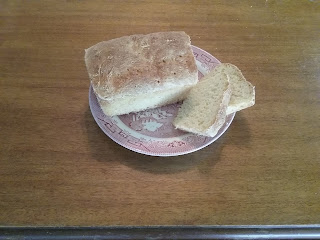
A loaf of home-made white bread on a pink transferware plate; two slices have been cut off and laid down next to the rest of the loaf.
Washington Cake is... a nice but boring white bread.

Wednesday, May 20, 2020

HFF 4.10: Sing For Your Supper


The Challenge: Sing for your supper! Make a dish associated with a song or with music.

The Recipe: Little Patty's Cakes from Domestic Management; Or, The Healthful Cookery-Book
[A bit of a stretch, since as far as I can tell the name is coincidental and has nothing to do with the rhyme.]

The Date/Year and Region: 1813 (2nd ed), London

How Did You Make It: On a quarter scale, since I have to mind how quickly I use eggs. I rubbed 2 oz of butter into 4 oz flour, added 2 oz sugar, 2 oz currants, 1/4 tsp ("a little") ground mace, then moistened the mixture into a sticky dough with 1 egg. The instructions say to lay small pieces in a buttered tin, which I'm interpreting as baking like a cookie (though whether drop or cut-out, I couldn't say; I went with drop this time). Baked 350F until the cakes just started browning; it was to be "half hour in a quick oven", but I was skeptical of anything so cookie-like taking that long on anything other than a very slow oven--and, more importantly, forgot to set the timer.

Time to Complete: About 10 minutes to mix up, uncertain baking time.

Total Cost: About $1 (everything on hand, estimating from usual butter/egg prices). 

How Successful Was It?: Very tasty. The texture and density is ultimately very similar to every other cookie-like sweet biscuit or small cake I've made from this period, but I think the currants and mace are my favorite flavor combination so far. For a change, I think I guessed right the first time on the spice amount--it's distinct and flavorful, but not at all excessive.

How Accurate Is It?: I mixed these cakes by hand (mostly being too lazy to haul out the mixer for such a small batch); as usual, zante currants substituted for the real currants. As already mentioned, it wasn't clear how the cakes should be shaped, though I think the drop method was perfectly serviceable, I could probably make them neater on a second try.

A pink transferware plate with 12 currant-spotted cookies.
Not the prettiest, but very tasty.


Friday, May 1, 2020

Original: Gothic Brocade Ballgown

Ballgown, British 1842. The Met.
I'm always a little surprised when I find an 1840s dress that I like (spent too long in the 1850s), but the conrasting front panels with the lattice-work trim is lovely. This one has a whole write-up on the Met's website, and the large-scale image really showcases the 18th century brocade and delicate looped details of the trim.