Friday, July 19, 2019

Walking Parasol, 1840s-early 1850s


A newly recovered 1840s/early 1850s walking parasol. It has a white-painted wood handle and baleen ribs.

Before.

The cover was badly tattered, though two of the panels were whole enough to trace as templates. The material (less faded on the inside) was originally a pink and purple plaid. It was pinked around the edge, unlined, and the panels seamed with a running stitch. A small circle of polished cotton, edges pinked in a V shape, was set between the rib hinges and the silk cover.

New and old covers with frame and liners.

Scalloped scallops, cut with a hand die.

Trying to copy the original stitching.
Fin.


Wednesday, July 17, 2019

Wimple Wednesday: 1749 Cap

The author, wesring a white linen cap reaching just below the ears, the front and  side edges finished with a 2 inch ruffle of the same linen.
Hair has to be dressed high on the back of the head to fit this one.
Even though I scaled up the caul, as usual.

This cute little ruffled cap is based on styles from the 1740s/1750s, and appears in The American Duchess Guide to 18th Century Dress. Mine is made of 5.3 oz mid-weight linen from Fabric-store.com, and about a million tiny hem stitches. Seriously. Each piece is hemmed along all sides, then gathered over fine linen cords and stitched down. The back drawstring is the linen cord from Burnley & Trowbridge

Tuesday, July 16, 2019

HFF 3.14: Ice


The Challenge: Ice

The Recipe: Strawberry Water Ices from The Art of Confectionery

The Date/Year and Region: Boston, 1865

How Did You Make It: Made a "32 degree" syrup by boiling 2 cups of water with 4 cups sugar (thanks to an 1914 source which actually defined the proportions); mashed 1.5 lbs of strawberries (then finished pulping them in the blender). Stirred both together with another 1/2 cup water, and the juice of 1 small lemon. Froze to solid consisency, put into 2 1-pint molds, and froze again.

Time to Complete: Aside from the freezing, about 20 minutes to mix up.

Total Cost: $3 for the fruit

How Successful Was It?: Very sweet, and with an intense strawberry flavor. Despite having fruit pulp instead of juice (or boiled peel), the texture felt very similar to other water ices I've made. Also, nothing caught fire this time, so I'd say it was "very successful".
The amount this made is a lot for just me, so in the future I'd scale it down by at least half--unless I was setting a full table for an event and needed two of the same molded ice)

How Accurate Is It?:  Modern cheats include the blender and having an electric freezer for the molds. Materials are good; I omitted the cochineal, as the mixture's pink color was perfectly appealing to me, and I didn't want to mix up a whole batch for the few drops called for.

A pink frozen dessert molded into a short tower shape, garnished with strawberries and mint leaves.
The plating was my idea. Maybe there's too much mint...


Saturday, July 13, 2019

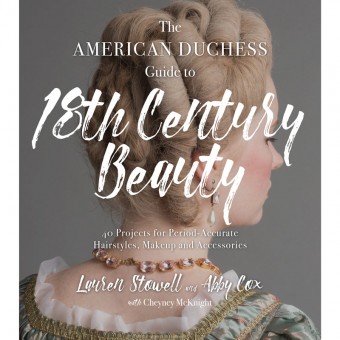
Book Review: The American Duchess Guide to 18th Century Beauty

For the first time, a timely review!
[Translation: my pre-ordered copy arrived today.]

Side back view of the shoulders and head of a  pale woman; her hair is powdered and dressed close to the head in a series of large curls and rolls.

The American Duchess Guide to 18th Century Beauty by Lauren Stowell and Abby Cox (with Cheney McKnight).

I've been excited for this book since I heard about it last January.  First, because I like historic hair-dressing, and second because I have a lot of faith in the authors' work. Their previous book on 18th Century Dress-Making presented well-cited research in a straightforward conversational manner, lavishly illustrated with color photographs. The projects were all based on specific paintings, period publications and surviving artifacts; the techniques were from the period with some reconstruction (not make-dos for hiding modern methods).

Suffice to say, I had moderately high expectations coming in.

Those expectations were met. One of the first projects in this book is a hand-sewn sheer peignoir to wear while dressing one's hair. From that point, it's safe to say they owned my soul.*

This book matches its predecessor in size and heft; it's 215 pages from Introduction to Epilogue, exclusive of notes and bibliography. There are eight general hairstyles covering the years 1750 to 1795, each with its own cushion project (to support the hair in the desired shape) and a suitable cap. Five pieces of outerwear (2 hats, 2 bonnets and a hood), the peignoir, a few ornamental bows, and three hair pieces round out the sewn projects.  There are also cosmetic recipes: 3 pomatums, 2 hair powders, 1 rouge, and 1 lip salve.  All have step-by-step illustrated instructions. Some of the project instructions will refer to other ones (particularly to the pomading and powdering section), but I didn't find this distracting or hard to follow.

As with the dress book, the projects are clustered chronologically: each hairstyle is preceded by the relevant cushion project and any specific texturing techniques (curl, crape) and is followed by the appropriate cap as well as any bonnets/lappets/plumes. Four models appear in the eight tutorials, and there is discussion about adapting the techniques for different hair textures. Ms. McKnight contributed a two-page summary on how women of African descent living in Europe and North America in the 18th century dressed their hair.

Stars: 5

Accuracy: High. The models look like they stepped out of mid/late 18th century portraits, and sources are cited.

Difficulty: All levels. The hairstyles are labelled easy to difficult. Four pages of stitch tutorials are included for the less-experienced sewist (many projects, including all of the shaped hair-pads and accessories, require some sewing). I've not yet tried the hairstyles, as I need to make the pads and hairpieces.

Strongest Impression: This is a very useful resource for anyone trying to understand how late 18th century hairstyles actually work. I think it's invaluable for living historians interpreting c.1750-1795, but also for costume designers, artists, authors, and other people depicting women's life/behavior/material culture.

*The casual humor also won me over.  I will happily pledge fealty to anyone who writes a serious book about historic hair-dressing methods while making their hard pomade in Darth Vader molds.

Friday, July 12, 2019

Godey's Lady's Book: Editor's Notes

Sometimes, the editor's messages in Godey's are the best part of the magazine. Yes,  mostly it's just shipping confirmations to various initials, but the January 1865 issue is practically a novel:

Clara.— Rubber gloves are used for whitening the hands, price $2.50 per pair.
Mr. B. Clinton, New York.— We know nothing of the whereabouts of the lady.
Maud N. — Perhaps you are growing older. We cannot judge from your description.
I. L. E. — The authoress yon mention died some time since. She was an admirable writer, and her Incognita was well preserved.
Mary. — A frock-coat is an admissible garment for a gentleman to wear when he nuptializes.
L. E. R. — The photographers will "pose" you, as they call it, but they sometimes pose you out of all likeness. A plaid or striped dress is best.
Miss D. H. — We know of no method of making blue eyes look expressive. If they are "naturally melancholy in their expression," we presume it is natural.
E. H. — Tell him at once that you have lost the ring. He must have little faith In you if he cannot believe you.
Miss Q. A. O. — Under the circumstance that you were engaged, you should wear mourning.

Wednesday, July 10, 2019

Wimple Wednesday: 17th century backless cap and forehead cloth

The last cap (in this project) from Jane Arnold's Patterns of Fashion 4. It's dated to the mid-17th century, though I noticed a similar design in the VAM, listed as late 17th- early 18th century.

[Of course, this should have been last week's entry, but one of the strings disappeared at the last minute, and sewing another cap was faster than bleaching 12" of linen tape to match.]

A lace-edged linen cap which fits smoothly over the wearer's head and along the cheek. The forehead cloth, also lace-edged, covers the hair just above the forehead.
Looks weird, but it's quite comfy.

The wearing method is somewhat tentative: the portrait featured in PoF4 shows only the front edge (the sitter's slightly angled and wearing a hat over the cap), so all we really have to go on is that it fits smoothly, and the lace goes along the face.


A wing-shaped linen cap, with loops at the center back and drawstrings along the neck edge; an oblong forehead cloth with long ties to match, both trimmed with white lace along the face edge.
The two cap pieces.
Inside out, because I ironed them that way.
The loops should be worked thread and the drawstring cord.
The cap has two loops at center back, which are intriguing: the cap needs to be joined or anchored around there to shape it to the head. There are also two sets of ties: long Y-shaped ones on the forehead cloth and very narrow tapes along the bottom edge of the cap. My best attempt has been to thread the cloth's ties through the cap's back loops, and then tie the tapes underneath my hair (back bun). The cap is then snugged slightly with the drawstrings and tied under the chin. The ties are a little short for comfort, but they are just long enough to fasten without trailing.

The fabric is light weight linen from Fabric-store.com; lace from The Tudor Tailor; ties are 1/4" and 1/2" linen tape from Burnley and Trowbridge (bleached white).

Monday, July 8, 2019

Straw Bonnet c.1855

When you need a bonnet display stand quickly: use an iron.

The bonnet is made from 1/2" hemp braid bonnet, worked in the Timely Tresses Lydia Alma pattern (second shallowest brim length). Materials from the same: 4" sage-colored moire ribbon ties and bavolet, purple and yellow flowers with light green velvet leaves. Lace 'cap' inside the brim is a 1" cotton lace.

Right side view of a low-brim natural straw bonnet, with green curtain; along the neckline there is a large cluster of yellow and purple flowers with pale green leaves.
This side has more flowers.

Left side view of a low-brim natural straw bonnet, with green curtain; along the neckline there is a large cluster pale green leaves with a few yellow and purple flowers.
But I really like how the leaves look here.