Saturday, May 27, 2017

Fricasseed Chicken

I tried cooking with Bessie, the long-suffering if somewhat temperamental wood-burning stove, again today.  Nothing burned this time, but the oven seemed to be running cool, even though I kept the fire up.  

Anyways, today's dinner consisted of fricasseed chicken, from Miss Leslie's Complete Cookery (1851), accompanied by boiled vegetables, 'excellent rolls' from Mrs. Beeton's Book of Household Management (1861), and followed by puff pastry cookies (a version of this appears in most of the cookery books I've looked at c.1850-1865).  The pastry was left over from making a lemon pudding (also from Miss Leslie's, though I got the idea from Mrs. Beeton's list of May menus); unfortunately, the lemon pudding didn't set in a timely manner.

Fricasseed Chickens, from Miss Leslie's Complete Cookery (1859)
Fricasseed Chicken. I cut up a whole chicken
without freaking out, even if it wasn't very neat.

Rolls. Could have used some more salt,
but the texture turned out quite passable.

Boiled vegetables with rosemary. Improvised.

Puff paste cookies with sugar and cinnamon
Puff Paste Cookies. Yum.

Lemon Pudding, from Miss Leslie's Complete Cookery (1859)
The lemon pudding didn't set
(well, not in the hot kitchen).

Thursday, May 25, 2017

Book Review: Paisley Plaid and Purled: Shawls of the Mid-Nineteenth Century

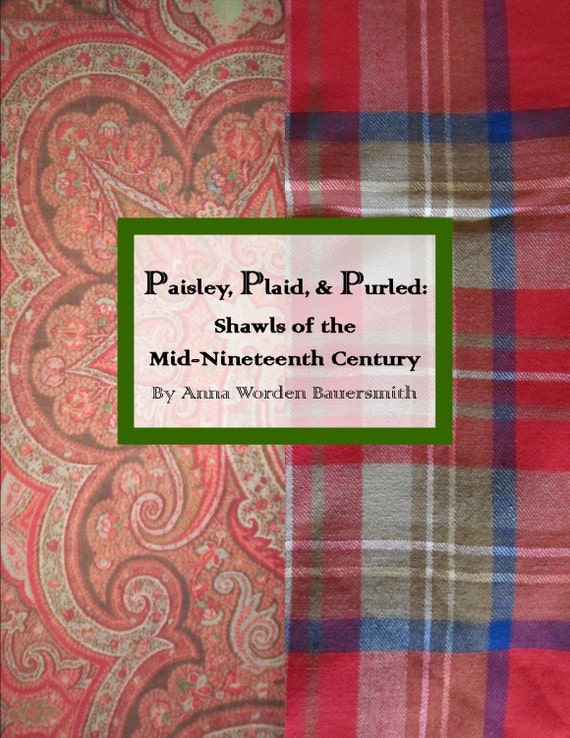
Cover of "Paisley Plaid and Purled: Shawls of the Mid-19th Century" by Anna Worden Bauersmith.

Paisley Plaid and Purled: Shawls of the Mid-Nineteenth Century by Anna Worden Bauersmith (2015)

Another much-over-due review from my winter reading list.  Ms. Bauersmith has written a thorough (nearly encyclopedic) introduction to shawl styles and varieties c. 1840-1865.  Like From Field to FashionPaisley, Plaid and Purled delves into manufacturing practices and deals extensively with written sources from the period.  However, it also includes a large number of pictures (of original shawls, as well as historic images featuring shawls), and even project instructions from period sources.

The main narrative covers half the book (63 pages), and details the author's research methods and results.  She looks at how shawls are described and referenced in the period, who was wearing them, what kinds were available (including common sizes), and how shawls were made and worn.  Some 27 period photographs are included, with discussion of the shawls featured therein.  Modern color images of two original shawls, in all their colorful glory, are also featured.  This section ends with period instructions for homemade shawls: quilted, embroidered, knitted, netted, and crocheted.

To aid in one's further research, there is also a seven page bibliography, as well as a lengthy appendix of useful information.  In addition to longer quotation from period sources (including more shawl instructions, and manufacturing information), there's a glossary of terms, a helpful table of shawl prices, extensive charts detailing shawl manufacture from around the world, descriptions of shawls in advertisements, and seasonal references to shawls, etc.

There's very little I would change about this book, as I'm busy swooning over the footnotes and gazing covetously on the original pictures.  A lot of the information is from publicly available sources, but the amount of work that went into assembling this information, and explaining it is tremendous, and definitely worth the cost of an e-book.  Those looking for explicit project instructions might be frustrated, as the ones featured here are all from the period, and thus spare in their instructions.  However, I don't know of any other source nearly this comprehensive which also translates the patterns for modern use.

Score: 5 Stars.

Accuracy: High. Extensive use of period material, fully cited.

Strongest Impression: I would recommend this book to anyone participating in costumed historic interpretation or interested in historic clothing.  Yes, including men.

Monday, May 15, 2017

Quilt Updates

I've been cutting scraps and seaming them for my autograph quilt (the winning design being the hourglass).  The block is basically "broken dishes", ie, it's a four-patch, with each of the four squares divided into two triangles.  Based on the dimensions of inspiration quilt, I'm aiming for 6" finished blocks: I've been cutting 6.5" squares for the white blocks, while the triangles are halves of 4" squares.

Three pieces "hourglass" blocks for 1850s reproduction quilt.
The general organizational scheme.

By my count, the original quilt is 15 by 15 blocks: 112 pieced hourglasses and 113 plain white ones. Now I just need to find 113 friends! And, maybe, cut and piece the other 96 blocks.

16 hourglass pieced quilt blocks made from reproduction 19th century fabric.
Sixteen down, ninety-six to go!

I've also been slowly whip-stitching my 3/4" hexagons, using all the fabric scraps that are too small for the autograph quilt (ie, less than 4" square).  This work is highly portable, so it's one of my favorites for commuting.

Hexagons of 29th century reproduction fabric for paper-piecing quilt.
Many tiny hexagons. This is a long-term project.

Saturday, May 13, 2017

Linen Smock, 16th Century

I made a second 16th century smock based on the instructions in The Tudor Tailor.  While the first one I made had a collar and cuffed sleeves with button fasteners, this time I made the collar-less version, with narrower sleeve (plain hemmed edge) and no fasteners.  Between the simplified finishing, and tracing the first smock for a pattern, this garment made up very quickly: about 10-15 minutes to cut, and 6 hours* to completely hand-sew.  The sleeve and gusset seams are all run-and-fell, while the sides seams are just running stitch; the neck, cuff, and bottom edges are all 1/4" twice-folded hems.  This time I used a slightly heavier (mid-weight) twilled linen, which I think I acquired from Fabric Mart during their last linen sale.

White linen smock for 16th century, from design in "The Tudor Tailor"
Plain linen smock for 16th century wear.

*While doing other activities: watching a hockey game, playing D&D, and listening to a lecture.  It may have gone quicker if I was not multi-tasking.

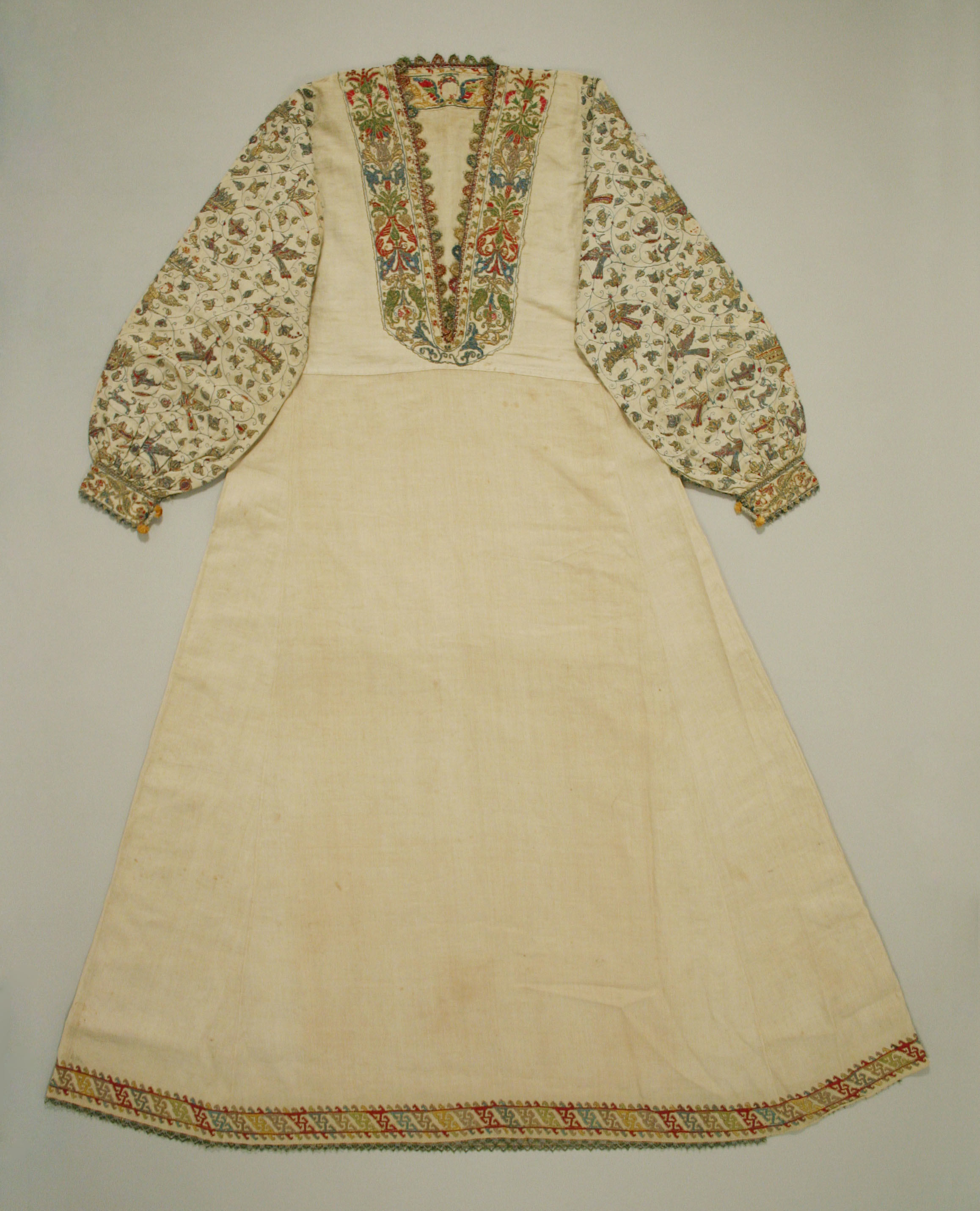
And, just for fun, here's an original 16th century smock from Italy:

16th century woman's smock (embroidered) in The Metropolitan Museum of Art
Late 16th century Italian smock, from The Met

I'm alternating between covetous admiration, and sheer terror at number of hours all that embroidery took. Also, awe that it survived that last four centuries, and a strong desire to inspect it more closely.

[Hint to costume designers: this is what should be worn under the corset/stays/bodies. Isn't it pretty? Don't you want to start including it in your plans?]

Monday, May 8, 2017

Petticoat From An Old Dress

One of the reasons I like using historical methods in garment construction is ease of reuse.

Consider my second-ever cotton dress:

Reproduction cotton plaid day dress with narrow coat sleeves, c.1862-1865.
Cotton "homespun" dress of red, blue and white plaid.

It doesn't fit my needs anymore. The coat sleeves post-date my main time, while figure fluctuations have affected the bodice fit in irreparable ways.

Fortunately, I made this dress as a finished bodice and skirt, so snipping a few basting threads gives my a perfectly functional working petticoat:

Gauged petticoat of plaid cotton, for mid-Victorian working wear (reproduction).
Colored petticoat. Cost: $0, 30 seconds of labor.
I flat-lined the bodice with white cotton, so both it and sleeve seams can be picked out, and the fabric used for patchwork or other small projects (doll clothes, sewing accessories, scrap-fabric hem facings). Modern techniques such as cutting out darts, serging seams, or using iron-in interfacing would reduce or eliminate this utility--I've remodeled a couple dresses with interfacing, and despite multiple washings, the fabric remained stiff and retained a gummy residue.

Monday, May 1, 2017

Brown print yoked dress, 1850s

I could use another washable dress for dirty work at the fort, and haven't made an adult-sized yoke dress before. This should fit the bill nicely:

Brown cotton yoked dress for 1850s wear
It really shouldn't show the dirt.

Full yoked bodice, bishop sleeves, and gauged skirt (all self-drafted). Fastens at center front with hooks and eyes, and at the wrist with shell buttons. The print is the brown floral from Marcus Fabrics' "historical stripes" line; lined with white muslin, scrap fabric facing.

Sunday, April 30, 2017

Soft Pomatum, 1854

Experimenting once again with cosmetics, this time with soft pomatum from Makenzie's Five Thousand Receipts: In all the Useful and Domestic Arts (Philadelphia, 1854).

From page 189: Soft pomatum Take 25 pounds of hog's lard, 8 pounds of mutton suet, 6 ounces of oil of Bergamot, 4 ounces essence of lemons, half an ounce of oil of lavender, and a quarter of an ounce of oil of rosemary. These ingredients are to be combined in the manner as those for the hard pomatum. This pomatum is to be put up in pots in the usual way. 

Not needing thirty pounds of hair product, I scaled this down to a mere ten ounces (8 oz lard to 2 oz tallow, having no ready source for suet).

1854 Soft Pomade Recipe: Lard and Tallow
Solid lard and tallow.

The process was very straight forward: I melted to the two fats together over low heat, allowed the solution to cool for a few minutes, then stirred in the scents, poured the liquid into tins, and set it aside to solidify.  Excluding the final cooling/hardening, the process took about fifteen minutes.

1854 Soft Pomade Recipe: Lard and Tallow Melting in Saucepan
The fats melted quickly over low heat.

For the scent, I maintained the 24:12:2:1 ratio, but as I was working at ~1/50 scale, I didn't try to calculate miniscule fractions of ounces. Instead, I opted to use 2 drops of rosemary essence and adjust from there (4 drops of lavender, 24 of lemon, 48 of bergamot).  This amount seems to work well, imparting a notable, but delicate, odor.

1854 Soft Pomade Recipe: Liquid pomade with bergamot, lemon, lavender, and rosemary essence.
The final liquid was faintly yellow and translucent.

Batch size note: the 10 ounces of fat (by weight) exactly filled the three 4-fl-oz tins I had prepared.


1854 Soft Pomade Recipe: Final product
The pomatum grew opaque and white as it solidified.

The final pomatum is somewhat softer than the one I previously used.  Where that one was a solid, and needed to be rubbed on the fingers to liquefy it for use, this pomade is ready to go--if it was any softer, it'd be liquid.  I'm a little concerned about how it'll fare during the summer heat (both in use and in its container), but am optimistic that it will be easy to use and won't leave tiny white specks behind in my hair, as happened when the other pomade aged and separated.

I'm tempted to also try the hard pomatum recipe in this book (white wax and suet); if I end up liking the soft version, I intend to try it again using fresh lard and suet, to see how that affects its consistency and behavior.

Update: Having now used this pomatum, I am pleased to report that it soldified still further, and was a perfectly nice consistency when I went to use it.  The melting point of the combined fats is just around body temperature, so very little friction was needed to work it into my hair. My hair styled easily (as much as it ever does) on the first and second day, after which the pomatum washed out easily with shampoo.  The scent proportions I used seemed fine to me; if anything, it was a hair strong, and I would be tempted to try it with half of the oils (1:2:12:24) to compare.  That being said, one of my friends still thought that the tin of pomatum smelled too strongly of lard.