Here's my new white waist for early 1860s wear. The inspiration piece is a basic gathered body with full bishop sleeves (from The Graceful Lady, first on the page). I'm kicking myself over the fabric--I have a piece of barred cotton very similar to the original which I had just cut up for a fancy knitting apron before I decided to make a white body. Alas. Instead, I ended up using a piece of plain cotton batiste that was on hand.
I decided to make a detached half-high lining for this body: none of the originals I've found pictures of have attached linings, and my material is so sheer that an intermediate layer is needed to conceal unsightly corset and chemise lines. I did not opt for a "corset cover" because I've still found little evidence that they were in use before 1865. The lining is white pimatex; both it and the body are draped-to-fit, with dart and armscythe adjustments courtesy of Nancy.
The silk waist has an interior structure of crinoline, with 1/4" steel boning in the points. It fastens with hooks and eyes on the side. It is displayed (and worn) with the green wool skirt that also accompanies my 1850s velvet and lace basque.
Thursday, July 21, 2016
Wednesday, July 20, 2016
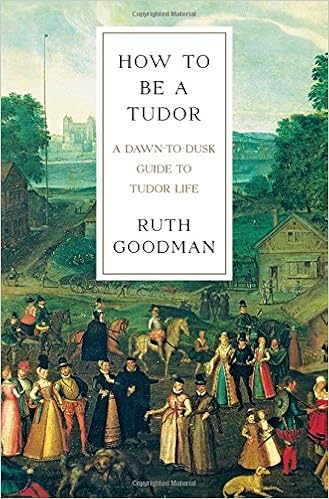
Book Review: How to be a Tudor
Ruth Goodman's How To Be A Tudor is a highly accessible overview of daily life in 16th century England. Like its predecessor, How To Be A Victorian, How To Be A Tudor uses the course of a day to examine how people slept, dressed, worked, ate, and amused themselves five centuries ago.
How To Be A Tudor has the same conversational tone, informative content, organizational structure, and geographical boundaries as its Victorian counterpart. However, this book is kept fresh and interesting by the different time span and content: there's fewer cholera epidemics and considerably more ale brewing and religious turmoil. The structure of this book also feels a bit tighter, as though the subtopics fit closer into the "daily routine" framework. I'm not sure if that is my imagination, intentional editing, or the result of having fewer written records from the time (in spite of which, Ms. Goodman managed to assemble an extensive bibliography).
There's little I'd think to change about this book, other than adding footnotes. Even at 300 pages, it's an engaging read and doesn't feel overly long. If another book in this style comes out, I'll make a point of reading it.
Score: 4.85 Stars (I'd still like some footnotes!)
Accuracy: Many primary sources were consulted and/or quoted, and a number of period illustrations are included; the book also details the author's personal experience with trying to live like a Tudor person. There's an 11-page bibliography for those seeking more information.
Strongest Impression: Send your copy of How To Be A Victorian through a 300 year time vortex, and you get How to Be a Tudor. A fun and informative read.
Saturday, July 9, 2016
Thread Buttons
Still here, still working on a few large projects--one of which needs some special fasteners. The thread is linen, the button forms are small wooden beads.
Monday, July 4, 2016
HFF 2.14: Waste Not, Want Not
The Challenge: Make a dish which averts waste.
The Receipt: Baked Bread Pudding from Mrs. Beeton's Book of Household Management:
1250. INGREDIENTS – 1/2 lb. of grated bread, 1 pint of milk, 4 eggs, 4 oz. of butter, 4 oz. of moist sugar, 2 oz. of candied peel, 6 bitter almonds, 1 tablespoonful of brandy.
Mode.—Put the milk into a stewpan, with the bitter almonds; let it infuse for 1/4 hour; bring it to the boiling point; strain it on to the bread crumbs, and let these remain till cold; then add the eggs, which should be well whisked, the butter, sugar, and brandy, and beat the pudding well until all the ingredients are thoroughly mixed; line the bottom of a pie-dish with the candied peel sliced thin, put in the mixture, and bake for nearly 3/4 hour.
The Date/Year and Region: 1861, British
How Did You Make It: Brought 16 oz of milk to a boil, stirred in 1 tsp. almond extract (subsituted for the bitter almonds), and poured over 8 oz of shredded bread. Beat 4 eggs, added 4 oz butter, 4 oz sugar, 1 Tbsp brandy and mixed well. Sliced 2 oz of homemade candied peel, and arranged in a pie pan. Mixed softened bread and other ingredients, then pressed into the prepared pan. Baked approximately 45 minutes at 350F.
Time to Complete: Just over an hour
Total Cost: All ingredients on hand.
How Successful Was It?: Well-received at the potluck. I thought the taste worked great: the almond was distinct, but not overwhelming, and the candied peel provided a nice contrast. It wasn't overly sweet, and might even stand to have a little more sugar next time; I didn't notice any taste of brandy in the finished pudding. The texture was mostly good, though I found it a tad damp along the pan edges, and next time I would be tempted plate it early and allow it to dry a little. I'll likely make this receipt again, since it went over so well.
How Accurate Is It?: I substituted 1 tsp almond extract for 6 bitter almonds; the amount is pure guesswork, but I'm satisfied with how it turned out. Shredding rather than grating the bread was my other main substitution, but that also seemed to work fine--a bit chunky on the top edge, but well-incorporated elsewhere. No bread type was specified in this receipt, so I used what I had on hand (a sourdough baguette with a few bits of pumpernickel to make the weight).
Tuesday, June 21, 2016
HFF 2.13: Pie
The Challenge: Make a pie.
The Recipe: Apple Pie from Mrs. Beeton's Book of Household Management (different receipt from last time).
APPLE TART OR PIE.
1233. INGREDIENTS – Puff-paste No. 1205 or 1206, apples; to every lb. of unpared apples allow 2 oz. of moist sugar, 1/2 teaspoonful of finely-minced lemon-peel, 1 tablespoonful of lemon-juice.
Mode.—Make 1/2 lb. of puff-paste by either of the above-named recipes, place a border of it round the edge of a pie-dish, and fill it with apples pared, cored, and cut into slices; sweeten with moist sugar, add the lemon-peel and juice, and 2 or 3 tablespoonfuls of water; cover with crust, cut it evenly round close to the edge of the pie-dish, and bake in a hot oven from 1/2 to 3/4 hour, or rather longer, should the pie be very large. When it is three-parts done, take it out of the oven, put the white of an egg on a plate, and, with the blade of a knife, whisk it to a froth; brush the pie over with this, then sprinkle upon it some sifted sugar, and then a few drops of water. Put the pie back into the oven, and finish baking, and be particularly careful that it does not catch or burn, which it is very liable to do after the crust is iced. If made with a plain crust, the icing may be omitted.
Note.—Many things are suggested for the flavouring of apple pie; some say 2 or 3 tablespoonfuls of beer, others the same quantity of sherry, which very much improve the taste; whilst the old-fashioned addition of a few cloves is, by many persons, preferred to anything else, as also a few slices of quince.
The Date/Year and Region: British, 1861
How Did You Make It: I used the #1206 puff paste receipt (as in the turn-overs two challenge past): made a paste of 1/2 lb of flour and 1/2 cup water, and rolled it out 3 times with 2 oz lard and 4 oz butter. For the filling, I sliced (but did not peel) 2 lbs of apples, then added 4 oz sugar, 1 tsp lemon peel, 2 tablespoons lemon-juice, and a dozen cloves. I understood the instructions to not call for a bottom crust; instead I lined the sides of the pan with paste, added the filling, and then covered the top. Baked 40 min at 350F, opted not to brush with egg white.
Time to Complete: Just over an hour.
Total Cost: Ingredients on hand.
How Successful Was It?: Good, if unlovely. It was spicier than the last apple pie I made for HFF, with the cloves and lemon peel adding a bit of excitement. I'd be interested to experiment with the optional sherry as well. I meant to bake it at 400F, but forgot to change the oven temperature. Nonetheless, I found it sufficiently cooked, and the soldiers seemed to like it.
How Accurate Is It?: As before, I didn't use heirloom baking apples, and so likely got a sweeter pie; the egg-white-and-sugar finish would have been a nice touch, but the receipt suggests it is not mandatory.
Monday, June 13, 2016
HFF 2.12: In a Jam
The Challenge: Make jam, jelly, pickles, or other preserved food.
The Recipe: Cherry Bounce from The Cook's Own Book. Which is definitely about preserving cherries.
CHERRY BOUNCE.Take a peck of morella cherries and a peck of black hearts. Stone the morellas and crack the stones. Put all the cherries and the cracked stones into a demi-john wtth three pounds of loaf-sugar slightly pounded or beaten. Pour in two gallons of double-rectified whisky. Cork the demi-john and in six months the cherry bounce will be fit to pour off and bottle for use; but the older it is the better.
The Date/Year and Region: 1854, American (Boston)
How Did You Make It: I scaled down the recipe to approximately 1/8 it's original amount. One peck is two dry gallons, or approximately 6-7 lbs of cherries; so, the receipt requires approximately 3 pounds of cherries (1.5 lb of each type) for 1 liter of whiskey (1 liter ~ 1 fluid quart). I also substituted local cherries for the named varieties: Washington sweet, dark cherries for the black hearts and Rainier for the morellas. The former seems to be a fair substitution (black hearts are sweet, dark, and hard to find today). Rainier cherries aren't as sweet as the dark ones, but they also aren't sour like the morella cherries called for in the receipt--unfortunately, they were the only other variety available just now.
To make it, I washed the cherries, and cut each in half to remove the pits. Half of the pits were briefly chopped in the blender. I then filled two quart-sized jars with the cherries, adding the cracked pits and approximately 6 oz of sugar to each. I poured whiskey into the jars until the fruit was covered, and then sealed them and set them aside.
Time to Complete: About 30 minutes to prepare (mostly pitting cherries); 6 months to mature.
Total Cost: Varies with price of cherries and quality of whiskey.
How Successful Was It?: I won't know for some months yet.
How Accurate Is It?: The cherry substitutions were noted above. I have seen period references to using other cherry varieties (such as wild cherries, particularly Virginian ones), and to using rum or brandy as the liquor, so a certain amount of improvisation seems acceptable. Another receipt only has the cherries infuse for 8-10 weeks, so I may be justified in sampling it before January (though, according to Mr. Irving, cherry bounce is a traditional New Year's refreshment). Using the blender to crack the stones was not period, but I couldn't think of another way to do it without making a mess of my hammer and cutting board. The receipts suggest that the cracked stones are optional and I've omitted them in the past--I will note, however, that the blender smelled very strongly of cherries, so I have hopes that this will result in an especially flavorful batch.
Edit: I have since learned that cherry stones contain small quantities of cyanide/cyanogens; while my calculations indicate that the amount of pits present should not be dangerous, I decided to remove the pits from the liquor as a precaution, and will not include them in future batches.
Wednesday, June 8, 2016
1850s Wide Collar
I'm still working on some larger projects, but meanwhile I completed a basic white collar for the mid-1850s. Since that's where I'm spending most of my time, it seemed necessary; narrow 1860s collars don't quite fit the aesthetic of c. 1855.
This collar is a single layer of pimatex broadcloth, which is slightly heavier than the pima lawn I'm using in the never-ending-broderie-anglaise-collar. It's fitted to the neckline of my yellow dress, measures 2.75" wide, and is finished with narrow hand-sewn hems.
Subscribe to:
Posts (Atom)