Showing posts sorted by relevance for query sing. Sort by date Show all posts

Saturday, November 25, 2017

Victorian Christmas Songs

Christmas Visitors (1860) by William MacDuff


Preparing for some festive seasonal events, I find myself again looking for era-appropriate carols, particularly for the 1850s and early 1860s. This time, I'm going to try making a list, and hopefully won't have to start all over again next year.

God Rest You Merry, Gentlemen
I Saw Three Ships
The First Nowell
Hark The Herald Angels Sing

[The first two also appear in Christmas with the Poets (1851), and are said to be seventeenth century]

Popular Music of the Olden Time (1859) adds:
A Virgin Most Pure


Christmas: Its Customs (1860) actually includes musical notations. Traditional carols include:
Adeste Fideles [note: this English translation varies from the modern O Come All Ye Faithful]
The Virgin and Child
The Golden Carol
The Boar's Head Carol

It also lists "current carols" popular in England:
Christians Awake, 
Good King Wenceslaus
Christmas Comes
Hark the Herald Angels Sing
Song of the Angels [While Shepherd Watch Their Flocks By Night]

More scored music in The Sunday-school Service and Tune Book (1863):
We Three Kings of Orient Are
Silent Night! Holy Night!
Hark! The Herald Angels Sing
Hark! What means those Holy Voices
Shout the Glad Tidings
Carol, Carol Christians
Hark! What Celestial Sounds
While Shepherds Watched
We come with loud Acclaim
The Son of God, so High, so Great
Bright and Joyful is the Morn
Carol, Brothers, Carol
To us a Child of Hope is Born
Luther's Christmas Hymn
How Precious is the Story

Obscure religious songs in Christmas carols : or, sacred songs, suited to the festival of our Lord's nativity ; with appropriate music, and an introductory account of the Christmas carol (1833):
Christmas comes, the Time of Gladness
Lo! He comes, an Infant Stranger
How blest with more than Woman's Bliss
How bright was the Glory
Once Again the Festal Morning
From the Hallow'd Belfry Tower
When Christ our Saviour came on Earth
When Bethlehem's Shepherds Home Returned
Praise We our God
Star of the East
How glorious is the Morning Sun
Christ the Lord was Born To-Day
What ear shall be closed
O Thou, who bad'st thy Star display
Man's Redeemer

And some sheet music:
The Holly and The Ivy (c.1812-1830)*
Twelve Articles (c.1812-1830)
Auld Lang Syne (1817) [and an 1858 version]
Star of the East (1831)
A Christmas Carol (1838)
While Shepherds Watch Their Flocks By Night (1831)
O Swift We Go: A Sleighing Song (1840)
A Christmas Hymn (Hark! The Herald Angels Sing) (1843)
A Christmas Anthem [For Unto Us A Child Is Born] (1848)
'Tis Merry When the Stars are Bright (1846)
The Christmas Sleigh Ride (1849)
One Horse Open Sleigh [Jingle Bells] (1854)
The Sleighing Song (1855)
The Merry Sleigh (1855)
Christmas Carol (1856)
Deck the Halls**
The Bells [I Heard the Bells on Christmas Day] (1870s, poem 1862)


**Finally found a copy. I'm still not sure how popular this one was, as there's that 1849 book review.  which makes it sound obscure. For extra fun, The Holly, The Holly! O Twine it with Bay in an 1857 retrospective of Christmas traditions (tune unknown to me).

**There are period references to the Welsh version (Nos Galan) but I haven't seen the original English translation, which Wikipedia dates to 1862. However, I did find this other 1862 translation and an alternative set of lyrics from 1874, complete with ghosts.

Wednesday, October 15, 2014

Experiential History: Living in a Corset

When I started reenacting/doing living history, I was looking for a reason to dress up.  Over time that rationale has morphed into dressing up as a way to teach others about history (creating 'the look' of a time), and--as I've lately come to realize--to teach myself more about how people lived and performed various activities.

Exhibit A: Wearing a Corset.
Corset from Der Bazar, February 1865

When I started living history, I expected to be somewhat hampered by the clothing: that I'd need to learn a different way of moving, and that some activities would be difficult or even impossible.  As it turns out, very little is impossible (no back bends), and the operative d-word is actually 'different'.   

Even among living historians corsets have a reputation as uncomfortable, problematic, or even downright dangerous.  They've been out of mainstream wear for a good 3 generations, leaving a nebulous mythology of Scarlet O'Hara's tight-lacing, professional invalids, professionals of another sort, and 'fainting couches'.* I've seen visitors (who had just commented on the group's good posture) visibly flinch when it's mentioned that the ladies present are, in fact, wearing corsets.  Others have assumed that I'm not wearing one because I'm doing 'X' activity, or that women of the period didn't do 'X' because of corsets, or that corsets of the period must be different from the one I'm wearing because I can do 'X' while wearing it.  (For the record, the following list is largely based off my experience wearing 1850s/1860s corsets--either gored or shaped-seam styles--which are somewhat shorter in the torso and less heavily boned than some other time periods).

Activities I have done while wearing a corset:
  1. Dance (ballroom, contra, swing...)
  2. Cook over a fire or on a stove
  3. Split kindling with an ax
  4. Start a fire
  5. Sing
  6. Pick apples
  7. Scale a low fence
  8. Jog/run (not recommended)
  9. Wait at table
  10. Move furniture
  11. Shoot arrows (also tried throwing a tomahawk once, but I'm apparently very bad at it)
  12. Nap
  13. Eat
  14. Dig potatoes
  15. Play games (rolling hoop is a bit tricky, see #8)
  16. Strike tents
  17. Act in a theatrical
  18. Drive a car
  19. Style hair (own or others)
  20. Help others to dress
  21. Ride the bus
  22. Jump over puddles
  23. Tie my shoes**
Things that I can't do in a corset:
  1. Slouch
  2. Overeat
  3. Some Yoga poses
'No slouching' is the really noticeable bit, in my opinion.  It can be bit weird and somewhat tiring to sit up straight all the time--and it makes modern car and movie theater seats really annoying, as leaning backward isn't comfortable--but the corset also provides ample back support.  I can and have sat down to elaborate dinners in period dress, and enjoyed many of the delicacies offered, but learned that you need to take small portions if you want to try everything.  You can even do a number of yoga poses while wearing a corset--just not all of the ones involving lots of torso flexibility (though I can still touch my toes).  

In all cases, the different ways of moving become more intuitive with practice.  You can't bend much at the waist, so you bend at the knees when tying your shoes or lifting an object. You walk briskly rather than running because it's easy to get out of breath (though, even with snug laces I can sing or do moderate exercise without trouble). Stretching to pluck an apple is no problem--from the corset at least, dropped armscythes are another issue.  Straight-back period chairs are actually really comfortable when your only option to sit up straight. 

The other thing that gets easier with practice is actually wearing the thing.  When I was dressing 5+ days a week this summer, I found myself getting dressed a bit faster each time.  The 'comfortable snugness' also changed with practice: I adjust my laces based on feel rather than measurement, and by the end of July most of my dresses were getting loose at the waist because my comfortably laced corset was tighter than it had been in June.

For a while there, not wearing a corset actually started feeling really strange; I remember taking a walk one day and just feeling really weird about my posture and carriage, only to realize that it was the just second time in ten days that I'd been in modern attire. It was certainly a different perspective: not so much 'liberated' as 'awkward and somewhat exposed'. A feeling shared, I imagine, by those dress-reformers who went without stays (not all of them did) in the 1850s, by some of the women adopting the early regency/directoire fashions of the late 1790s, and by many young women after WWI.

The only time I've found a corset really uncomfortable is when I've laced it too tightly (not worth, won't repeat), or when a bone works it's way loose and started poking me in the hip or shoulder.  Bits of metal hurt.  The plastic's better in that respect--my first two corsets had plastic boning--but in all other ways, 1/4" spring steel really is more comfortable.  It gives better support than featherlight or zip ties, and is much less bulky than the latter.

One thing that's stayed true over time: however comfortable a corset is to wear, however good the support (think your favorite bra times about a million), taking it off always feels really nice.

*The true purpose of a chaise lounge is, of course, posing dramatically.  For maximum effect, clutch at your pearl necklace with one hand, while dramatically holding the other up to your forehead. Employ smelling salts as desired.

**Nonetheless, I prefer to take care of my shoes and hair first when getting dressed in period attire, particularly the shoes

Wednesday, May 20, 2020

HFF 4.10: Sing For Your Supper


The Challenge: Sing for your supper! Make a dish associated with a song or with music.

The Recipe: Little Patty's Cakes from Domestic Management; Or, The Healthful Cookery-Book
[A bit of a stretch, since as far as I can tell the name is coincidental and has nothing to do with the rhyme.]

The Date/Year and Region: 1813 (2nd ed), London

How Did You Make It: On a quarter scale, since I have to mind how quickly I use eggs. I rubbed 2 oz of butter into 4 oz flour, added 2 oz sugar, 2 oz currants, 1/4 tsp ("a little") ground mace, then moistened the mixture into a sticky dough with 1 egg. The instructions say to lay small pieces in a buttered tin, which I'm interpreting as baking like a cookie (though whether drop or cut-out, I couldn't say; I went with drop this time). Baked 350F until the cakes just started browning; it was to be "half hour in a quick oven", but I was skeptical of anything so cookie-like taking that long on anything other than a very slow oven--and, more importantly, forgot to set the timer.

Time to Complete: About 10 minutes to mix up, uncertain baking time.

Total Cost: About $1 (everything on hand, estimating from usual butter/egg prices). 

How Successful Was It?: Very tasty. The texture and density is ultimately very similar to every other cookie-like sweet biscuit or small cake I've made from this period, but I think the currants and mace are my favorite flavor combination so far. For a change, I think I guessed right the first time on the spice amount--it's distinct and flavorful, but not at all excessive.

How Accurate Is It?: I mixed these cakes by hand (mostly being too lazy to haul out the mixer for such a small batch); as usual, zante currants substituted for the real currants. As already mentioned, it wasn't clear how the cakes should be shaped, though I think the drop method was perfectly serviceable, I could probably make them neater on a second try.

A pink transferware plate with 12 currant-spotted cookies.
Not the prettiest, but very tasty.


Monday, November 27, 2017

Nine Reasons to Sing at Reenactments

[This post has been languishing in my drafts for several years.  I think it was originally inspired by Liz's Top Ten Reasons You Need to Make a Petticoat.]


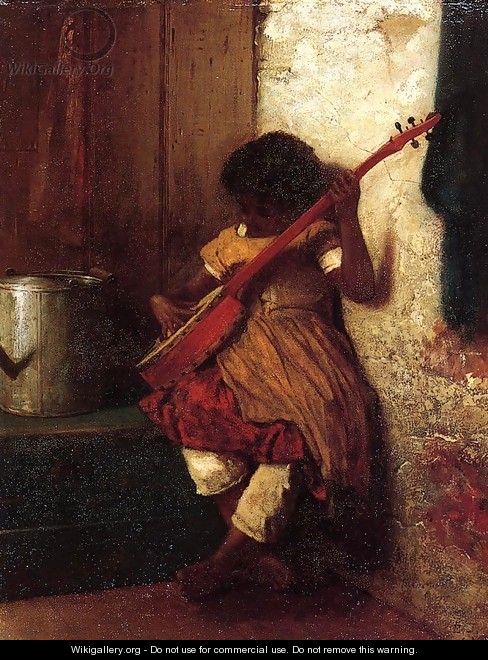
Musical Instinct (1860-69) by Eastman Johnson.


9. Easy to find.  Particularly if you're doing the mid 19th to early 20th century, mass-printed sheet music and song books mean lots of originals survive--originals that are old enough to be public domain, and widely available on-line thanks to Google Books, Internet Archive, the LOC, and various other archives and repositories.

8. No equipment required.  You can add it if you want: a handwritten page of lyrics, or a pitchpipe and some printed music, all the way up to beautifully-bound reproduction music books and period correct instruments.  There are lots of options.

7. Can be added to your other activities.  Sing while sewing, while cooking, or while washing up.  Start your ladies' meeting with a hymn; cheer the soldiers' parade with a patriotic tune; lullaby the children to their naps.

6. Creates subtle activity: music can add to an event's ambiance, even for people who aren't currently in your area.

5. Attracts attention. Sound carries.  A little singing (on its own or for amusement while working) lets people know where you are, without interrupting their current pursuits.  It doesn't demand an audience, but invites one in.

4. It's easy to start and end.  If you do get some visitors investigating your siren song, you can easily wind it down to engage them in conversation or answer their questions. No dropped stitches, fumbling for book marks, or materials getting ruined because you set them aside.

3. It's free.

2. It's fun.

1. It's authentic.  Puritans aside, whatever period you're doing, people were singing. And so can you!

Tuesday, March 24, 2020

Forfeits

"As the penalty consists chiefly in kissing, forfeits are rather popular..."
--"Letters from the Country" (1861) 
".. no one guessed who held the thimble, which had been selected on account of its convenient size, and which Eunice, who passed it round. made a show of placing in the hands of each. The muffs, shawls, caps, hats, handkerchiefs, and gloves which were consequently obliged to be given as pledges, when piled together on the table, formed a miniature pyramid."
--"Sketches from Real Life" in Godey's (1848)

"As soon as the tea was over a game of family coach was started, which set every one laughing and scampering for places,-- forfeits were gathered in a pile in the lap of one of the elder ladies. Blindman's-buff followed, and Wilkie might have caught a few ideas had he seen the sly tricks of some of the demurest looking of the young girls." --"Forest Gleanings" in The Anglo-American Magazine (1858)


Many parlor games use mechanic of "forfeits" or "penalties" to raise the stakes of the games. Some games act as little more than means to rack up as many forfeits as possible! Indeed, depending on the source, "forfeits" may be a category of parlor game, a game in its own right, or simply score-keeping mechanic for games in general. Games for All Seasons speaks of  "The Game of Forfeits", and then enumerates ways in which these forfeits are doled out: in other books, many of these are called "games" in their own right. At the other extreme, A Week's Delight offers few forfeit tasks, but instead suggests that the first person to incur a penalty has to chose the next game the group will play.

"The Face of Wood"
A forfeit in The Sociable (1858)

During the course of the game, a player who makes a mistake or hesitates too long, will surrender a personal item (like the handkerchiefs and gloves above) into the forfeit pile. When the time comes to redeem the forfeits, items are drawn at random, and the owner is assigned an amusing or seemingly impossible task--not unlike a modern game of "truth or dare". The Victorian versions, however, quite famously involve more kissing than the modern analogue.

Fear not! For the modern audience, there are plenty of options for forfeits which do not involve kissing. 

An article in Godey's (August 1858) describes four possible forfeits, which encompass much of the variety available. The first is to make the person sing an impromptu song on a an assigned topic (or pick and sing a song about the topic if they can't make one up). The second is an exercise in wit: the forfeit-payer must 'making a will' by bequeathing one trait or possession of theirs to each person playing (potentially complimenting or mildly insulting everyone present). The third, in a similar vein, requires the person to pick one member of the party and an object, and then make a comparison between the two, as well as a contrast (again offering opportunities to compliment or insult). The last is the ever popular task to"kiss the candlestick"--more easily accomplished by handing a candle to a person you want to kiss (who is thus temporarily acting as a candlestick).

As indicated by the above, forfeits often fall into categories of wit, complimenting others, performing an impossible task, and kissing (or being excluded from kissing). The first two groups are often easiest to play in the modern day. "Making a Venus", for example, requires the forfeit-redeemer to compliment each lady in the room by selecting a trait from her with which to endow the goddess of love. A similar forfeit requires the person to "bow to the prettiest, kneel before the wittiest, and kiss the one [they] love best". Impossible tasks include passing an object through a keyhole (hint: write the word on a piece of paper), kissing the inside and outside of a reticule without opening it (hit the lining and exterior, or hang it on a wall and creatively define "inside"), or 'putting two chairs together, taking off your shoes, and jumping over them' (jump over the shoes, not the chairs!).

The kissing forfeits take various forms: from having to kiss a random person, to having to pick someone to kiss, or having to pick other people to kiss eachother while the penitent is excluded. In the "bridge of love" (aka Aristotle's steed, aka Ariadne's steed, aka the bench, see also the game "beast of burden"), a male forfeit-payer kneels on all fours while a couple sits on his back to kiss eachother. In "the wooden face" (see illustration), members of the group are lined up back to back, and on a signal, each turns around and kisses the person they are facing--the forfeit-payer, however, is always  positioned to be facing a wall instead of a person.


Period Sources for Forfeits

 The Sociable or One Thousand and One Home Amusements (1858), describes 56 forfeit tasks, starting on page 262.

The Corner Cupboard (London, 1858) describes 20 forfeits, starting on page 6.

The Book of Parlor Games (Philadelphia, 1853) has categories of "penances", starting page 42.

Fireside Games For Winter Evening Amusement (New York, 1859), forfeits start page 93.

Every Boy's Book of Games (London, 1852), forfeits start on page 45. 

Games for All Seasons (London, 1858), lists forfeits starting on page 191.

Round Games for All Parties (London, 1854), forfeits start on page 196.

Friday, August 7, 2020

Nisqually Brigade

It is odd having a year without a reenacting season. Today would have been set-up for the Nisqually Brigade, the second weekend in August.  With the camps set up during the day, Friday evening is the time to relax, greet old friends, and sing all our bawdy period ballads around the campfire (in those years without a burn ban).  

A small book bound in marbled paper and leather, next to a partial necklace of glass trade beads with a silver beaver pendant.
One pair of beads for each Brigade and each camp, 2014-2019.
And my song lyric manuscript.

Monday, December 23, 2019

Historical Food Fortnightly Season Four Challenges

Time to start thinking ahead to next year. With thanks to Quin for many ideas.


  1. January 1-14: One Last Holiday Hurrah. Pick a holiday, any holiday, and start the New Year with some in- or out-of-season merriment.
  2. January 15-28: Downstairs Dinner. Make a dish of the working classes.
  3. January 29- February 11: The Tiffany Problem. Have you ever come across a dish that is older than you expected? That seems like it should be an anachronism, but isn't? Now's the time to give it a try. [Explanation of term.]
  4. February 12-25 Heart-y Fare. Whatever "hearty" or "heart"-y foods speak to your heart.
  5. February 26- March 10: Centerpiece Dish. Pull out all the stops to make something pretty and eye-catching to adorn your table.
  6. March 11-24: Erin Go Bragh! Actual Irish dishes, or those with only the most tenuous associations to Ireland and/or St. Patrick's Day.
  7. March 25-April 7: April Foolery. Surprise foods, deceptive foods, funny foods, and/or foods with "April" or "Fool" in the name.
  8. April 8-21: Egg-actly What You'd Expect. Make something with some connection/resemblance to eggs. Clever egg substitutes also accepted!
  9. April 22-May 5: Flower Power. A dish that is floral, flowery, or flour-y, as you desire.
  10. May 6-19: Sing for Your Supper. Make a dish associated with a song or with music.
  11. May 20- June 2: Commemorative Dishes. Try preparing something associated with a famous event or person.
  12. June 3- 16: Get Saucy! Make a sauce, relish, or topping.
  13. June 17-30: Summer Sun. Try a food suitable for summer, or involving the sun.
  14. July 1- 14: Fresh Start. Half-way through the year, make something 'fresh'. If you've fallen behind on challenges, take this as a chance to re-start.
  15. July 15- 28: Tea Party. A delicate refection for teatime, and/or party food.
  16. July 29-August 11: First Fruits. Cooking with fruit, or beginning the harvest.
  17. August 12-25: In a Jam. Jams, jellies, and all sorts of preserves.
  18. August 26-September 8: Labor of Love. A dish that's hard work, an ingredient you love, or a combination thereof.
  19. September 9-22. Eat your veggies. Make a dish with vegetables.
  20. September 23- October 6: What's In a Name? Pick a food with a fun name--person, place, thing, or just something fun to say.
  21. October 7-20: Let Them Eat Cake. Make a cake. Or cakes.
  22. October 21-November 3: Fear Factor. Here's the challenge to challenge yourself: pick an intimidating ingredient or technique. 
  23. November 4-17: Comfort Foods. A food that is comforting to eat or comfortable to make.
  24. November 18-December 1: Serve it in a bowl. Soup, stew, broth, ice cream: anything that you would serve in a bowl.
  25. December 2-15: Yuletide Head-Start. Make a seasonal dish for the holiday of your choice, or a food that needs to be prepared in advance of serving. 
  26. December 16-31: Hindsight is 2020. Your chance to revisit an earlier challenge (from any season or from outside the HFF challenges), and try it again. Use the lessons you've learned, try a variation, polish up your technique, or address an issue that arose last time you made it. 

Saturday, September 16, 2017

The Quilting Bee

Elizabeth and Elisabeth had a quilting bee--or two--over the summer, so I did some reading about period practices. Here is my belated attempt to synthesize that reading into a coherent summary.

The short version:
  1. A "quilting bee", "quilting party", or just "a quilting" is a favorite topic for reminiscences and historical fiction in the 1840s-1850s. They are considered to be old-fashioned and nearly extinct; after 1860, these mentions dwindle.
  2. The quilt should be pieced and placed on the frame before guests arrive. With enough workers, it will be done in a single afternoon.
  3. The order of events is: quilting, a meal (tea/supper), dancing or parlor games, optional snack. The first part is for women; men are added at either step 2, 3, or 4.
  4. Common times to have a quilting are on winter evenings in New England, or when a young lady is about to be married.  Quiltings are not limited to these circumstances, however. 


A Quilting Party (1876) by Enoch Wood Perry


From the dictionaries:
BEE, a collection of people who unite their labor for the benefit of an individual or family, as a quilting bee.
--The English Language In Its Elements and Forms (1850)
The term 'Bee' although now almost obsolete, was but a few years since the fashionable title given, in the backwoods of America, to tea or scandal parties.
--Hogg's Instructor vol. VIII (1852) 
BEE. An assemblage of people, generally neighbors, to unite their labors for the benefit of one individual or family. The quilting-bees in the interior of New England and New York are attended by young women who assemble around the frame of a bed-quilt, and in one afternoon accomplish more than one person could in weeks. Refreshments and beaux help to render the meeting agreeable. Husking-bees, for husking corn, are held in barns which are made the occasion of much frolicking. In new countries, when a settler arrives, the neighboring farmers unite with their teams, cut the timber and build him a log-house in a single day; these are termed raising-bees. Apple-bees are occasions when the neighbors assemble to gather apples, or to cut them up for drying.
--The Dictionary of Americanisms (1848)

The second edition (1859) adds an additional entry to the above:
Quilting-Bee or Quilting-Frolic. An assemblage of women who unite their labor to make a bed-quilt. They meet by invitation, seat themselves around the frame upon which the quilt is placed, and in a few hours complete it. Tea follows, and the evening is sometimes closed with dancing or other amusements.
As many of these explanations indicate, the quilting bee is outdated by the 1850s. From a century and a half onward, it is an interesting experience to read so many authors lamenting the dissipated entertainments of their present day and reminiscing about the innocent amusements of their youth.
"The Spinning Wheel", an opinion piece that appeared in The Ladies' Wreath in 1852 asserts that: 
"We were as busy as bees to be sure, but then we were as blithe as a lark, and as merry as a cricket all the day long. We never even heard of the thousand ailments common now among young folks, and as to recreation, why we had more heart gaiety and frolic at a quilting bee, a sleigh-ride, or a paring match, than one of your fashionable belles enjoys in a whole year." 
These writers are quite explicit that the quilting bee is rare by the mid-century. A story in The Lady's Album (1846) exclaims: "Reader--were you ever at a Quilting Party--an old fashioned quilting party? If not--you will do well to read our description, which, of course, must fall far short of the reality--and this reality, as the thing is now nearly obsolete, you may never have the satisfaction of witnessing." 
Eleven years later, another short story refers to quilting parties as  "quite old-fashioned", and goes on to relate a story from fifty years past, in which a quilting figures prominently.

Another interesting note is how often the non-fiction references to quilting bees are explanations aimed at urban readers, especially Europeans.  The overall impression is that quilting bees/parties are largely a phenomenon of rural communities in early-19th-century America/Canada. Consider:
There are "quilting bees." where the thick quilts, so necessary in Canada, are fabricated... At the quilting, apple, and shelling bees there are numbers of the fair sex and games dancing and merrymaking are invariably kept up till the morning."
--The Englishwoman in American (1856)
The women have their bees as well as the men such as sewing been or quilting bees. A quilt is thus completed in a day that would otherwise be unfinished for months. The beverage of every meal, even of dinner, is tea; and how much better it is than whiskey or beer I need not say. I have heard in deed, that naughty things are said of the absent over the teacup; and I fear that sewing and quilting bees are not altogether innocent, but I am sure that a little female tea cup scandal is infinitely less than the evils of beer drinking and whiskey drinking. It may be necessary for me to hint that a ladies bee includes of course something nicer in the dietetic department than an out-door bee.
--Canada: Its Geography, Scenary, Produce, etc. (1860) 
Among the home productions of Canada the counterpane or quilt holds a conspicuous place not so much in regard to its actual usefulness as to the species of frolic 'yclept a Quilting-bee in which young gentlemen take their places with the Queen-bees, whose labours they aid by threading the needles while cheering their spirits by talking nonsense. The quilts are generally made of patchwork and the quilting with down or wool is done in a frame. Some of the gentlemen are not mere drones on these occasions but make very good assistants under the superintendence of the Queen-bees. The quilting bee usually concludes with a regular evening party The young people have a dance. The old ones look on. After supper, the youthful visitors sing or guess charades.
--Twenty Seven Years in Canada (1853)

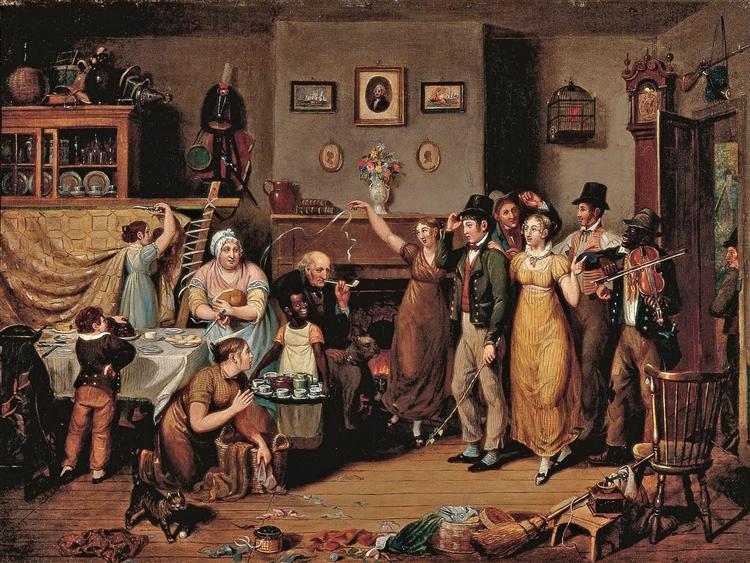
The quiltings described by 1850s writers mostly look like this:
industrious amusements of a simpler time, ie, the writer's youth.
[The Quilting Frolic (1813) by John Ludwig Krimmel]

 
A few stories allude to specific quilting parties in preparation for a wedding, but the majority do not. Excepting one story in which fifteen "misses" aged 14-20 gather to quilt for a friend's wedding, most of the descriptions explicitly describe both single and married women holding and attending quilting parties.  That being said, the after-dinner amusements and flirtations are especially directed for the former.  The need for gentlemen to escort ladies to and from the quilting also lends itself to flirtation and gossip.

"Coverlids [sic] generally consisted of quilts, made of pieces of waste calico, elaborately sewed together in octagons, and quilted in rectangles, giving the whole a gay and rich appearance. This process of quilting generally brought together the women of the neighborhood, married and single and a great time they had of it--what with tea talk and stitching. In the evening, the beaux were admitted so that a quilting was a real festival not unfrequently getting young people into entanglements which matrimony alone could unravel."
--Recollections of a Lifetime (1856)
The quilting generally began at an early hour in the afternoon, and ended at dark with a great supper and general jubilee, at which that ignorant and incapable sex which could not quilt was allowed to appear and put in claims for consideration of another nature.      --"The Minister's Wooing", The Atlantic Monthly (1859)
Some of the quilting parties corresponded with a wood-chopping party for the men.  Their separate work concluded with the daylight, both groups then meet up for dinner, which is followed by parlor games or dancing, with copious flirtation in either case. While the quilting portion was largely the domain of women (and the odd helpful brother), men are often invited for the concluding festivities, even when not preceded by a working party of their own.

Not all quilting bees produced a completed quilt. "My Economy Quilt" in The Lady's Repository (1860) deliberately emphasizes things not going as intended, and has the namesake quilt only half-done after an afternoon's work, thereby requiring another week of the maker's time to complete. Putting the quilt on the frame before the party started was one way to help ensure that a quilt was finished by the end of the day:
Here we found a collection of women busily occupied in preparing the quilt, which you may be sure was a curiosity to me. They had stretched the lining on a frame and were now laying fleecy cotton on it with much care; and I understood from several aside remarks which were not intended for the ear of our hostess, that a due regard for etiquette required that this laying of the cotton should have been performed before the arrival of the company, in order to give them a better chance for finishing the quilt before tea, which is considered a point of honor.
--Forest Life (1842)
This and most other sources indicate that the quilting party was only for the actual quilting: any patchwork or applique was completed by the hostess well in advance.  One story seems to allude to patchwork being done as a group activity: "The 'old married folks' have 'quilting parties' occasionally. They meet to sew together little bits of calico, and at the same time take the characters of their neighbors to pieces." (Burrillville: As it was, and As it is, 1856)  However, this could just be a verbal counterpoint to 'taking their neighbors to pieces'.

In "My Economy Quilt", the quilters' evening meal ("tea") includes 'nice biscuits, boiled custard, cold tongue and cheese and  pickled peaches and preserved citrons and mince pie and loaf cake and sponge cake and tea and coffee', with a final serving of 'apples, and nuts, and raisins' before the guests disperse.' In another story, an afternoon's quilting ends with a "sumptous supper" served at dusk, which is then followed by dancing, and ends at 9 o'clock with cider and dough-nuts.  The 1853 book Clovernook describes the preparations for a quilting party, including the purchase of "calico for the border of the quilt, with cotton batting and spool thread, but we also procured sundry niceties for the supper, among which I remember a jug of Orleans molasses, half a pound of ground ginger, five pounds of cheese and as many pounds of raisins". It goes on to note that "...before the appointed day every thing was in readiness--coffee ground, tea ready for steeping, chickens prepared for broiling, cakes and puddings baked, and all the extra saucers filled with custards or preserves."  In a description in the American Agriculturalist (1847),  it is stated the "bread and cakes are baked and every nice thing made ready for the feast the day before" the quilting party; in this case, men are not included in the supper, but they are "allowed to partake of the cakes, apples, and cider before the party breaks up"

While I could find little information about the proceedings, it appears that even enslaved women gathered for quilting parties.

P.S. For those looking for quilting pictures, Barbara Brackman has compiled some lovely images of women quilting, with commentary; she also discusses quilt frames of the 1860s (twice).