Wednesday, May 29, 2024

Spinach, As in France

I have a lot of spinach coming up in the garden just now, so the obvious solution is to find period recipes for cooking with it.

SPINACH AS IN FRANCE. When well picked and washed (which is most essential in dressing spinach), put it into a stewpan with a good bit of butter, a bunch of parsley, two shallots, a clove, salt and pepper; simmer over a slow fire, stirring occasionally; when ready, add a tea-spoonful of sugar and a bit of butter rolled on flour; well incorporate the whole. Fried bread as a garnish.

-Maria Rundell's The English Cookery Book (1856)

I tried this one last week at the fort.  I started by picking a large double handful of parsley from my container garden and a full vegetable bag of spinach from my allotment. In the kitchen, I rinsed both plants twice, and set them to dry on a sieve. I chopped the shallot (just one since I miscounted) and the parsley, and put ~4 Tbsp of butter on the stove top to melt. I then added the shallot, parsley, clove, salt, pepper, and spinach. I was worried about the limited liquid (and the spinach more than filling the largest saucepan I could find), but the spinach cooked down in short order, and also released enough moisture to keep from burning. Once it had achieved a consistent texture, I added a small spoon of sugar and another ~2 Tbsp butter rolled in flour.


Draining spinach; chopped parsley & shallot.

Meanwhile, with the spinach first cooking and then keeping warm on the back water-tank, Quin and I finally got to use the telescoping toasting forks. We experimented with a few options, but since the whole stove-top was in use, found that the best result involved opening the firebox front a little, and sticking the toast perpendicular on the forks. Unfortunately, this made the oven temperature go haywire, but it is a promising option for when the stove top is in use and the oven is not. 

Spinach as in France (left), with bonus sausages and mashed potatoes (after Soyer).

The spinach ended up being a hit with 3/4 historic interpreters, particularly spread over the toast. I found the flavor quite palatable (the shallots and parsley really added some nice depth and interest to the spinach), but alas did not enjoy the slimy texture of cooked-down leaves. Fortunately, we also had mashed potatoes going on that afternoon, and I found that they worked pretty well to disguise the texture while letting the flavor through.

All told, this dish was easy, cheap, and well-received. I'm not going to make it for myself, but I'd definitely consider it for any future living history events where I need a hot, savory side-dish while the spinach is in season.

Wednesday, May 1, 2024

Original: Wool Sateen Boots, c.1850

 Just dreaming about a possible summer project...

Girl's Boots, c.1850 from LACMA.

The description says they're made of wool sateen, bound in cotton tape, with leather soles. I wish they had an image of the back heel area.


Tuesday, April 30, 2024

April Mending

One of three sock darns, and evidence my corset is finally re-bound.

 Some sewing that I did get done this month: I darned my pale blue stockings in three places (and fairly neatly, if I don't say so myself), and finally put the binding back on my mid-century corset. I'd forgotten how comfortable it is to not have half the bones escape every time I put it on, though I fear the last several months of misuse have ingrained permanent wrinkles in the coutil. I ended up removing all the bones to give it a good press (after accidentally discovering that some of the bones' tip-coating reacts at high temperature), which got most of the wrinkles out at least, though a few tenacious ones are hanging on. 

Monday, April 29, 2024

Early 19th Century Pocket

   
Now every outfit has pockets.

Mea culpa for falling behind on posts. Again. I finally made up my long-planned late 18th/early 19th century dettached pocket last month, and then proceeded to not photograph it for some seven weeks.

Anyway, the patchwork is based on this early 19th century pocket from the Met. It uses larger square patches for the bottom of the pocket, and smaller squares and rectangles where the pocket narrows around the opening. As the Met has not kindly provided useful dimensions in their catalog, I used the measurements from a c.1840 pocket in the Old Sturbridge Village collection. I was able to draw a trapezoid from the height and two widths given, round the corners, and add a slit of the specified length. Very handy. I thought that particular example would suit this project, since it incorporates prints c.1790-1835, and mine mixes scraps from my Williamsburg haul with leftovers from a Regency dress (and chintz from a closer-to-mid-century quilting project). I lined the front and cut the back from a cotton ticking; the binding is narrower strips of chintz cut on the straight. Per both originals, I did not bind the outside edges.

I'm quite content with the capacity of this pocket, and have already used that to humorous effect in two museum programs. No one seems to expect me to pull a miniature sword out of my pocket (following the undersleeves, kerchief, hairbrush, sewing kit, knitting project, card case, pocket book, toothbrush, folding parasol, &c. This pocket can hold a lot). I do think I'll switch out the 1/4" cotton tape for a stouter article; it just digs in too much when worn without a corset, and I keep thinking the tape is going to break under the weight of items-that-fit-in-this-pocket.


Monday, April 1, 2024

Original: Net Cap, c1840


Cap, c.1840, in LACMA.

I really like how the texture of the different materials come through in this cap. But my count there's at least four different materials--scalloped lace, spotted net, striped ribbon, and a diagonal-striped fabric (bias strip?)--all in the same soft cream color. I think this adds a lot of visual interest to the cap, while keeping the overall effect light, airy, and subtle.

Thursday, March 28, 2024

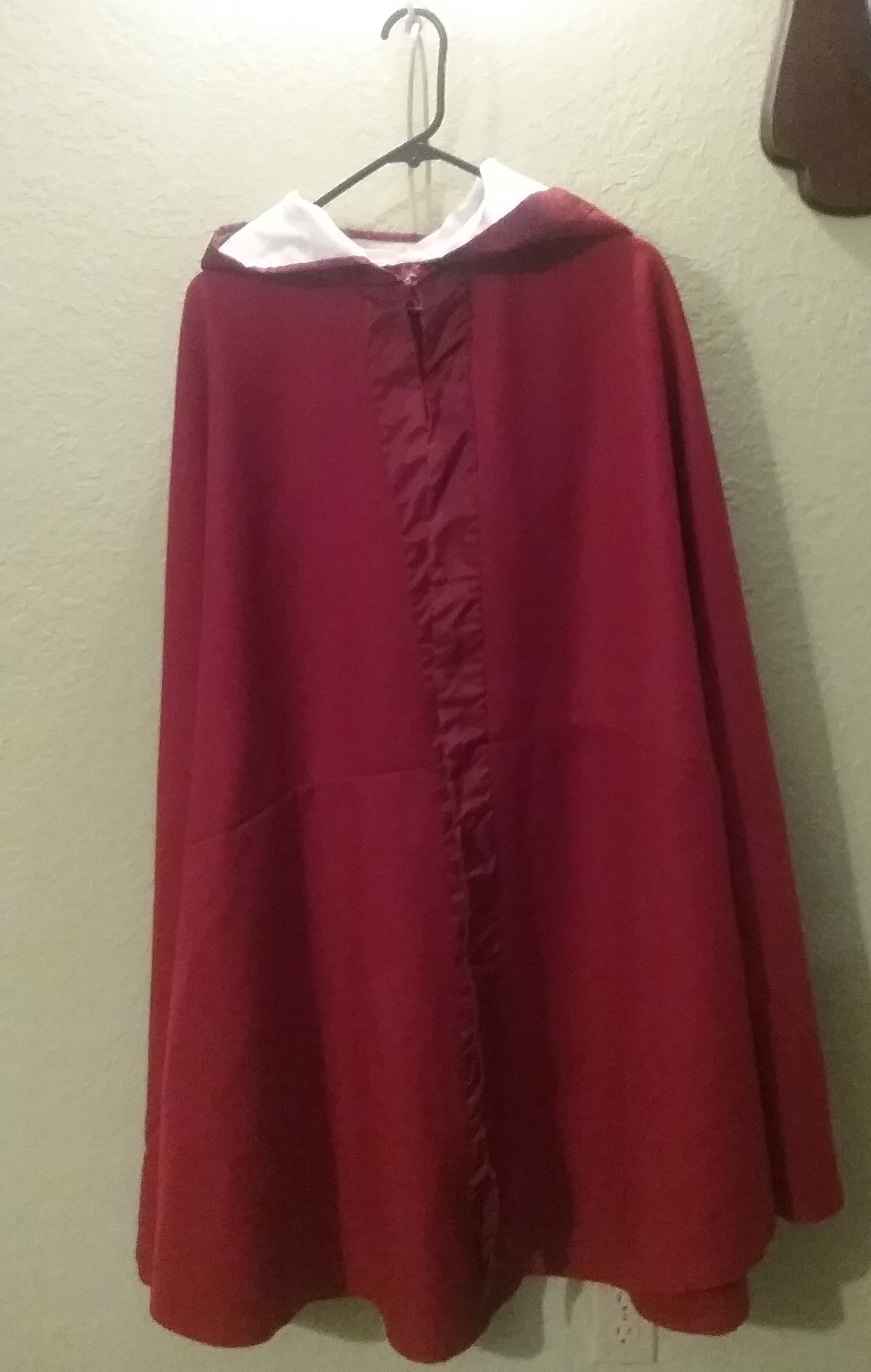
Red Wool Cloak, 18th Century


Cloak!

Based on an 18th century woman's cloak featured in Costume Close-Up. The original garment is in the collection of Colonial Williamsburg. As the garment was later altered, I used this similarly-dated (and similarly-constructed) cloak, also in the Williamsburg collection, for the facing width (2"), placement (on the outside, not the interior) and fastening information (ribbons).

I used 2 3/4 yards red broadcloth, per the original, though I didn't actually have to piece the hood (and the original was comprised of so many little strips that calculating out the sizes would have been more of a headache than actually sewing them together). The facing and hood lining are scrap silk from my collection. Due to the difficulties in finding silk ribbon of sufficient strength, I opted to use a stout replica hook-and-eye clasp on my cloak.

Overall, I'm pretty satisfied with the construction and fit of the cloak--all except the exterior silk facing, which looks rumbled no matter how much I iron it. And it was ironed at every stage of the process: after cutting, after the initial pass of sewing, and then as it was tacked down. I cut it along a pulled thread, so I know the silk's on-grain; at this point I'm pretty sure the problem is that I pulled the wool too tight relative to the silk as I was sewing the first seam. Alas.

Friday, March 1, 2024

Original: Embroidered Pocket, 18th Century

Pocket, English, mid-18th century. LACMA.
 

I've been reading a lot of Laurel Thatcher Ulrich's Good Wives, and selected this month's antique beauty in honor of this passage at the end of chapter 1:

"Much better than a spinning wheel, this homely object [the pocket] symbolizes the obscurity, the versatility, the personal nature of the housekeeping role. A woman sat at her wheel, but she carried her pocket with her from room to room, from house to yard, from yard to street...Whether it contained cellar keys or a paper of pins, a packet of seeds or a baby's bib, a hank of yarn or a Testament, it characterized the social complexity as well as the demanding diversity of women's work."
Also, I really like the embroidery.