Thursday, March 26, 2020

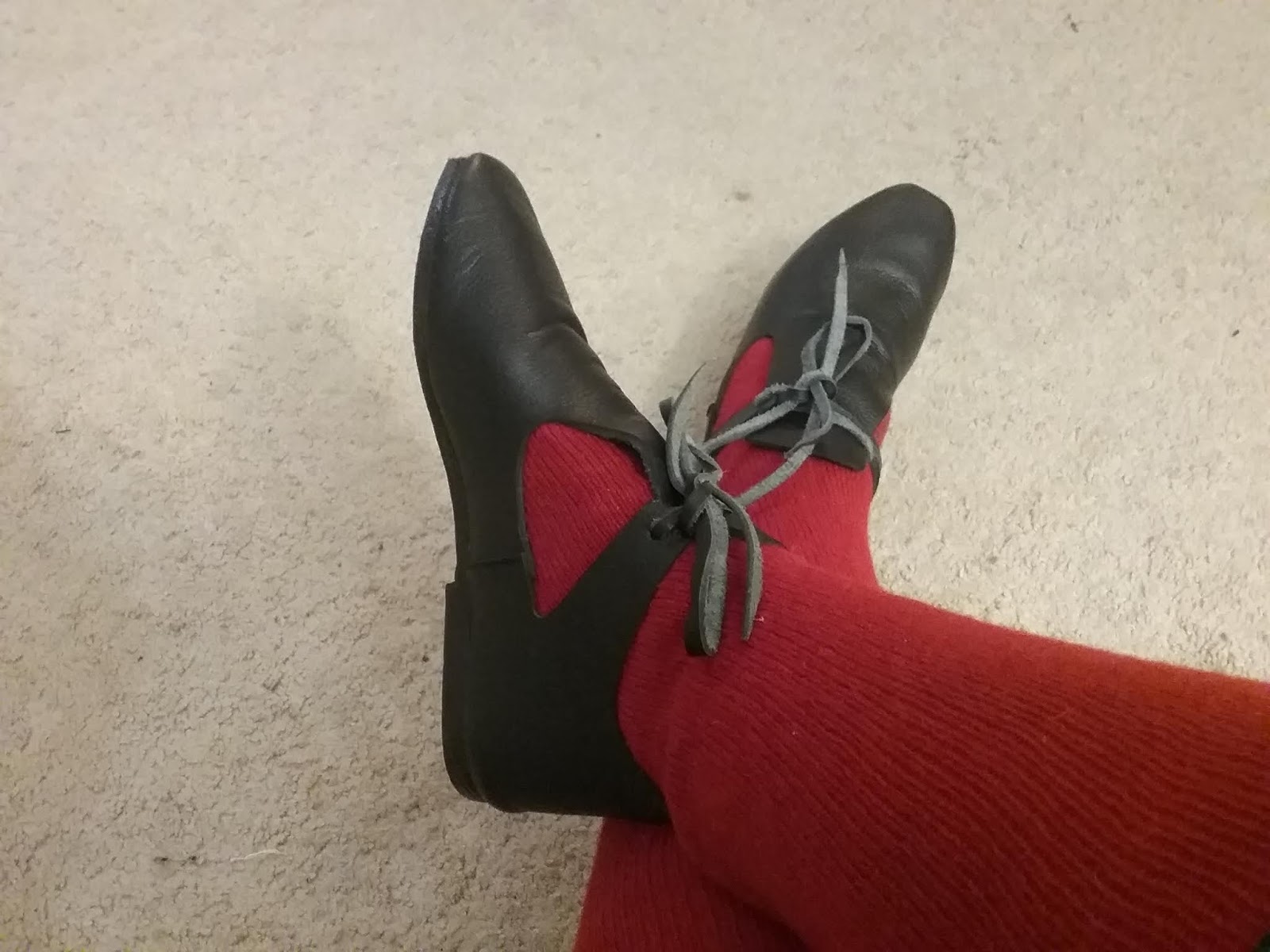
New Medieval & Renaissance Shoes

So, I've had my eye on Bohemond's Mary Rose Tudor shoes for a while...


Black leather renaissance shoes worn over red wool stockings.
Absurdly comfortable. 10/10.

 And the 10% sale/combined shipping somehow persuaded me that I really need to start making some 14th century garb.  As you do.

Black leather pointed toe 14th century shoes with ankle strap, worn over red stockings.
A little tight through the toes, need breaking in.

But considering how the event season is currently looking, it's prudent to be prepared for autumn/winter weather...


The same pointed toe 14th century shoes with ankle strap, now with wooden pattens strapped beneath them.
I'm absurdly excited for these pattens.


Tuesday, March 24, 2020

Forfeits

"As the penalty consists chiefly in kissing, forfeits are rather popular..."
--"Letters from the Country" (1861) 
".. no one guessed who held the thimble, which had been selected on account of its convenient size, and which Eunice, who passed it round. made a show of placing in the hands of each. The muffs, shawls, caps, hats, handkerchiefs, and gloves which were consequently obliged to be given as pledges, when piled together on the table, formed a miniature pyramid."
--"Sketches from Real Life" in Godey's (1848)

"As soon as the tea was over a game of family coach was started, which set every one laughing and scampering for places,-- forfeits were gathered in a pile in the lap of one of the elder ladies. Blindman's-buff followed, and Wilkie might have caught a few ideas had he seen the sly tricks of some of the demurest looking of the young girls." --"Forest Gleanings" in The Anglo-American Magazine (1858)


Many parlor games use mechanic of "forfeits" or "penalties" to raise the stakes of the games. Some games act as little more than means to rack up as many forfeits as possible! Indeed, depending on the source, "forfeits" may be a category of parlor game, a game in its own right, or simply score-keeping mechanic for games in general. Games for All Seasons speaks of  "The Game of Forfeits", and then enumerates ways in which these forfeits are doled out: in other books, many of these are called "games" in their own right. At the other extreme, A Week's Delight offers few forfeit tasks, but instead suggests that the first person to incur a penalty has to chose the next game the group will play.

"The Face of Wood"
A forfeit in The Sociable (1858)

During the course of the game, a player who makes a mistake or hesitates too long, will surrender a personal item (like the handkerchiefs and gloves above) into the forfeit pile. When the time comes to redeem the forfeits, items are drawn at random, and the owner is assigned an amusing or seemingly impossible task--not unlike a modern game of "truth or dare". The Victorian versions, however, quite famously involve more kissing than the modern analogue.

Fear not! For the modern audience, there are plenty of options for forfeits which do not involve kissing. 

An article in Godey's (August 1858) describes four possible forfeits, which encompass much of the variety available. The first is to make the person sing an impromptu song on a an assigned topic (or pick and sing a song about the topic if they can't make one up). The second is an exercise in wit: the forfeit-payer must 'making a will' by bequeathing one trait or possession of theirs to each person playing (potentially complimenting or mildly insulting everyone present). The third, in a similar vein, requires the person to pick one member of the party and an object, and then make a comparison between the two, as well as a contrast (again offering opportunities to compliment or insult). The last is the ever popular task to"kiss the candlestick"--more easily accomplished by handing a candle to a person you want to kiss (who is thus temporarily acting as a candlestick).

As indicated by the above, forfeits often fall into categories of wit, complimenting others, performing an impossible task, and kissing (or being excluded from kissing). The first two groups are often easiest to play in the modern day. "Making a Venus", for example, requires the forfeit-redeemer to compliment each lady in the room by selecting a trait from her with which to endow the goddess of love. A similar forfeit requires the person to "bow to the prettiest, kneel before the wittiest, and kiss the one [they] love best". Impossible tasks include passing an object through a keyhole (hint: write the word on a piece of paper), kissing the inside and outside of a reticule without opening it (hit the lining and exterior, or hang it on a wall and creatively define "inside"), or 'putting two chairs together, taking off your shoes, and jumping over them' (jump over the shoes, not the chairs!).

The kissing forfeits take various forms: from having to kiss a random person, to having to pick someone to kiss, or having to pick other people to kiss eachother while the penitent is excluded. In the "bridge of love" (aka Aristotle's steed, aka Ariadne's steed, aka the bench, see also the game "beast of burden"), a male forfeit-payer kneels on all fours while a couple sits on his back to kiss eachother. In "the wooden face" (see illustration), members of the group are lined up back to back, and on a signal, each turns around and kisses the person they are facing--the forfeit-payer, however, is always  positioned to be facing a wall instead of a person.


Period Sources for Forfeits

 The Sociable or One Thousand and One Home Amusements (1858), describes 56 forfeit tasks, starting on page 262.

The Corner Cupboard (London, 1858) describes 20 forfeits, starting on page 6.

The Book of Parlor Games (Philadelphia, 1853) has categories of "penances", starting page 42.

Fireside Games For Winter Evening Amusement (New York, 1859), forfeits start page 93.

Every Boy's Book of Games (London, 1852), forfeits start on page 45. 

Games for All Seasons (London, 1858), lists forfeits starting on page 191.

Round Games for All Parties (London, 1854), forfeits start on page 196.

Monday, March 23, 2020

Top 5 Parlor Games

For all of you locked down and sheltering at home with family, here are some of my favorite parlor games. These were a staple amusement for Victorians, particularly during long winter evenings. I've previously posted some popular Christmas games; here are my all-around favorites.

A realistic painting of two dozen adults and children dressed in 1860s clothing, playing a game in a circle outdoors, under a very large tree.
Hunt the Slipper (1860) by Frederick Goodall
Don't play in such large groups just now.

5. The Elements. Players sit or stand in a circle, and toss a small ball or knotted handkerchief. The person throwing the ball names one of the four classical elements (earth, water, air, fire), and the person catching the ball must name an animal appropriate to that element. For "fire", the catcher needs to say nothing. Forfeits are assessed for repeating an animal, naming an inappropriate one, or forgetting to call out an element.

4. Biz. This simple counting game is surprisingly amusing. Players sit in a circle, and count down the row 1, 2, 3, etc. However! The person who gets "4" (or a multiple of 4, or a number with a "4" in it), instead says "biz". The trick is to keep on count, and not say the forbidden numbers or 4, 8, 12, 14, etc. Forty through forty-nine are especially interesting. The game is played with forfeits (for errors and stalling).

3. Barnyard Animals. This is a story-telling game that's fun with kids, and hilarious with adults. Everyone selects an animal, and sits in chairs in a circle, with one person standing in the center.  The standing person starts to tell a story, using the animals as characters. When an animal is named, the corresponding player must stand  up, spin in a circle making the animal's noise, then sit again. At the phrase "all the barnyard animals", everyone stands, spins while making noises, and then scrambles for a new seat. The player without a seat becomes the next story-teller.

[I've found this game in period books as "My Lady's Toilette", with everyone pretending to be shoes and combs and so on, but prefer it with animals, as I learned it with LHS.]

2. I Love My Love With An A. An alphabetical game of wit. The group goes alphabetically around the circle, the first player getting "A", then "B", "C", all through the alphabet. Each player much think of a name, occupation, and trait that starts with that letter. For advanced play, add a flower, a food, and a present. The rulebook recommends skipping Q, X, Y, Z, though intrepid players can power through these tricky letters. You do not have to play with forfeits, but can assign them for forgetting a category, choosing a word with the wrong letter, or stalling too long.

Example rounds:

Person 1: "I love my love with an A for her name is Anna, she is an architect, and she's angelic."
Person 2: "I love my love with a B for his name is Ben, he is a bus-driver, and he's very bashful."
(Full version) Person 3: "I love my love with a C, for their name is Chris, they are a carpenter, and they're very careful. I will feed them carrots, give them a candle, and crown them with chrysanthemums."

1. What is my thought like? My current favorite is a game of wit. It's very popular with middle schoolers and adults alike; I've not tried it with younger children.

The person whose turn it is will think of an object (or concept), and without saying what it is ask the group "What is my thought like?" Each person then makes a comparison. After everyone's committed, the turn-taker will announce their thought, and everyone must explain why their comparison is true. Once everyone has done so, the next person gets a turn to pick the secret thing. You can play the game for forfeits, but I have never done so.

Example round:
Abby: I'm thinking of a thought. What is my thought like?
Ben: I think your thought is like a book.
Claire: I think your thought is like a summer's day.
Danny: I think your thought is like a baby.

Abby: I was thinking of my bunny slippers.
Ben: Abby's bunny slippers are like a book, because they are useful for relaxing at the end of a long day.
Claire: Your slippers are like a summer's day, because they are very comfortable.
Danny: The slippers are like a baby, in that I'd get in trouble for losing them.

The game continues with Ben picking an object, while Abby, Claire, and Danny make similes for it.

***

Honorable Mention: Blindman's Bluff. Not a good social distancing game, but very fun with a small group of close friends, at some point when it's safe to touch eachother again.

The two versions I like are blindman's bluff with a wand and seated blindman's bluff. In both games, one person is blindfolded, and tries to catch another member of the group and guess who they've caught. When played 'with a wand', the whole party holds hands in a circle around the blindfolded person, who uses a long stick to feel around for someone in the circle; the blindfolded player must then guess who it is. "Porco" (an Italian variant) allows the blindfolded player to make animal noises, which must be repeated  by the person being tapped with the stick (giving a clue to their voice). For safety, be sure to hold the stick low--below waist level--to avoid hitting faces.

In seated blindman's bluff, the whole company sits in chairs in a tight circle, and the person guessing has to sit on someone and guess who it is, rather than hitting anyone with a stick.

Sources

The Sociable, or 1001 Home Amusements (1858)
A Week's Delight or Games and Stories for the Parlor and Fireside (1859)
Fireside Games: For Winter Evening Amusement (1859)
Parlour Pastimes for the Young (1859)
Sports and Pastimes for In-Doors and Out (1863)

[Parts of this post previously appeared at my old Civil War blog.]

Sunday, March 22, 2020

Letting One's Hair Down (1850s)

At some point, I got into an argument about when women of the 1850s wore their hair down versus up. It resulted in the following list of contemporary paintings, which, in my humble opinion, supports the hypothesis that even very poor women generally wore their hair up.

Rural Working Class & Poor
French peasant (1855) Hair worn in fashionably wide bands.
Gorse gatherer (1855) Hair pinned up (details unclear, seems unfashionably tight and narrow, but still very much worn up and out of the way).
Countrywoman (1855): The cottage may be small and dark, but mom's wearing her hair up, under a neat cap.
Rural Scottish women (1855): Orphans, dirty cottages...and both women wearing their hair up, under caps, with neat center parts.
Cottager (1850) dressing a baby: hair is up, center parted, and under a cap.
Cottagers (1850) dressed up for a Baptism: hair is up and under caps!
Horse-riding member of the rural working class (1850) [note the man's smock]: Again, hair is up, bonnet is on.
Peasant woman in short skirts (1850): Hair up with center part and low chignon at the back.
Peasant woman (1855): Wearing her hair up, under a cap.
Cottager (1855) getting visited by the local gentry: has her hair up under a neat cap, center part visible.
In the yard (1854), the young mother wears her hair neatly dressed up.

Urban Working Class & Poor
Lacemaker (1855) In a garret, starving (the painting's titled "Bread and Tears"), but her hair is not only worn up, it's neatly brushed to glossiness and dressed fashionably wide over rats.
Seamstress (1858) Neatly dressed, with hair likewise.
Beggar girl (1855) Literally freezing on a street, still wearing hair up under a cap.
Dead destitute woman (1850): Has frozen on the streets, but her hair is still worn off the face, and appears contained.

Household Work
Peeling onions (1852), with hair worn up out of the way.
Cooking (1856) with hair up in stylish glossy bands.
Making stew (1854), the mistress wears her hair in fashionable bands, but the servant also has her hair up neatly up and out of the way.
Cooking waffles in a hearth (1853), the woman's hair is dressed low in bands.

Travelling
Emigrant woman (1855) She may be riding uncomfortably on the deck, but Madame has her hair up in wide bands, and wears a bonnet and shawl.

Undress
Bathing in a stream (1855), this lady still puts her hair up in glossy, wide bands.
Sleeping outdoors after bathing (1850) Hair is mostly obscured, but appears to still be up. [Note before clicking link that the figure is unclothed.]
Half dressed, without a chemise, but hair being put up first. [Note that the figure in this painting is topless before clicking link.]
Wearing a wrapper (1857) while caring for a baby, hair is worn up.
Wearing a wrapper (1855) while playing with baby, hair is worn up.

Hair worn down
Young woman with a sick baby (1855): Alone, in the privacy of the house, and with other pressing concerns, this young woman's hair is down...but still center-parted and smoothed behind the ears.
Teenage French Peasant herding cows (1855), one exception to the many women wearing their hair up and out of way while working outdoors.
Elizabeth Siddal appears with hair down or being combed in a number of Rosseti's drawings and paintings of her (some historical, some contemporary).

My conclusion remains that (unless one is running with the pre-Raphaelites) adult women of the 1850s wore their hair up--even if they were poor, or working, or in their own room at home.

Saturday, March 21, 2020

Strawberry Cream

Strawberry ice cream molded into a rose shape, set atop a fluted mold of ice cream. Quartered strawberries line the edges.
Strawberry ice cream.
Probably should have used some mint leaves for contrast.


I've made it before, but there were strawberies and cream to use up in the fridge, and I wanted to work on plating ideas. Miss Leslie's Complete Cookery (1851); half scale receipt with 1 pint strawberries, 1 pint cream, and 2 oz sugar. I tried using cooking spray instead of oil on the molds; while fast and tidy, the ice cream stuck more than usual.

Friday, March 20, 2020

Sweet and Savory Herbs


O, those fun "make in the usual fashion" shorthands.  During season 3 of the Historical Food Fortnightly, I was trying to branch out from my usual baked goods and desserts... only to run into dish after dish calling for the meat or vegetables or eggs or sauce to be seasoned with "sweet herbs" or "savory herbs", and without guidance for what these might be.

So, I started poking around at some other sources, and eventually compiled this short list of possibilities:

Sweet herbs


Savoury/Savory Herbs


In addition to the fun versatility of parsley and basil, there's also some nomenclature overlap. The Principles of Cooking refers to the bouquet garni as a bunch of sweet herbs (or a bunch of herbs in general); The Epicure defines it as a bunch of savory herbs. The Modern Housewife uses it as a catch-all, with the specific herbs to be named in the receipt (but when not specified, it means parsley).

Incidentally, The Modern Housewife (1851) has some good discussion of culinary herbs and how to cook with them but doesn't use the 'sweet' and 'savory' designations. A list of "Sweet and Pot Herbs" from an 1829 Seed Catalogue likewise does not distinguish by culinary category. Facts for Farmers lists common culinary herbs (anise, sweet basil, carraway, corriander, dill, fennel, sweet marjoram, summer savory, thyme, sage) without further sweet/savory designation. Domestic Economy and Cookery / The Book of the Household specify that different mixtures of "sweet herbs" could be purchased and should be used for different dishes. Cassell's states their lists/recipes are widely inclusive, and that herbs which are unavailable or undesired should be omitted.

TL;DR: Use parsley, thyme, sage, and basil for everything. And marjoram for sweet herbs.


*Don't actually cook with this one. I've read both historic and contemporary sources indicating that pennyroyal causes miscarriages. See my program on Nineteenth Century Contraceptives for more information.

**This might be the full list of plants used in different 'savory herbs' combinations from Domestic Economy and Cookery, but it's grammatically ambiguous and some of these seem to be used a vegetables.

Thursday, March 19, 2020

Introductions and Modes of Address, Mid-19th Century

[This post originally appeared on February 27, 2015 at my Civil War blog. I'm moving select content here to my main blog.]

Black and white illustration of a woman in a late 1850s open-front wrapper whispering to a lady in a day dress of the same era.
"Allow me to introduce you."

New to first-person conversation?  There's no better place to start than at the beginning. The preferred period method for introductions features a person presenting one friend to another--you meet people largely on the recommendation of your existing acquaintances.  

"Mrs. Jones, have you met my sister, Mrs. Smith?" 

"Mrs. Denny, allow me to present M. Hugo, from Paris." 

"Miss Thomas, may I present Dr. Adams?"

When making an introduction, you always present one person to the other; the higher ranking person is addressed first. To determine precedence in this and most other social situations, some guidelines:
  1. Ladies outrank gentlemen (this is the most important rule)
  2. Married ladies outrank unmarried ladies
  3. Older persons outrank young ones*
  4. Rank your close friends and family lower than strangers
  5. Social status—this is bit nebulous, unless you're dealing with actual aristocrats—but could come up if you're introducing two people of the similar age, gender, marital status, and proximity to yourself, in which case the one of greater social prominence goes first
Dropping in additional information (relationship to you, recent travel abroad, a visitor's hometown) is appropriate. The idea is to get people acquainted with each other, after all, and those details may help start a conversation.  Miss Leslie (The Behavior Book, 1853) writes that it is acceptable for ladies who are travelling alone to introduce themselves to genteel (female) strangers, when there is no one available to make an introduction. Similarly, persons meeting a the house of a mutual friend (according to Charles Day in Hints on Etiquette and the Usages of Society, 1844) may introduce themselves, as the host's invitation indicates that they are both respectable. Another period option is to present a letter of introduction from a mutual associate.

In certain situations (public balls), a designated 'floor manager' or 'master of ceremonies' is delegated to introduce potential partners for the dance only; these introductions are different from normal social introductions and do not allow for future social interaction.

 In any case, make sure to use social titles and surnames, when speaking to adults. Avoid reenactorisms, such as calling a middle-aged woman "Miss Betty"**, or addressing the postmaster as "George"***.  Use of first names, in period writing and address, is limited to family members, children, servants, and some intimate correspondence between friends. The exception is to differentiate between people with the same title and last name, in which case the first name is added for the junior parties.

Example: The Smith family has four daughters and three sons. Both the eldest son and the eldest daughter are married. The middle son and daughters are grown-up, but unmarried. The youngest son and daughter are still children, and not brought into adult society. The family is addressed as:
Mr. Smith (dad)
Mrs. Smith (mom)

Mr. John Smith (eldest son)
Mrs. John Smith (daughter-in-law)
Mr. Robert Smith (younger adult son)
(Master) Michael Smith (child) 

Mrs. Brown (married daughter)
Mr. Brown (son-in-law)
Miss Smith (eldest unmarried daughter)
Miss Deborah Smith (other unmarried adult daughter)
(Miss) Liza Smith (child)

 In public, Mr. Smith refers to his wife as Mrs. Smith; she refers to her husband as Mr. Smith (she may call him "Mr. S",  but her friends would find this inelegant or even affected). What the Smiths call eachother in private is their own business. They address their children by their given names. [Note: Mr. Day's book condemns the practice of calling one's own children Mr._ or Miss_, which means some people did it.]
When Master Smith grows up, he will be styled "Mr. Michael Smith" (unless/until he attains a professional distinction styling him as "Dr.", "Professor", or "Reverend", or assumes a notable military rank). The younger men will continue to use their first names with the last in any situation where multiple "Mr. Smith"s would create ambiguity. Among their male friends, the sons are just called "Smith", dropping the honorific.****

 Similarly, Mrs. Brown uses her husband's first name when more than one Brown is around. When Miss Smith marries, her sister Deborah will stop using her first name and simply be "Miss Smith". When little Liza is old enough to enter society, if any of her older sisters are still unmarried, she'll be styled Miss Elizabeth Smith. If Deborah never marries, she'll continue to hold the title of "Miss Smith"; in that case, Liza could pass right from "Miss Elizabeth Smith" to "Mrs. MarriedLastName" without ever being the sole "Miss Smith".

 Women can attain professional titles, but they are very, very rare. The Rev. Miss Antoinette Brown (later Rev. Mrs. Blackwell) and her future sister-in-law, Dr. Elizabeth Blackwell, are quite exceptional--as is their shared sister-in-law, Lucy Stone.  [In order, they are the first woman ordained by a mainstream protestant sect in America, the first woman to receive a medical degree in America, and the the first prominent woman in America to keep her own name after marriage.]

References
Day, Charles William. Hints on Etiquette and the Usages of SocietyBoston: William Ticknor & Co, 1844. Available here.
Leslie, Eliza. The Behavior Book. Philadelphia: Willis P. Hazard, 1853. Available here.
Thornwell, Emily. The Ladies' Guide to Perfect Gentility. New York: Derny & Jackson, 1856. Available here.
The illustration is from Peterson's Magazine, January 1859 issue.

 *If you're dealing with a venerable spinster and a very young matron, there may be some interplay of rules 2 and 3, where the younger person gives way to the older. There's also an exception for guests of honor being elevated to the top position, but that's event-specific.

 **That's "Miss Betty Thompson" if she's a spinster, with an elder sister who is also a spinster ("Miss Thompson"). The exception is if you can document a local custom appropriate to your impression. The one place I've seen it in the period is in a diary referring to a governess (socially ambiguous position), who appears variously as "Miss Firstname", "Miss Lastname" and "Firstname Lastname".

 ***It's only appropriate if he's your son or brother.

 ****While I'm still gathering information, this particular form of intimate address seems to be used in casual talk between men of equal rank (or towards those of lower rank) who know eachother from adulthood: college friends, coworkers, employers towards upper servants. That is, they know eachother from adult life where first names aren't used, but are on familiar terms. Women don't move in the public sphere in the same way; if they're using a special name for a close friend its her first name.