 |
| Strawberry ice cream. Probably should have used some mint leaves for contrast. |
Saturday, March 21, 2020
Strawberry Cream

Friday, March 20, 2020
Sweet and Savory Herbs

O, those fun "make in the usual fashion" shorthands. During season 3 of the Historical Food Fortnightly, I was trying to branch out from my usual baked goods and desserts... only to run into dish after dish calling for the meat or vegetables or eggs or sauce to be seasoned with "sweet herbs" or "savory herbs", and without guidance for what these might be.
So, I started poking around at some other sources, and eventually compiled this short list of possibilities:
Sweet herbs
- Savory, thyme, basil, knotted marjoram The New London Cookery Book (1827)
- Burnet, tarragon, parsley, sage, thyme, penny-royale*, marjoram and knotted marjoram, savory, and basil... also in The New London Cookery Book (1827)
- Parlsey, thyme, and sage (optional cibols or spring onions) make 'a fagot of sweet herbs' in The Principles of Cooking (1884)
- Basil is a sweet herb as well as a savory The Epicure (1898)
- Parsley, young onions, lemon thyme, winter savory, and terragon Domestic Economy and Cookery (1827) [copied verbatim in The Book of the Household (1861)]
- Knotted marjoram, sweet basil, parsley, thyme, chives, and chervil Cassell's Household Guide (1869)
- Marjoram is defined as a sweet herb in Kersey's Dictionary (1793)
- Clary, costmary, lavender, mint, rosemary, tansy, and thyme show up as sweet herbs for cultivation An Encyclopedia of Gardening (1835)
- Sage is one of the sweet herbs Methods of Canning (1890)
- Balm and thyme are specifically called sweet herbs Gardener's Chronicle (1888)
Savoury/Savory Herbs
- Parsley, thyme, bay, celery, and carrots The Epicure (1898)
- Basil is a savory herb, as well as a sweet The Epicure (1898)
- Parsley is called one of the savory herbs Beeton's Book of Household Management (1861), also in Facts for Farmers (1866)
- Celery, and possibly fennel (Domestic Economy and Cookery /The Book of the Household then brings up sweet herbs as a group, under the savoury heading, so your mileage may vary)
- Parlsey, sweet basil, summer savory, winter savory, marjoram, marigold, bay, common whitlow, star of Bethlehem, leek, black briony, coventry bells, hyssop, purslane, primrose, fennel, dill, burnet, tansy, young hops, and golden thistle**
- Onion, sage, spinach, beets, parsley, and leeks all figure into a "savory herb pudding" in The Family Save-All (1861)
- Parsley, savory, sweet marjoram thyme, basil, and lemon peel make a savory herb powder Cassell's Household Guide (1869) and The Domestic Service Guide (1865)
- In a horticultural context Plain and Pleasant Talk About Fruits, Flowers, and Farming (1859) mentions "savory herbs, as sweet marjoram, sweet basil, thyme, sage, lavender, etc., etc."
In addition to the fun versatility of parsley and basil, there's also some nomenclature overlap. The Principles of Cooking refers to the bouquet garni as a bunch of sweet herbs (or a bunch of herbs in general); The Epicure defines it as a bunch of savory herbs. The Modern Housewife uses it as a catch-all, with the specific herbs to be named in the receipt (but when not specified, it means parsley).
Incidentally, The Modern Housewife (1851) has some good discussion of culinary herbs and how to cook with them but doesn't use the 'sweet' and 'savory' designations. A list of "Sweet and Pot Herbs" from an 1829 Seed Catalogue likewise does not distinguish by culinary category. Facts for Farmers lists common culinary herbs (anise, sweet basil, carraway, corriander, dill, fennel, sweet marjoram, summer savory, thyme, sage) without further sweet/savory designation. Domestic Economy and Cookery / The Book of the Household specify that different mixtures of "sweet herbs" could be purchased and should be used for different dishes. Cassell's states their lists/recipes are widely inclusive, and that herbs which are unavailable or undesired should be omitted.
TL;DR: Use parsley, thyme, sage, and basil for everything. And marjoram for sweet herbs.
*Don't actually cook with this one. I've read both historic and contemporary sources indicating that pennyroyal causes miscarriages. See my program on Nineteenth Century Contraceptives for more information.
**This might be the full list of plants used in different 'savory herbs' combinations from Domestic Economy and Cookery, but it's grammatically ambiguous and some of these seem to be used a vegetables.
Thursday, March 19, 2020
Introductions and Modes of Address, Mid-19th Century
[This post originally appeared on February 27, 2015 at my Civil War blog. I'm moving select content here to my main blog.]
New to first-person conversation? There's no better place to start than at the beginning. The preferred period method for introductions features a person presenting one friend to another--you meet people largely on the recommendation of your existing acquaintances.
"Mrs. Jones, have you met my sister, Mrs. Smith?"
"Mrs. Denny, allow me to present M. Hugo, from Paris."
"Miss Thomas, may I present Dr. Adams?"
When making an introduction, you always present one person to the other; the higher ranking person is addressed first. To determine precedence in this and most other social situations, some guidelines:
In certain situations (public balls), a designated 'floor manager' or 'master of ceremonies' is delegated to introduce potential partners for the dance only; these introductions are different from normal social introductions and do not allow for future social interaction.
In any case, make sure to use social titles and surnames, when speaking to adults. Avoid reenactorisms, such as calling a middle-aged woman "Miss Betty"**, or addressing the postmaster as "George"***. Use of first names, in period writing and address, is limited to family members, children, servants, and some intimate correspondence between friends. The exception is to differentiate between people with the same title and last name, in which case the first name is added for the junior parties.
Example: The Smith family has four daughters and three sons. Both the eldest son and the eldest daughter are married. The middle son and daughters are grown-up, but unmarried. The youngest son and daughter are still children, and not brought into adult society. The family is addressed as:
Mr. Smith (dad)
Mrs. Smith (mom)
Mr. John Smith (eldest son)
Mrs. John Smith (daughter-in-law)
Mr. Robert Smith (younger adult son)
(Master) Michael Smith (child)
Mrs. Brown (married daughter)
Mr. Brown (son-in-law)
Miss Smith (eldest unmarried daughter)
Miss Deborah Smith (other unmarried adult daughter)
(Miss) Liza Smith (child)
In public, Mr. Smith refers to his wife as Mrs. Smith; she refers to her husband as Mr. Smith (she may call him "Mr. S", but her friends would find this inelegant or even affected). What the Smiths call eachother in private is their own business. They address their children by their given names. [Note: Mr. Day's book condemns the practice of calling one's own children Mr._ or Miss_, which means some people did it.]
When Master Smith grows up, he will be styled "Mr. Michael Smith" (unless/until he attains a professional distinction styling him as "Dr.", "Professor", or "Reverend", or assumes a notable military rank). The younger men will continue to use their first names with the last in any situation where multiple "Mr. Smith"s would create ambiguity. Among their male friends, the sons are just called "Smith", dropping the honorific.****
Similarly, Mrs. Brown uses her husband's first name when more than one Brown is around. When Miss Smith marries, her sister Deborah will stop using her first name and simply be "Miss Smith". When little Liza is old enough to enter society, if any of her older sisters are still unmarried, she'll be styled Miss Elizabeth Smith. If Deborah never marries, she'll continue to hold the title of "Miss Smith"; in that case, Liza could pass right from "Miss Elizabeth Smith" to "Mrs. MarriedLastName" without ever being the sole "Miss Smith".
Women can attain professional titles, but they are very, very rare. The Rev. Miss Antoinette Brown (later Rev. Mrs. Blackwell) and her future sister-in-law, Dr. Elizabeth Blackwell, are quite exceptional--as is their shared sister-in-law, Lucy Stone. [In order, they are the first woman ordained by a mainstream protestant sect in America, the first woman to receive a medical degree in America, and the the first prominent woman in America to keep her own name after marriage.]
References
Day, Charles William. Hints on Etiquette and the Usages of Society. Boston: William Ticknor & Co, 1844. Available here.
Leslie, Eliza. The Behavior Book. Philadelphia: Willis P. Hazard, 1853. Available here.
Thornwell, Emily. The Ladies' Guide to Perfect Gentility. New York: Derny & Jackson, 1856. Available here.
The illustration is from Peterson's Magazine, January 1859 issue.
*If you're dealing with a venerable spinster and a very young matron, there may be some interplay of rules 2 and 3, where the younger person gives way to the older. There's also an exception for guests of honor being elevated to the top position, but that's event-specific.
**That's "Miss Betty Thompson" if she's a spinster, with an elder sister who is also a spinster ("Miss Thompson"). The exception is if you can document a local custom appropriate to your impression. The one place I've seen it in the period is in a diary referring to a governess (socially ambiguous position), who appears variously as "Miss Firstname", "Miss Lastname" and "Firstname Lastname".
***It's only appropriate if he's your son or brother.
****While I'm still gathering information, this particular form of intimate address seems to be used in casual talk between men of equal rank (or towards those of lower rank) who know eachother from adulthood: college friends, coworkers, employers towards upper servants. That is, they know eachother from adult life where first names aren't used, but are on familiar terms. Women don't move in the public sphere in the same way; if they're using a special name for a close friend its her first name.
 |
| "Allow me to introduce you." |
New to first-person conversation? There's no better place to start than at the beginning. The preferred period method for introductions features a person presenting one friend to another--you meet people largely on the recommendation of your existing acquaintances.
"Mrs. Jones, have you met my sister, Mrs. Smith?"
"Mrs. Denny, allow me to present M. Hugo, from Paris."
"Miss Thomas, may I present Dr. Adams?"
When making an introduction, you always present one person to the other; the higher ranking person is addressed first. To determine precedence in this and most other social situations, some guidelines:
- Ladies outrank gentlemen (this is the most important rule)
- Married ladies outrank unmarried ladies
- Older persons outrank young ones*
- Rank your close friends and family lower than strangers
- Social status—this is bit nebulous, unless you're dealing with actual aristocrats—but could come up if you're introducing two people of the similar age, gender, marital status, and proximity to yourself, in which case the one of greater social prominence goes first
In certain situations (public balls), a designated 'floor manager' or 'master of ceremonies' is delegated to introduce potential partners for the dance only; these introductions are different from normal social introductions and do not allow for future social interaction.
In any case, make sure to use social titles and surnames, when speaking to adults. Avoid reenactorisms, such as calling a middle-aged woman "Miss Betty"**, or addressing the postmaster as "George"***. Use of first names, in period writing and address, is limited to family members, children, servants, and some intimate correspondence between friends. The exception is to differentiate between people with the same title and last name, in which case the first name is added for the junior parties.
Example: The Smith family has four daughters and three sons. Both the eldest son and the eldest daughter are married. The middle son and daughters are grown-up, but unmarried. The youngest son and daughter are still children, and not brought into adult society. The family is addressed as:
Mr. Smith (dad)
Mrs. Smith (mom)
Mr. John Smith (eldest son)
Mrs. John Smith (daughter-in-law)
Mr. Robert Smith (younger adult son)
(Master) Michael Smith (child)
Mrs. Brown (married daughter)
Mr. Brown (son-in-law)
Miss Smith (eldest unmarried daughter)
Miss Deborah Smith (other unmarried adult daughter)
(Miss) Liza Smith (child)
In public, Mr. Smith refers to his wife as Mrs. Smith; she refers to her husband as Mr. Smith (she may call him "Mr. S", but her friends would find this inelegant or even affected). What the Smiths call eachother in private is their own business. They address their children by their given names. [Note: Mr. Day's book condemns the practice of calling one's own children Mr._ or Miss_, which means some people did it.]
When Master Smith grows up, he will be styled "Mr. Michael Smith" (unless/until he attains a professional distinction styling him as "Dr.", "Professor", or "Reverend", or assumes a notable military rank). The younger men will continue to use their first names with the last in any situation where multiple "Mr. Smith"s would create ambiguity. Among their male friends, the sons are just called "Smith", dropping the honorific.****
Similarly, Mrs. Brown uses her husband's first name when more than one Brown is around. When Miss Smith marries, her sister Deborah will stop using her first name and simply be "Miss Smith". When little Liza is old enough to enter society, if any of her older sisters are still unmarried, she'll be styled Miss Elizabeth Smith. If Deborah never marries, she'll continue to hold the title of "Miss Smith"; in that case, Liza could pass right from "Miss Elizabeth Smith" to "Mrs. MarriedLastName" without ever being the sole "Miss Smith".
Women can attain professional titles, but they are very, very rare. The Rev. Miss Antoinette Brown (later Rev. Mrs. Blackwell) and her future sister-in-law, Dr. Elizabeth Blackwell, are quite exceptional--as is their shared sister-in-law, Lucy Stone. [In order, they are the first woman ordained by a mainstream protestant sect in America, the first woman to receive a medical degree in America, and the the first prominent woman in America to keep her own name after marriage.]
References
Day, Charles William. Hints on Etiquette and the Usages of Society. Boston: William Ticknor & Co, 1844. Available here.
Leslie, Eliza. The Behavior Book. Philadelphia: Willis P. Hazard, 1853. Available here.
Thornwell, Emily. The Ladies' Guide to Perfect Gentility. New York: Derny & Jackson, 1856. Available here.
The illustration is from Peterson's Magazine, January 1859 issue.
*If you're dealing with a venerable spinster and a very young matron, there may be some interplay of rules 2 and 3, where the younger person gives way to the older. There's also an exception for guests of honor being elevated to the top position, but that's event-specific.
**That's "Miss Betty Thompson" if she's a spinster, with an elder sister who is also a spinster ("Miss Thompson"). The exception is if you can document a local custom appropriate to your impression. The one place I've seen it in the period is in a diary referring to a governess (socially ambiguous position), who appears variously as "Miss Firstname", "Miss Lastname" and "Firstname Lastname".
***It's only appropriate if he's your son or brother.
****While I'm still gathering information, this particular form of intimate address seems to be used in casual talk between men of equal rank (or towards those of lower rank) who know eachother from adulthood: college friends, coworkers, employers towards upper servants. That is, they know eachother from adult life where first names aren't used, but are on familiar terms. Women don't move in the public sphere in the same way; if they're using a special name for a close friend its her first name.
Wednesday, March 18, 2020
HFF 4.6: Erin Go Bragh!

The Challenge: Erin Go Bragh! Make a dish associated with Ireland or St. Patrick's Day (the connection may be as tenuous as you wish).
The Recipe: An Irish Cordial from Sarah J. Hale's The New Household Receipt Book
The Date/Year and Region: 1853 / New York (claims the recipe is Irish)
How Did You Make It: I started by scalding my "yellowware" pitcher. Once dry, I put 2 oz of currants, 1/8 of a lemon peel, 3/16 tsp ground ginger, and 1/2 cup whiskey in the jar pitcher [working on 1/8 scale]. I covered the pitcher and let it sit for a day, then strained off the fruit, stirred in (with difficulty) 2.5 oz of sugar, and strained it again.
Time to Complete: 1 day (actual work < 10 minutes)
Total Cost: Varies with the whiskey.
How Successful Was It?: Tasty, but very thick (syrupy). The sugar and fruit makes it really smooth, with a bit of a burn from the whiskey afterwards. I like the taste, but the texture is a bit much.
Incidentally, mixed 1:1 with hot water, it makes a delightful drink. Hot, sweet, fruity, and alcoholic, very reminiscent of my favorite hot toddy recipe.
How Accurate Is It?: I wonder if cordials are meant to be sipped in this period, or if they're supposed to be mixed with something. I could see this being really tasty added to hot water, wine, etc., for the flavor and kick, even as the thick sugary cordial is a bit much on its own.
I interpreted the 'well pounded ginger' to mean ground dried ginger rather than fresh (though I have plenty of fresh and was tempted to go that route). The original receipt called for white currants, for which I substituted zante currangs (as usual). I did find another receipt which called for raisins instead of currants (also seville orange peel instead of lemon, and considerably more spice), so hopefully my substitution of zante currants for white currants is acceptable.
 |
| The ingredients assembled. |
 |
| An Irish Cordial (1853) |
Thursday, March 12, 2020
New Pipkin
Every project I've touched the last two months seems to be stuck at 90%, so here's the new toy tool I'm looking forward to trying.
 |
| Earthenware pipkin from Jeanne Wood. It's glazed inside and out, and the green is even prettier in person. |
Tuesday, March 10, 2020
HFF 4.5: Centerpiece
The Challenge: Centerpiece. Pull out all the stops to make something pretty and eye-catching to adorn your table.
The Recipe: A pretty dish of oranges from Beeton's Book of Household Management. I chose Beeton because it goes into more detail about plating than most of my usual references. I also completely forgot how badly my sugar-boiling always goes, so...
The Date/Year and Region: 1861, London
How Did You Make It: I peeled 4 oranges*, and divided them into sections. I then heated 1/2 lb of white sugar in 1/2 cup water on the stove; in the span of ~13 minutes it got to boiling, and started thickening towards the 'brittle in water' stage described in the recipe.
I meant to then dip each orange slice in the sugar syrup, then lay it along the wall of my plainest pudding mold, forming an overlapping wall of oranges that would stick to eachother.
Instead, the sugar crystalized. So, I added more water and reheated it. Then the oranges decided (3/4 of the way through) to stop adhering to their neighbors and start falling into the dish's center. After three more attempts, including two aditonal batches of sugar when the first ones ran out, I eventuslly gave up on making the oranges pretty, and just packed them in the bottom of the dish, relying on the core of the mold to make the central cavity. I also ended up throwing a 5th orange into the bowl, just to fill space (this was a navel orange, as I ran out of the other kind). Being frustrated, I put the whole mold into the fridge overnight, in hopes the sugar would set better (and to avoid dealing with it).
The next day, I prepared the whopped cream. In a complete contrast, it turned out perfectly on the first try. I used the ingredients from the above recipe, but looked to whipped cream #1492 for proportions and technique. I placed 1.5oz granulated sugar, 2 tablespoons of brandy, and 1 cup heavy cream in a bowl, then beat until fluffy. Fortunately, instead of spending an hour at this as directed, the electric mixer completed the task in ~2min. I then unmolded the oranges (a little hot water outside the mold helped), spooned whipped cream into the center, and used a pastry bag to decorate the dish with the remaining whipped cream.
*I don't know the specific variety. They're a moderate-sized sweet orange from the local Chinese grocery store--smaller and more flavorful than navel oranges, which are the only other kind I ever see.
Time to Complete: A million years. It seemed.
Total Cost: ~$7
How Successful Was It?: Tasty, but I need a but more practice to get the 'centerpiece' part down. The oranges are slightly sweetened by the sugar syrup, but not overwhelmingly so; the whipped cream was very nicely balanced, with the brandy prominent but not excessive.
How Accurate Is It?: Electric conveniences abound, but I think it was a reasonable approximation of the dish. I do need to work on my sugar-boiling skills, and the presentation. The pastry bags were used in period: other 1860s confectionery books mention using folded paper with a cut corner to do smooth lines and dots, while metal tips were available for more complicated effects. So while I wouldn't use my bags in a period demo, I feel alright using them offstage.
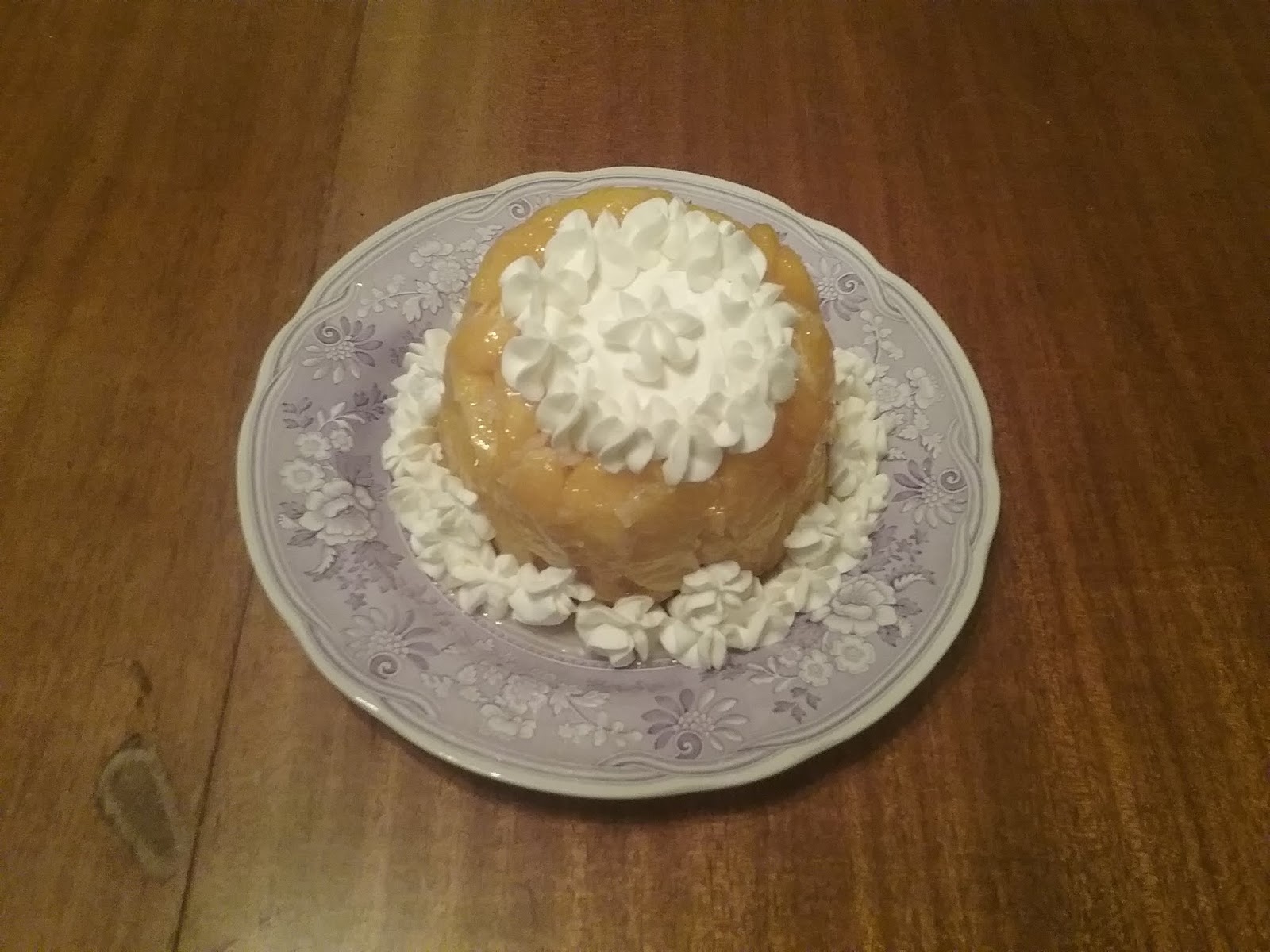 |
| Next time, I should just do a jelly... |
Sunday, March 1, 2020
Original: 1930s Court Gown
Subscribe to:
Posts (Atom)