[If you haven't seen Cranford, this is the relevant scene. Also, you should watch Cranford!]
Sunday, June 4, 2017
Tuesday, May 30, 2017
Crinoline Cartoons
Just for fun, here are a few favorite mid-nineteenth century cartoons about crinolines. Some funny, some casually classist, some intended seriously:"Why do women like stays?" "Because they feel so-laced by them."--Frank Leslie's, 1862, p.561
![]() |
| 1858. "The Dangers of Crinoline" Not intended as a humor, but perhaps the 2-in-1 hoop lightning rod won't catch on. |
![]() |
| "Song of the Hoop" Harper's New Monthly Magazine 1857 This needs to be performed at Conference next year. Ideally with choreography. |
![]() |
| Punch Aug 23, 1856. Other than the exaggerated circumference of hoop and skirt, this one isn't too bizarre. I like that you can see an under-hoop petticoat in use. |
![]() |
| "The 'Skirt Movement' Illustrated." Peterson's 1856. Text: "Little Boy--Ma! call to Bridget! She's gone and put my hoop under her dress." |
![]() |
| Punch, Nov 21, 1863 |
Mary: "Did you call, Mum?"
Lady: "Yes, Mary! I thought I told you not to wear your hoop before you had done your rooms, because you broke the jugs and basins with it!"
Mary: "Oh, Mum! You see the sweeps were coming this morning, and, really, I could
not think of opening the door to them such a figger as I should ha' been without my crinoline!
![]() |
| Graham's Magazine, 1856 |
The Convenience of Crinoline. A Warning to Mothers.
Troublesome Parent.--"Who was making that noise, Clara?"
Clara.--"Only me and Moustache, Mamma!"
![]() |
| Punch. January 1857. When crinolines aren't hiding illicit beaux, they're apparently quite adept at fending them off. |
![]() |
| Frank Leslie's, 1857 |
![]() |
| Punch. Jan 17, 1857 I'd love to see an inflatable crinoline at some point. |
Caroline. "Dear me! --I'm only Thirty-Two--I must Inflate a little!"
![]() |
| Punch, December 12, 1857. Playing "Crimea" with sister's crinoline for a tent. |
Monday, May 29, 2017
Chicken Croquettes
On Sunday, I decided to recycle Saturday's left-overs, nineteenth-century style.
The chicken bones (along with a beef marrow bone, some bacon, herbs, and vegetables), went into the pot for a "medium stock", later used in a Soup a la Flamande (second version; both receipts from Mrs. Beeton's).
The left-over chicken meat went into Chicken Croquettes, from Miss Leslie's (page 143). The extra rolls were grated up for the bread crumbs. Due to ingredient shortages, I omitted the suet and parsley. Nonetheless, the croquettes held together well, looked prettier than I expected, and tasted splendid (primarily of chicken and mace). All six people who tried them liked them.
I finished the meal with another batch of "excellent rolls", and a batch of ginger-and-lemon-peel dessert biscuits.
![]() |
| Croquettes in progress: ground chicken and herbs with egg yoke, then shaped into pears and rolled in bread crumbs. The stems are cloves. |
![]() |
| Finished Chicken Croquettes. |
P.S. The top of the lemon pudding eventually set, after spending the night in the refrigerator. A lower liquid layer persisted, however. Despite the off-putting texture, it tasted alright: lemon and wine, with a nice pastry crust. I would be willing to try making it again, if I could figure out a way of tweaking it for solidity.
Saturday, May 27, 2017
Fricasseed Chicken
I tried cooking with Bessie, the long-suffering if somewhat temperamental wood-burning stove, again today. Nothing burned this time, but the oven seemed to be running cool, even though I kept the fire up.
Anyways, today's dinner consisted of fricasseed chicken, from Miss Leslie's Complete Cookery (1851), accompanied by boiled vegetables, 'excellent rolls' from Mrs. Beeton's Book of Household Management (1861), and followed by puff pastry cookies (a version of this appears in most of the cookery books I've looked at c.1850-1865). The pastry was left over from making a lemon pudding (also from Miss Leslie's, though I got the idea from Mrs. Beeton's list of May menus); unfortunately, the lemon pudding didn't set in a timely manner.
![]() |
| Fricasseed Chicken. I cut up a whole chicken without freaking out, even if it wasn't very neat. |
![]() |
| Rolls. Could have used some more salt, but the texture turned out quite passable. |
![]() |
| Boiled vegetables with rosemary. Improvised. |
![]() |
| Puff Paste Cookies. Yum. |
![]() |
| The lemon pudding didn't set (well, not in the hot kitchen). |
Thursday, May 25, 2017
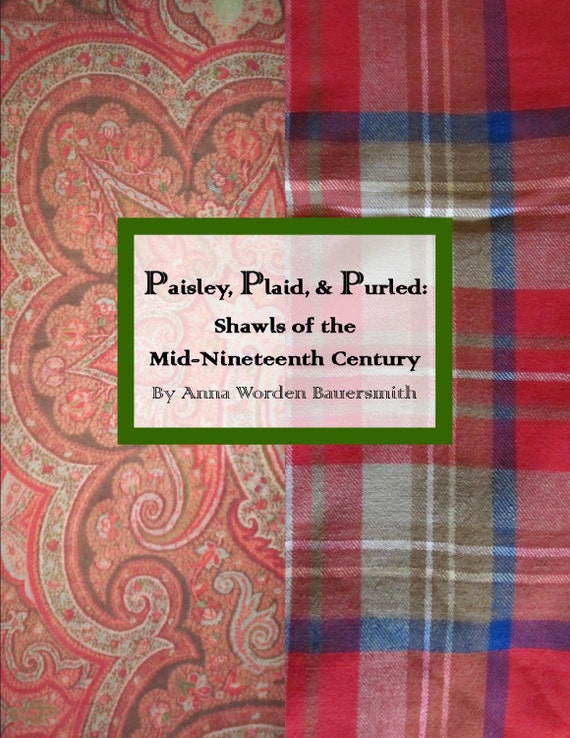
Book Review: Paisley Plaid and Purled: Shawls of the Mid-Nineteenth Century
Paisley Plaid and Purled: Shawls of the Mid-Nineteenth Century by Anna Worden Bauersmith (2015)
Another much-over-due review from my winter reading list. Ms. Bauersmith has written a thorough (nearly encyclopedic) introduction to shawl styles and varieties c. 1840-1865. Like From Field to Fashion, Paisley, Plaid and Purled delves into manufacturing practices and deals extensively with written sources from the period. However, it also includes a large number of pictures (of original shawls, as well as historic images featuring shawls), and even project instructions from period sources.
The main narrative covers half the book (63 pages), and details the author's research methods and results. She looks at how shawls are described and referenced in the period, who was wearing them, what kinds were available (including common sizes), and how shawls were made and worn. Some 27 period photographs are included, with discussion of the shawls featured therein. Modern color images of two original shawls, in all their colorful glory, are also featured. This section ends with period instructions for homemade shawls: quilted, embroidered, knitted, netted, and crocheted.
To aid in one's further research, there is also a seven page bibliography, as well as a lengthy appendix of useful information. In addition to longer quotation from period sources (including more shawl instructions, and manufacturing information), there's a glossary of terms, a helpful table of shawl prices, extensive charts detailing shawl manufacture from around the world, descriptions of shawls in advertisements, and seasonal references to shawls, etc.
There's very little I would change about this book, as I'm busy swooning over the footnotes and gazing covetously on the original pictures. A lot of the information is from publicly available sources, but the amount of work that went into assembling this information, and explaining it is tremendous, and definitely worth the cost of an e-book. Those looking for explicit project instructions might be frustrated, as the ones featured here are all from the period, and thus spare in their instructions. However, I don't know of any other source nearly this comprehensive which also translates the patterns for modern use.
Score: 5 Stars.
Accuracy: High. Extensive use of period material, fully cited.
Strongest Impression: I would recommend this book to anyone participating in costumed historic interpretation or interested in historic clothing. Yes, including men.
Monday, May 15, 2017
Quilt Updates
I've been cutting scraps and seaming them for my autograph quilt (the winning design being the hourglass). The block is basically "broken dishes", ie, it's a four-patch, with each of the four squares divided into two triangles. Based on the dimensions of inspiration quilt, I'm aiming for 6" finished blocks: I've been cutting 6.5" squares for the white blocks, while the triangles are halves of 4" squares.
By my count, the original quilt is 15 by 15 blocks: 112 pieced hourglasses and 113 plain white ones. Now I just need to find 113 friends! And, maybe, cut and piece the other 96 blocks.
I've also been slowly whip-stitching my 3/4" hexagons, using all the fabric scraps that are too small for the autograph quilt (ie, less than 4" square). This work is highly portable, so it's one of my favorites for commuting.
![]() |
| The general organizational scheme. |
By my count, the original quilt is 15 by 15 blocks: 112 pieced hourglasses and 113 plain white ones. Now I just need to find 113 friends! And, maybe, cut and piece the other 96 blocks.
![]() |
| Sixteen down, ninety-six to go! |
I've also been slowly whip-stitching my 3/4" hexagons, using all the fabric scraps that are too small for the autograph quilt (ie, less than 4" square). This work is highly portable, so it's one of my favorites for commuting.
![]() |
| Many tiny hexagons. This is a long-term project. |
Saturday, May 13, 2017
Linen Smock, 16th Century
I made a second 16th century smock based on the instructions in The Tudor Tailor. While the first one I made had a collar and cuffed sleeves with button fasteners, this time I made the collar-less version, with narrower sleeve (plain hemmed edge) and no fasteners. Between the simplified finishing, and tracing the first smock for a pattern, this garment made up very quickly: about 10-15 minutes to cut, and 6 hours* to completely hand-sew. The sleeve and gusset seams are all run-and-fell, while the sides seams are just running stitch; the neck, cuff, and bottom edges are all 1/4" twice-folded hems. This time I used a slightly heavier (mid-weight) twilled linen, which I think I acquired from Fabric Mart during their last linen sale.
*While doing other activities: watching a hockey game, playing D&D, and listening to a lecture. It may have gone quicker if I was not multi-tasking.
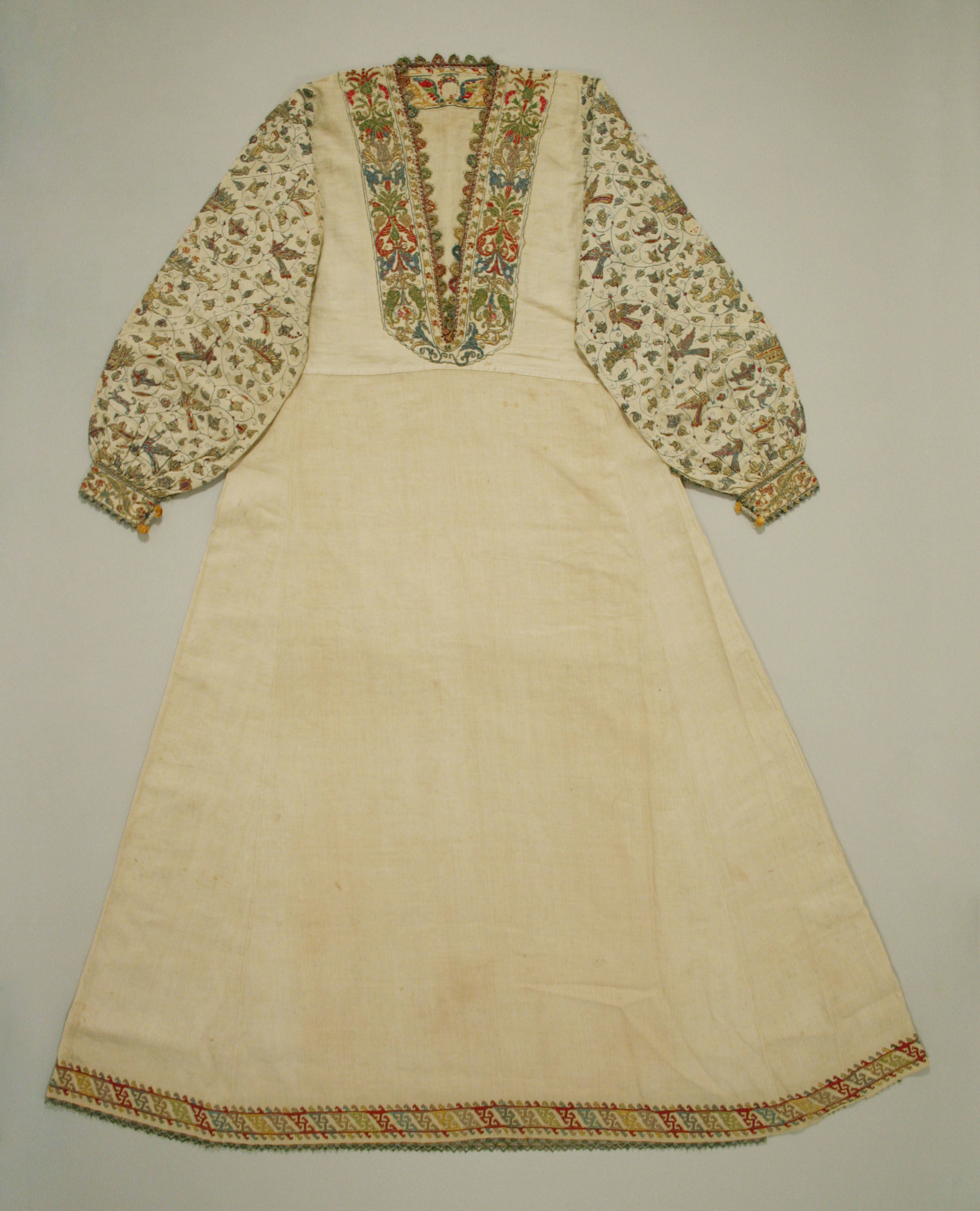
And, just for fun, here's an original 16th century smock from Italy:
I'm alternating between covetous admiration, and sheer terror at number of hours all that embroidery took. Also, awe that it survived that last four centuries, and a strong desire to inspect it more closely.
![]() |
| Plain linen smock for 16th century wear. |
*While doing other activities: watching a hockey game, playing D&D, and listening to a lecture. It may have gone quicker if I was not multi-tasking.
And, just for fun, here's an original 16th century smock from Italy:
![]() |
| Late 16th century Italian smock, from The Met |
I'm alternating between covetous admiration, and sheer terror at number of hours all that embroidery took. Also, awe that it survived that last four centuries, and a strong desire to inspect it more closely.
[Hint to costume designers: this is what should be worn under the corset/stays/bodies. Isn't it pretty? Don't you want to start including it in your plans?]
Subscribe to:
Posts (Atom)