Wednesday, March 18, 2020

HFF 4.6: Erin Go Bragh!


The Challenge: Erin Go Bragh! Make a dish associated with Ireland or St. Patrick's Day (the connection may be as tenuous as you wish).

The Recipe: An Irish Cordial from Sarah J. Hale's The New Household Receipt Book

The Date/Year and Region: 1853 / New York (claims the recipe is Irish)

How Did You Make It: I started by scalding my "yellowware" pitcher. Once dry, I put 2 oz of currants, 1/8 of a lemon peel, 3/16 tsp ground ginger, and 1/2 cup whiskey in the jar pitcher [working on 1/8 scale]. I covered the pitcher and let it sit for a day, then strained off the fruit, stirred in (with difficulty) 2.5 oz of sugar, and strained it again.

Time to Complete: 1 day (actual work < 10 minutes)

Total Cost: Varies with the whiskey. 

How Successful Was It?: Tasty, but very thick (syrupy). The sugar and fruit makes it really smooth, with a bit of a burn from the whiskey afterwards. I like the taste, but the texture is a bit much.

Incidentally, mixed 1:1 with hot water, it makes a delightful drink. Hot, sweet, fruity, and alcoholic, very reminiscent of my favorite hot toddy recipe.  

How Accurate Is It?: I wonder if cordials are meant to be sipped in this period, or if they're supposed to be mixed with something. I could see this being really tasty added to hot water, wine, etc., for the flavor and kick, even as the thick sugary cordial is a bit much on its own. 

I interpreted the 'well pounded ginger' to mean ground dried ginger rather than fresh (though I have plenty of fresh and was tempted to go that route). The original receipt called for white currants, for which I substituted zante currangs (as usual). I did find another receipt which called for raisins instead of currants (also seville orange peel instead of lemon, and considerably more spice), so hopefully my substitution of zante currants for white currants is acceptable.

A striped ceramic picture next to a bowl containing dried currants, lemon peel, ground ginger; behind them a bottle of Jameson's whiskey.
The ingredients assembled.

Old fashioned cordial glass full of a dark amber-colored liquid.
An Irish Cordial (1853)


Thursday, March 12, 2020

New Pipkin

Every project I've touched the last two months seems to be stuck at 90%, so here's the new toy tool I'm looking forward to trying.

A short, green-glazed pottery pipkin cooking pot, with three legs, lid, and a short hollow handle.
Earthenware pipkin from Jeanne Wood.
It's glazed inside and out, and the green is even prettier in person.


Tuesday, March 10, 2020

HFF 4.5: Centerpiece


The Challenge: Centerpiece. Pull out all the stops to make something pretty and eye-catching to adorn your table.

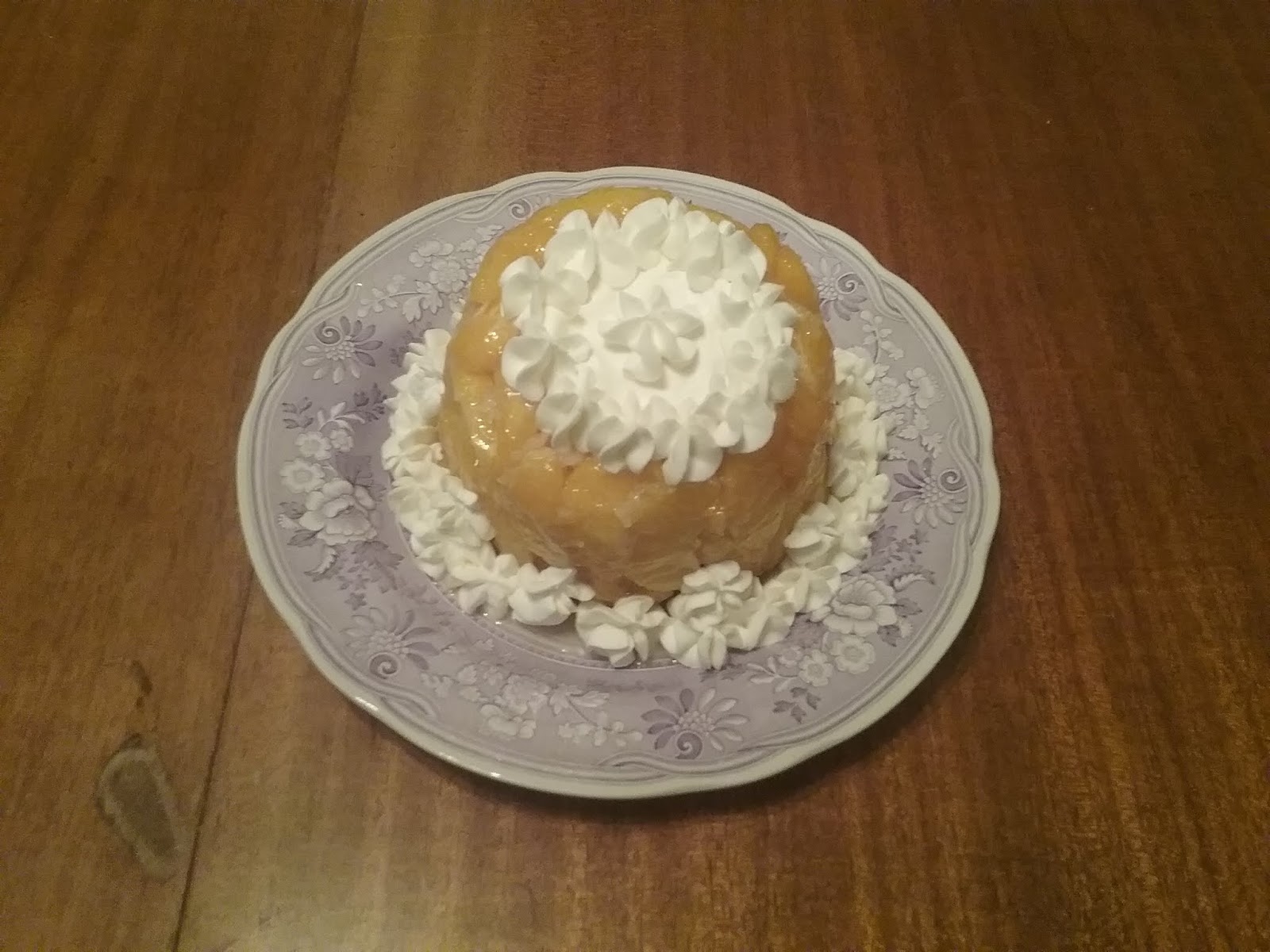
The Recipe: A pretty dish of oranges  from Beeton's Book of Household Management. I chose Beeton because it goes into more detail about plating than most of my usual references. I also completely forgot how badly my sugar-boiling always goes, so...

The Date/Year and Region: 1861, London

How Did You Make It: I peeled 4 oranges*, and divided them into sections. I then heated 1/2 lb of white sugar in 1/2 cup water on the stove; in the span of ~13 minutes it got to boiling, and started thickening towards the 'brittle in water' stage described in the recipe.

I meant to then dip each orange slice in the sugar syrup, then lay it along the wall of my plainest pudding mold, forming an overlapping wall of oranges that would stick to eachother. 

Instead, the sugar crystalized. So, I added more water and reheated it. Then the oranges decided (3/4 of the way through) to stop adhering to their neighbors and start falling into the dish's center. After three more attempts, including two aditonal batches of sugar when the first ones ran out, I eventuslly gave up on making the oranges pretty, and just packed them in the bottom of the dish, relying on the core of the mold to make the central cavity. I also ended up throwing a 5th orange into the bowl, just to fill space (this was a navel orange, as I ran out of the other kind). Being frustrated, I put the whole mold into the fridge overnight, in hopes the sugar would set better (and to avoid dealing with it).

The next day, I prepared the whopped cream. In a complete contrast, it turned out perfectly on the first try. I used the ingredients from the above recipe, but looked to whipped cream #1492 for proportions and technique. I placed 1.5oz granulated sugar, 2 tablespoons of brandy, and 1 cup heavy cream in a bowl, then beat until fluffy. Fortunately, instead of spending an hour at this as directed, the electric mixer completed the task in ~2min. I then unmolded the oranges (a little hot water outside the mold helped), spooned whipped cream into the center, and used a pastry bag to decorate the dish with the remaining whipped cream.   

*I don't know the specific variety. They're a moderate-sized sweet orange from the local Chinese grocery store--smaller and more flavorful than navel oranges, which are the only other kind I ever see.

Time to Complete: A million years. It seemed.

Total Cost: ~$7

How Successful Was It?: Tasty, but I need a but more practice to get the 'centerpiece' part down. The oranges are slightly sweetened by the sugar syrup, but not overwhelmingly so; the whipped cream was very nicely balanced, with the brandy prominent but not excessive.

How Accurate Is It?: Electric conveniences abound, but I think it was a reasonable approximation of the dish. I do need to work on my sugar-boiling skills, and the presentation. The pastry bags were used in period: other 1860s confectionery books mention using folded paper with a cut corner to do smooth lines and dots, while metal tips were available for more complicated effects. So while I wouldn't use my bags in a period demo, I feel alright using them offstage.

A purple transferware plate with a cylindrical mass of orange wedges, surmounted by dollops of whipped cream.
Next time, I should just do a jelly...


Sunday, March 1, 2020

Original: 1930s Court Gown

Apparently the robe de style was a thing, but I just keep thinking of awkwardly obsolete hoops in early 19th century English court dress.

Court Presentation Dress by BouĂ© Soeurs. c.1932-4
The Met.

Monday, February 24, 2020

HFF 4.4: Hearty Fare


The Challenge: Hearty Fare. I opted for "heart"-y rather than "hearty" because puns make me happy.


The Date/Year and Region: London, 1777 (3rd ed.)

How Did You Make It: There wasn't much detail for how to mix the ingredients (beyond creaming the butter and beating the eggs), so I decided to just add things in the listed order (instead of say, separating the eggs and beating the whites fluffy, as I might for a cake). So, I beat 1lb butter to a cream, then stirred in beaten eggs (12 yolks 6 whites), and followed that up with 1lb sugar, 1 lb flour, then 1 lb currants, and 4 Tbsp brandy. This made a thick batter, not quite a dough. I spooned it into buttered muffin tins, placing pieces of candied lemon and orange peel in the center (totaling 2oz candied peel). Baked at 350F.  

Time to Complete: The batter mixed up in 10 minutes; each pan baked for ~17 minutes.

Total Cost: Currants were $4 for the pound, butter on sale for $2/pound, all other ingredients on hand.

How Successful Was It?: Tasty. The cakes seemed a little bland at first, but they go very well with tea, and I actually don't want them any sweeter. They aged well over several days without going stale. My mom thought they were muffins, and didn't observe anything unusual about them. I wouldn't call them either dense or dry, but I found the texture slightly more substantial than a modern muffin or cake.  

How Accurate Is It?: Electric oven and mixer, as usual. Likewise, zante currants instead of real ones, because that's what I can get in this area. The original called for candied orange and citron, though I didn't consider until afterward that they might have meant fruit pieces instead of peel (my orange and lemon peel are always mixed, thus my inclusion of lemon). I think the cupcake tins were a good approximation of size, since I know I overfilled the first pan, but still ended up with 31 cakes where the recipe indicated 36.

My best guess for the 'heart' name is that it's the candied fruit at the center.


A pink transferware plate, containing 12 small unfrosted cupcakes. The cakes are spotted with raisin-like dried currants.
Heart cakes

Monday, February 10, 2020

HFF 4.3: The Tiffany Problem


The Challenge: Make a dish that's older than you expected. 

After considering several dishes that have surprised me over the years with their antiquity (fondue and macaroni foremost), I decided to try a very familiar dish straight out of 1720s cookbook: French Toast.

[Yes, I know from a friend that this dish goes back at least to the middle ages, but I hadn't seen a recipe for it before the mid-19th century, and wanted to try this one.]

The Recipe: Cream Toast or Pain Perdu from The Cook's and Confectioner's Dictionary: Or, the Accomplish'd Housewife's Companion (for full effect, imagine those s's are long)
The Date/Year and Region: 1723, London

How Did You Make It: I set 2 Tbsp unsalted butter to melt in a frying pan on medium heat, then mixed together 1/2 cup cream and 1/4 cup milk in a deep bowl, beat two eggs together in another bowl, and sliced about 1/3 of a loaf of French bread into 3/8" wide slices. I soaked the bread in the milk, sprinkled it with ground cinnamon and granulated sugar, dipped each slice in the egg, and set them to fry. When browned, I removed the toast from heat and sprinkled with more sugar.     

Time to Complete: 25 minutes (10 to prepare while heating the pan, about 15 to cook 9 slices of bread) 

Total Cost: $4

How Successful Was It?:  This is some very tasty French toast. I was wondering if it would be bland without the syrup, etc., used today, but the cinnamon and sugar were just right, and the milk/cream/egg/butter combination was pleasantly rich without being too greasy. I was using fresh bread (quelle horror!) so there was little utility in soaking the bread so long, but I can see where it would be useful if using older bread.

How Accurate Is It?: Cooked on a modern stove, but I didn't effect any intentional changes to the instructions or ingredients. If I found myself hearth-cooking, I would be tempted to use this receipt, as it went together easily and pan-frying is a technique I'd be comfortable attempting in such a set-up.

A handpainted plate with 8 slices of French toast, flanked by a horn-handled knife and two-tine fork.
Yes, this is my Faire kit.
The recipe pre-dates all my transerware!


Saturday, February 1, 2020

Original: Purple Silk with Paisley Interludes

Dress, c.1860
LACMA
Have I posted a lot of c.1860s dresses? Yes. Is this one too fabulous to pass-up? Also, yes. I mean, look at that figured silk! I love and loathe it at the same time. Not to mention the dangling pom-pom trim, and lace.  I find the cut intriguing--those flowing sleeves look right around 1860, while the bust trim and waist placement feel closer to '63-'65 to me.