Sunday, November 30, 2025

Plain Collar and Cuffs, Late 1850s

I didn't have much mending to do this month, and instead I was mostly finishing new projects. One of these was a simple collar and cuff set. Several of my white collars need replacing, and I have fewer pairs of white cotton cuffs than I have bishop-sleeved dresses which need them, so this was a timely project.

The aforementioned accessories.

The collar was traced from one of the 1850s examples in Liz Clark's collar pattern (and adjusted to fit my new green dress's neckline), and the cuffs are simply drafted from that dress's wrist measurements. Both are constructed of a single-layer of white cotton batiste, hemmed on three sides, and finished with a bias-band of the same fabric.  

Thursday, November 27, 2025

Simple Muffatee for a Gentleman, 1859

Adapted from Mlle Riego's The Winter Knitting Book for 1859As given, the pattern is for a 2-2 ribbed tube (knit flat and seamed), which is then joined again to make a two layer muffatee. I knit in the round, on the machine, rather than flat, and switched the 2-2 rib for 3-1 mock-rib due to my on-going difficulties with the ribber attachment.


Muffatees in original color scheme.

I maintained the color scheme in the original for my first attempt (white with colored stripes), and reversed it for the second. A third pair was made in a solid color in a 2-2 mock rib; while they turned out fine, I think the stripes add a lot of interest to the finished appearance of the muffatees. I used a faux Russian join to make the color changes in the first two sets, and found it very easy to do (especially as the double layering meant the ends didn't need to be trimmed further). To close the tubes, I used Kitchener stitch (grafting) to join the live stitches on either end, rather than hemming each separately and then joining them together. 


Overall, I'm quite pleased with the result. I was surprised at the finished size (60 rows, after doubling, is rather a long muffatee), but will have to wait for feedback from the wearers. I did make the other two pairs slightly smaller after seeing the first set: the second striped set are only 48 rows on their finished length, and the solid ones 50. I reduced the length because I was thinking of these as primarily worn over the wrist and the full length would thus cover most of the forearm. However, I'm now wondering if they aren't meant to be worn a bit higher, to cover the hand up to just below the thumb (as there's no slit for the thumb to pass through) as well as the wrist and part of the forearm. Looks like some experimentation is in order.

Wednesday, November 26, 2025

Green Plaid Summer Dress, 1855

I did actually finish the plain summer dress I wanted for 1850s events. It's a shirting weight cotton, so noticeably cooler than my brown calico, with a yoked bodice, gauged skirt, and bishop sleeves. The cuffs fasten with buttons, so they're easier to roll up when working in the kitchen.


The calico stenciling on the cuff buttons are this dress's only ornament, though I cut the yoke on the bias to add some visual interest. I wanted to do the same for the waistband (despite having done that on my last summer-weight green plaid), but didn't have enough fabric to do it without extensive piecing. 

I like that it's cool and comfortable, though the neckline is still giving me trouble. It's been my main 1850s dress since last June (mostly interpreting cooking and similar physical work), and is now going into the closet until the weather warms up again. 

Sunday, November 23, 2025

Muffatees (modern interpretation)

This project's mostly a modern interpretation, but I like how it turned out. I'm calling them muffatees, since they follow the general form (tube with a thumb slit) of one of the common historic variations. This form show up, for instance, in the Driving Mitts and Knit Muffatee patterns in The Workwoman's Guide.

Muffatees in 3-1 mock rib.
 

The 3-1 mock rib, knit in the round, is not a historic variation to my knowledge; I've found patterns for muffatees in 1-1, 2-2, 3-3, and 4-2 ribbing. However, of the options available on my machine, I thought that it would give the best coverage, while retaining at least some of the appearance and flexibility of ribbing. The yarn is a lace-weight pale purple that's actually 50% wool, 35% alpaca, and 15% linen. I love color, and the materials were certainly available in the mid-1850s, but as I haven't found any examples of wool/alpaca/linen blend yarn being used in English-language sources from that period, I decided to use this yarn for a modern gift instead.

Saturday, November 22, 2025

Eyelet Muffatees

Definitely in the interpretation realm, using the cuff and motif from the "eyelet mittens" in Miss Watt's The Ladies' Knitting and Netting Book: Second Series (1840) as a muffatee/cuff. 

Cuffs or muffatees based on an 1840 mitten pattern.

While I think this is a historically sound interpretation to mix motifs with form (for instance, the 'shell pattern manchettes' two pages later specifically mention that the pattern also works well for mittens), I also think I have enough departures from the given recipe to warrant the 'interpretation' label. Main changes:

  1. Made the muffatees symmetric by adding another section of ribbing at the far end, and working 4 plain rows before the first eyelet row, not only after.
  2. Sixty rather than 66 stitches around (limited by cylinder size).
  3. Because I still can't get the ribber working in time, I substituted mock-rib for true ribbing. I tried to compensate for any lost warmth by making the mock-rib sections double-layered (a hung hem).

On the other hand, the elements that these do have going for them:

  1. Accurate material: I made these out of a fine wool yarn, opting for an indigo-dyed light blue.
  2. The knitting machine (which did exist in the period!) makes the same stockinette stitches as knitting by hand, and the eyelets can be made on it quite easily.
  3. Historic precedence in this and other sources for the shape (knit tube for the wrist or forearm without a thumb slit), which come in variety of lengths and may be variously called muffatees, cuffs, or manchettes. 

For the set-up, I used my 60-cylinder set to a 2-2 mock-rib. I set the tension to 1L3, determined through experiment with the other muffatee patterns I've been trying in similar yarn weights. This is also how I got my gauge of ~10 rows to the inch.

1) Worked 20 rows of mock-rib.

2) Hung the hem, adding in the missing needles at the same time, and picking up stiches for them.

3) Knit 4 rows plain.

4) Knit 1 row eyelets by moving every second stitch to the previous needle.

5) Knit another 4 rows plain, 1 row eyelets, 4 rows plain, 1 row eyelets, 4 rows plain.

6) Remove every 3rd and 4th needle (transferring the active stitches from the third needle to the second and the fourth to the first).

7) Knit 20 rows 2-2 mock rib.

8) Remove from machine and sew up the hem on the second side.

I'm generally happy with how these turned out. I was surprised at how the mock-rib changed appearance between the first and second sections, and despite using the same tension settings and weight. Blocking them did help. I ended up not liking the double-layer on the mock rib as much as I thought, since it overshadows the eyelet section. Next time, I'd like to see how it looks with true ribbing, even if I have to work it by hand. Visually, I'd also like to make the eyelet section longer (maybe 5 or 7 rows of eyelet), though the overall length fits nicely over the wrist. It could also be fun to adapt this pattern into a hand-covering muffatee (ribbing at the wrist and maybe the fingers, eyelet over the hand, with a slit for the thumb) 

Monday, November 3, 2025

Foods in Season: November, 1861

Checking Beeton's Book of Household Management to see what's in season for November, we are definitely starting to see a reduction in available ingredients.

Fish- Brill, carp, cod, crabs, eels, gudgeons, haddocks, oysters, pike, soles, tench, turbot, whitling.

Meat- Beef, mutton, veal, doe venison.

Poultry- Chickens, fowls, geese, larks, pigeons, pullets, rabbits, teal, turkeys, widgeon, wild ducks.

Game- Hares, partridges, pheasant, snipes, woodcocks, doe venison. 

Vegetables- Beetroot, cabbages, carrots, celery, lettuces, late cucumbers, onions, potatoes,  salading, spinach, sprouts--various kitchen herbs.

Fruit- Apples, bullaces, chestnuts, filberts, grapes, pears, walnuts.

The fish list lost barbel, flounder, lobster, mullet, plaice, prawns, and skate, gaining in return cod and pike. Pork is off the meat list again. No changes to poultry. Blackcock and grouse came off the game menu (and doe venison was moved into "meat"), with no new additions. Root vegetables and cool-weather greens dominate the vegetable list, which has since last month lost artichokes, cauliflower, tomatoes, mushrooms, pease, turnips, and vegetable marrow. It did see the addition of late cucumbers, though [which confuses me, since my cucumber plants were at their most prolific through July/August and active into September, all months which do not list cucumbers at all.] The fruit category lost damsons, figs, and quinces, but gained chestnuts; we're firmly into an autumn mix of hard tree-fruits, nuts, and grapes.

Saturday, November 1, 2025

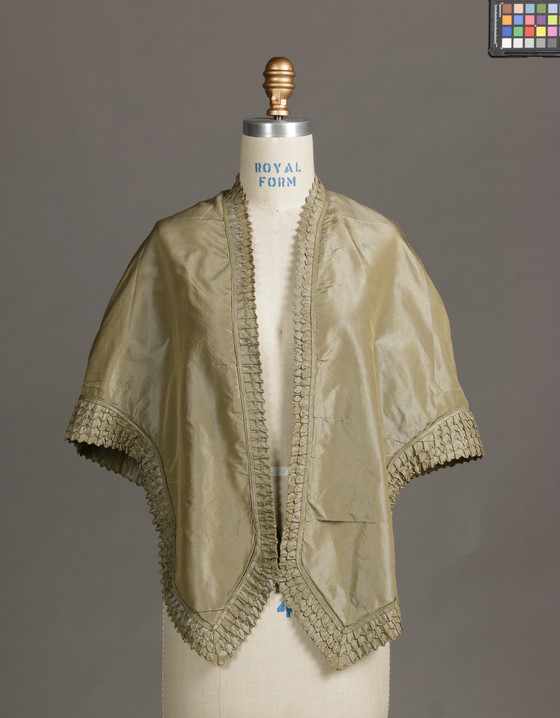
Originals: Silk Mantle, 1850s

Woman's mantle in off-white silk taffeta. This item is listed as a pelerine, though I disagree: the size (down to the elbow on the sides and past the waist in front) and shape more closely resemble a mantle, in my opinion.  


"Pelerine" (mantle), 1850s, in LACMA.
 

It's worth zooming in for a look at that self-fabric trim. It appears to be a variation on puffed gathering; there's a minimum of two rows all around the edges, expanding to four at the elbows, which adds a delightfully subtle extra bit of shaping there.